
- Release Year: 2013
- Platforms: Windows
- Publisher: ak tronic Software & Services GmbH
- Genre: Compilation, Tile matching puzzle
- Game Mode: Single-player
- Gameplay: Match-three
Description
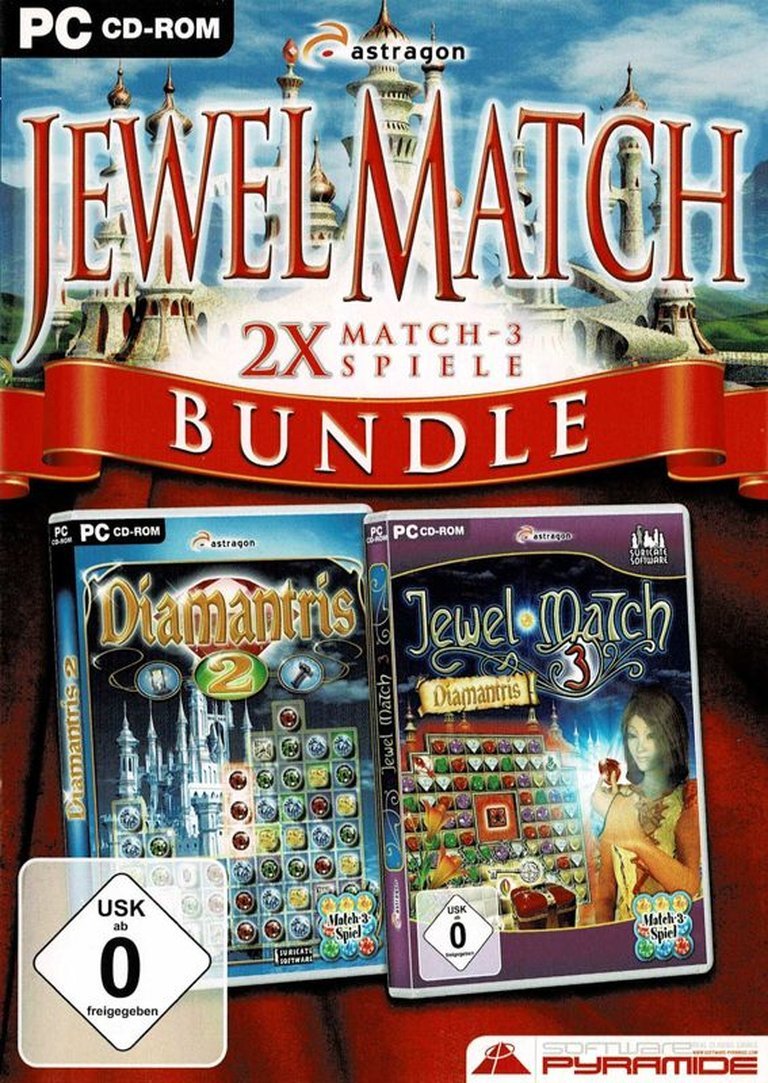
Jewel Match Bundle is a compilation of two popular match-three puzzle games from the Jewel Match series, Jewel Match 2 and Jewel Match 3. Released in 2013 for Windows, this bundle offers a delightful and relaxing experience where players align and match jewels to clear levels. Each game features a variety of levels and unique challenges, providing hours of casual fun and strategic gameplay.
Jewel Match Bundle Reviews & Reception
gadgetspeak.com : I do enjoying playing Match-3 type games. I find the genre particularly relaxing and ideally suited for taking a break from other pressing matters.
Jewel Match Bundle Cheats & Codes
Jewel Match 2 PC
| Code | Effect |
|---|---|
| Ctrl+Alt+W | Beat any level instantly. |
| Ctrl+Alt+R | Lose any level instantly. |
Jewel Match Bundle: Review
Introduction
In the pantheon of match-three puzzle games, few franchises have sustained the quiet longevity of the Jewel Match series. Released in 2013, the Jewel Match Bundle packages two titles—Jewel Match 2 (2008) and Jewel Match 3 (2011)—into a single compilation, offering a distilled snapshot of the series’ evolution. While far from revolutionary, this bundle exemplifies the genre’s appeal: accessible mechanics, soothing repetition, and incremental innovation. This review positions the bundle as a time capsule of casual gaming’s golden age, where simplicity and charm outweighed the industry’s obsession with photorealism and hyper-competition.
Development History & Context
Developed by Suricate Software and published by ak tronic Software & Services GmbH, the Jewel Match series emerged during a boom in casual puzzle games. The late 2000s saw the rise of Bejeweled clones and Candy Crush Saga’s imminent domination, creating a crowded marketplace. Suricate’s approach was iterative rather than revolutionary. The studio leaned into familiar mechanics—swap adjacent gems to form matches—but layered in light RPG elements and narrative flourishes to differentiate itself.
Technologically, the games were modest, designed for low-spec Windows PCs and distributed via CD-ROM, a nod to the era’s lingering physical media habits. The bundle’s 2013 release arrived just as digital storefronts like Steam began eclipsing brick-and-mortar sales, making it a transitional artifact between retail and download-only gaming.
Narrative & Thematic Deep Dive
The Jewel Match series is not known for its storytelling, but the bundle’s two entries reveal a subtle shift toward world-building.
- Jewel Match 2 frames its puzzles around rebuilding castles, using match-three gameplay to gather resources like coins and mana. The narrative is threadbare—a royal gardener’s quest to restore a kingdom—but its whimsical tone and fairy-tale aesthetics provide a comforting backdrop.
- Jewel Match 3 deepens the lore with protagonist Luna, a magic student tasked with restoring the castles of Nevernear. Dialogue sequences (though text-only) and hidden-object mini-games add flavor, while wizards and spells introduce light RPG progression.
Themes of restoration and growth underpin both games, aligning with the genre’s therapeutic ethos. While hardly The Witcher, these narratives succeed in giving players a raison d’être beyond high scores.
Gameplay Mechanics & Systems
The bundle’s core gameplay adheres to genre fundamentals but introduces nuanced twists:
- Matching & Objectives: Both games task players with clearing gold or silver-tiled gems by forming matches of three or more. Jewel Match 3 complicates this with multi-layered boards requiring consecutive matches to break chains or ice blocks.
- Power-Ups & Economy:
- Jewel Match 2 introduces coins earned during matches, spent on shop items like hammers (to remove single gems) or treasure chests (for bonus resources).
- Jewel Match 3 adds spellcasting via mana bottles and “chroma gems” that clear entire rows.
- Progression Systems:
- Jewel Match 2 uses a linear map where completing levels unlocks castle-building segments.
- Jewel Match 3 adopts a semi-open structure, with players navigating interconnected rooms and solving puzzles to advance.
Flaws emerge in repetition: later levels rely on bloated gem counts and padded difficulty rather than inventive design. Still, the games strike a balance between relaxation and challenge, particularly in their untimed modes.
World-Building, Art & Sound
The Jewel Match aesthetic is unapologetically cheerful. Vibrant, jewel-toned tiles pop against dreamy backdrops—enchanted forests, icy palaces—rendered in a crisp, cartoonish style. While hardly pushing technical boundaries, the art direction excels in clarity; players never struggle to distinguish gem types.
Sound design follows genre conventions:
– Satisfying clinks and crashes accompany matches.
– Soothing, looped orchestral tracks evoke fantasy films, though they grow repetitive over long sessions.
The overall effect is cozy and unchallenging, ideal for players seeking a stress-free escape.
Reception & Legacy
At launch, the Jewel Match Bundle flew under critics’ radar, reflecting the genre’s then-marginalized status. However, its commercial performance—bolstered by the series’ loyal fanbase—demonstrated the enduring appeal of polished match-three gameplay.
The franchise’s legacy lies in its expansion. Later entries (Jewel Match Twilight, Jewel Match Solitaire) experimented with gothic horror and card-game hybrids, proving the template’s flexibility. While not industry-shaking, the series carved a niche among casual gamers who valued consistency over innovation.
Conclusion
The Jewel Match Bundle is neither a masterpiece nor a footnote. It is a competent, crowd-pleasing compilation that captures the essence of mid-2000s casual gaming—a time when “fun” didn’t require a 100-hour open world or a GPU-melting graphics engine. For puzzle purists, it offers a comforting return to basics; for historians, it’s a reminder of how the industry’s silent majority often prefers simplicity to spectacle.
Final Verdict: A charming, if unambitious, pairing of two solid puzzle games. Worth revisiting for genre fans, but unlikely to convert skeptics.
Score: 7/10