
- Release Year: 2016
- Platforms: Browser, Windows
- Publisher: Sinclair Strange
- Developer: Sinclair Strange
- Genre: Action, Arcade, Platform, Shooter
- Perspective: Side view
- Game Mode: Single-player
- Gameplay: Platforming, Score attack, Shooting
- Setting: One Room
- Average Score: 60/100
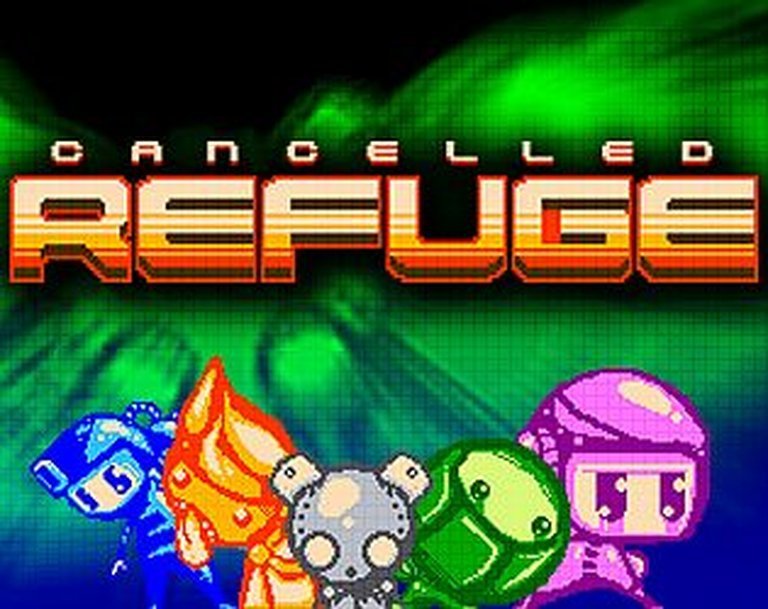
Description
Cancelled Refuge is a fast-paced, 2D platform shooter developed for Ludum Dare 37, where players navigate a single level that restarts with increased difficulty after each completion. The goal is to achieve the highest score by completing as many loops as possible. The game features three stages of varying difficulty and six unique characters, each with their own special abilities and quirks. Created in under 72 hours, it offers a challenging and engaging experience for fans of arcade-style shooters.
Cancelled Refuge: Review
Introduction
In the vast, ever-expanding cosmos of indie game development, Cancelled Refuge (2016) exists as a curious artifact—a fleeting experiment born from the crucible of Ludum Dare 37, a 72-hour game jam themed “One Room.” Developed by the enigmatic studio Sinclair Strange, this minimalist platform shooter is a testament to the creative constraints of rapid development. While it never achieved mainstream recognition or critical acclaim, Cancelled Refuge offers a fascinating microcosm of indie design philosophy: a stripped-down, endlessly looping arcade challenge that prioritizes mechanical purity over narrative or spectacle. This review dissects its fleeting legacy, exploring how it embodies both the potential and limitations of game jam creations.
Development History & Context
Released on December 13, 2016, for Windows and browser platforms, Cancelled Refuge emerged during a transformative era for indie games. The mid-2010s saw the rise of platforms like itch.io and the growing cultural cachet of events like Ludum Dare, where developers embraced limitations to fuel innovation. Sinclair Strange, a studio with no other known titles, built the game using Clickteam Fusion 2.5—a tool favored for its accessibility but often criticized for technical rigidity.
The game’s development context is crucial: crafted in just three days, Cancelled Refuge reflects the scrappy ethos of the game jam scene. Unlike high-profile cancellations like Doom 4 1.0 (a doomed reboot later reimagined as 2016’s Doom), Cancelled Refuge was never intended to be a polished product. Instead, it captures the raw energy of a prototype, leveraging the “One Room” theme to create a compact, infinitely replayable challenge. At a time when AAA studios grappled with open-world bloat and live-service pipelines, Cancelled Refuge stood as a defiantly small-scale counterpoint.
Narrative & Thematic Deep Dive
Cancelled Refuge dispenses with narrative entirely—a deliberate choice, given its jam origins. There are no characters with backstories, no dialogue, and no environmental storytelling. The player’s goal is abstract: survive escalating waves of enemies in a single room to rack up a high score. This absence of narrative framing aligns with its arcade-inspired design, where the “loop” itself becomes the story.
Thematically, the game inadvertently critiques modern gaming’s obsession with progression systems. By stripping away unlocks, cutscenes, and extrinsic rewards, Cancelled Refuge forces players to find meaning in mastery alone. Its six playable characters—each with minor perks like dash abilities or alternate fire modes—exist purely as gameplay variables, not personalities. The game’s title, Cancelled Refuge, hints at a deeper irony: the player seeks refuge in repetition, only to have it “cancelled” by escalating difficulty.
Gameplay Mechanics & Systems
At its core, Cancelled Refuge is a side-scrolling shooter with a punishing roguelike twist. The player navigates a single screen, battling waves of enemies while dodging projectiles and environmental hazards. Key mechanics include:
– The Loop System: Completing a “loop” (clearing the room) restarts the level with increased enemy density, speed, and aggression. Each loop awards one point, creating a risk-reward tension between survival and score chasing.
– Character Variety: The six selectable characters offer slight variations, such as jetpack-enabled mobility or explosive secondary attacks. However, these differences feel incremental rather than transformative.
– Controls: Designed for simplicity, movement and shooting are responsive but basic. The lack of advanced techniques (e.g., parrying, combos) underscores the game’s focus on raw execution.
Flaws emerge in the monotony of its systems. With only three stage variations, the game struggles to sustain long-term engagement. The UI is functional but barebones, lacking even a pause menu tutorial. Yet, these shortcomings feel almost intentional—a reflection of its jam-born identity.
World-Building, Art & Sound
Visually, Cancelled Refuge adopts a retro pixel-art style reminiscent of early NES titles. The “one room” premise confines the player to a static, claustrophobic arena, with background details limited to rudimentary parallax scrolling. Enemy designs are minimalistic, favoring clarity over flair, while the player characters are distinguished by small color swaps.
Sound design is equally sparse. Gunfire and explosion effects are serviceable but lack punch, and the absence of a soundtrack amplifies the isolation of the gameplay loop. The game’s aesthetic choices prioritize function over atmosphere, a pragmatic decision given its development timeline.
Reception & Legacy
Cancelled Refuge arrived to little fanfare. It garnered no professional reviews and remains absent from mainstream gaming discourse. Player impressions, where they exist, describe it as a “curious diversion” or “proof-of-concept” rather than a must-play experience.
Yet its legacy lies in its embodiment of game jam culture. Alongside titles like Downwell or Super Crate Box, Cancelled Refuge exemplifies how constraints can breed creativity—even if the result feels more like a sketch than a finished painting. Its influence is subtle but perceptible in later indie shooters that adopt loop-based progression, such as Devil Daggers or Hyper Demon.
Conclusion
Cancelled Refuge is neither a masterpiece nor a failure. It is a fleeting snapshot of a developer’s 72-hour sprint, a game that prioritizes mechanical immediacy over depth or polish. While its lack of content and audiovisual ambition limit its appeal, it serves as a compelling case study in rapid prototyping and minimalist design. For historians, it captures a moment when indie devs leveraged jams to sidestep industry pressures; for players, it’s a brisk, unforgiving challenge best enjoyed in short bursts.
In the annals of video game history, Cancelled Refuge will likely remain a footnote—a minor experiment in a sea of bolder innovations. But as a testament to the creativity born from limitations, it deserves a quiet nod of respect.
Final Verdict: A flawed but fascinating artifact of game jam culture, best suited for enthusiasts of arcade-style challenges and indie development narratives.