
- Release Year: 2007
- Platforms: Android, Linux, Windows
- Publisher: Irrgheist, OOO Polyet Navigatora
- Developer: Irrgheist
- Genre: Action, Driving, Racing
- Perspective: Third-person
- Game Mode: Hotseat, Single-player
- Setting: Futuristic, Sci-fi
- Average Score: 63/100
Description
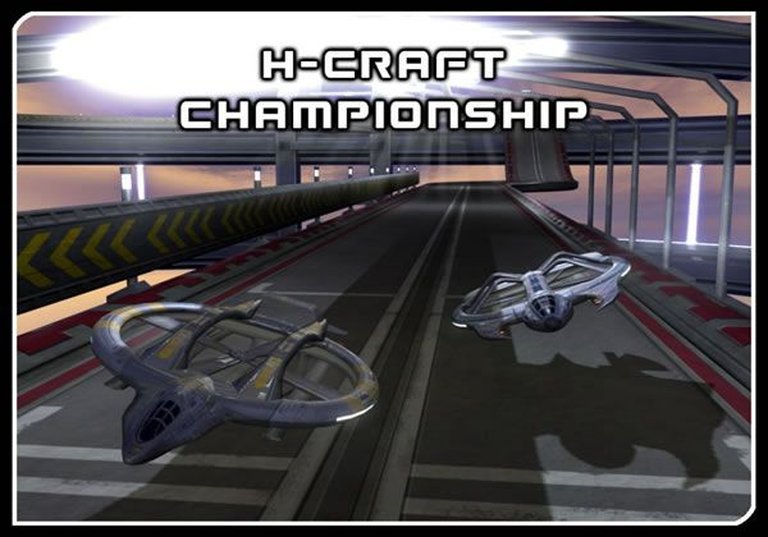
H-Craft Championship is a futuristic hovercraft racing game featuring high-speed competitions across 28 tracks suspended in the air. Players choose between Championship, Arcade, and Timeattack modes, racing against AI opponents or competing via hot-seat multiplayer for up to four players. The Championship mode spans three seasons, rewarding points to unlock new hovercraft, while Timeattack allows players to share ghost data for the best lap times. With no narrative focus, the game emphasizes skillful racing, track navigation, and minor collision mechanics in a sci-fi setting.
Gameplay Videos
H-Craft Championship Reviews & Reception
en.wikipedia.org (80/100): Although not widely known, what reviews there are for the game are generally positive.
mobygames.com (61/100): Average score: 61% (based on 3 ratings)
gamereviewsbox.blogspot.com (62.5/100): A distinctive driving model that is way too difficult for mass acceptance: 5/8
retro-replay.com : H-Craft Championship delivers pure, adrenaline-charged racing that’s easy to pick up and impossible to put down.
hookedgamers.com (50/100): Staying on the track could be said to be more important than going fast and this could become frustrating for some gamers.
H-Craft Championship: A Sci-Fi Racing Relic Reexamined
Introduction
In 2007, as AAA studios battled for supremacy with cinematic blockbusters, a tiny German indie team, Irrgheist, quietly launched H-Craft Championship—a futuristic hovercraft racer built on passion and open-source tech. With no narrative fanfare or corporate backing, the game carved a niche among hardcore racing enthusiasts and Linux loyalists, embodying the raw spirit of indie development during a transitional gaming era. H-Craft Championship is a paradoxical artifact: a technically ambitious yet brutally demanding title that revels in its minimalist purity while exposing the limitations of small-team development. This review dissects its legacy, unpacking how a game once dismissed as a “difficult oddity” quietly influenced open-source racing projects and defied commercial conventions.
Development History & Context
The Indie Underdogs
Founded in Tübingen, Germany, Irrgheist comprised just two core developers: Philipp Lossack (design) and Michael Zeilfelder (programming). Operating outside mainstream hubs, they leveraged the Irrlicht Engine, a free, open-source 3D graphics library, to build their vision of anti-gravity racing. At a time when indie studios were still fighting for digital distribution legitimacy, H-Craft Championship debuted via Manifesto Games—a short-lived platform championing unconventional titles—while a Russian publisher, Akella, handled regional physical releases.
Technological Constraints and Triumphs
The choice of Irrlicht was both pragmatic and ideological. With no budget for proprietary engines like Unreal, Irrgheist embraced Irrlicht’s flexibility, using SDL for cross-platform input and FreeType for text rendering. The result was a lean, 49 MB package (later 127 MB for the Russian CD edition) that ran smoothly on modest hardware—a necessity in 2007, when multi-core CPUs were nascent and Linux gaming was a fringe pursuit. However, engine limitations surfaced in simplistic collision detection and the absence of real-time lighting effects, forcing the team to rely on vibrant, low-poly art to mask technical gaps.
The 2007 Gaming Landscape
H-Craft Championship launched into a market dominated by Forza Motorsport 2 and Project Gotham Racing 4—games that prioritized realism and accessibility. By contrast, Irrgheist’s title embraced arcade-inspired physics and punishing difficulty, targeting a niche audience of simulation-curious players. Its May 2007 release on Windows/Linux (and later Android in 2015) coincided with early digital storefronts like Steam gaining traction, yet the lack of online multiplayer or DRM-free alternatives (until its 2014 freeware pivot) hampered reach.
Narrative & Thematic Deep Dive
Absence as Statement
H-Craft Championship defiantly rejects narrative. No drivers, no lore, no dystopian corporations—just hovercrafts racing across “superhighways in the sky.” This austerity mirrors early arcade racers like F-Zero, where the thrill of velocity supersedes story. Thematically, it evokes isolation: tracks float in cosmic voids, with only competitors and abyssal drops as companions. Winning isn’t about glory but survival—a metaphor for indie development itself.
Minimalist Worldbuilding
Tracks bear utilitarian names (Twister, Crystal) and lack environmental storytelling. This void focuses players on mastering physics, not lore. Even the unlockable H-Crafts—earned via Championship points—prioritize function over flair, with subtle design variations influencing speed and handling rather than backstory.
Gameplay Mechanics & Systems
The Core Loop: Precision or Perish
Three modes define H-Craft Championship:
– Championship: Three seasons, each with four quarters of three races. Points unlock tracks/crafts.
– Time Attack: “Hotlap” (unlimited laps for record-setting) and “Timerace” (fixed-lap sprints).
– Rivals: Four-player hot-seat ghost racing (no split-screen).
Races pit players against three AI opponents with “superhuman” precision (per Out of Eight’s review). Collisions are purely physics-based—no weapons, only strategic bumps to nudge rivals off tracks. Victory demands memorizing turns and managing inertia, as hovercrafts lack grip and oversteer violently.
Innovations and Flaws
- Track Design: 28+ tracks escalate from gentle ovals to vertiginous corkscrews. Falling triggers instant respawns but kills momentum—a brutal penalty.
- Ghost Data: Players export best laps as “ghosts,” enabling asynchronous competition (a proto-leaderboard system).
- Pain Points: No tutorial, assist options, or track editor (missed opportunity given simplistic geometry). The AI’s perfectionism frustrated critics (Hooked Gamers noted it “lacked mercy”).
UI and Progression
A neon-minimalist HUD displays speed, laps, and position. Championship mode’s progression is linear but grindy; unlocking all crafts requires near-flawless performance. Disappointingly, no difficulty settings ease newcomers in.
World-Building, Art & Sound
Visual Identity: Low-Poly Radiance
Using Irrlicht’s limitations as strength, H-Craft embraces a retro-futuristic aesthetic: tracks glow with neon borders, set against gradient-skied voids. Hovercrafts resemble angular insects, with engine trails pulsating like fireflies. While textures are rudimentary (static clouds, flat terrain), the art direction’s consistency—clean lines, vibrant blues/purples—creates a hypnotic, almost Tron-like atmosphere.
Soundscape: Ambience Over Adrenaline
Composer Manolo Camp’s soundtrack blends synthwave and ambient electronica, evoking Vangelis’ Blade Runner score. Engine hums and collision clangs are functional but sparse, reinforcing isolation. Reviewers praised the music’s “altísima calidad” (Softonic), though its repetition grows stale during marathon sessions.
Reception & Legacy
Launch Reception: Divided Critics
The game garnered a 61% average from critics (based on three reviews):
– Praise: Track variety, art style, and hot-seat multiplayer (Softonic).
– Criticism: Punishing difficulty, no online play, and missing QoL features (Out of Eight, Hooked Gamers).
Player scores averaged 3.1/5, with few leaving written reviews—evidence of its niche appeal.
Post-Release Evolution
Irrgheist abandoned the game post-launch until 2014, re-releasing it as freeware. In 2015, they open-sourced the code (under zlib license), while keeping art/assets proprietary. This sparked modding experiments—unofficial track generators, physics tweaks—though no major community projects emerged.
Influence and Retrospective
While not a commercial hit, H-Craft Championship became a cult reference in open-source gaming circles. Its use of Irrlicht inspired indie devs to explore accessible engines, while its ghost-sharing mechanic presaged time-trial cultures in games like Trackmania. Linux publications (AllForLinux, LinuxLinks) still hail it as a “best-of” entry for the platform.
Conclusion
H-Craft Championship is a fascinating case study in indie ambition colliding with production realities. Its design—unyielding difficulty, minimalist art, and focus on “pure” racing—resonates as both a throwback to arcade purism and a flawed experiment in player patience. Technologically, it demonstrated how open-source tools could empower micro-studios, yet its lack of polish and content depth hindered broader appeal.
Does it deserve a place in gaming history? Absolutely—but as a cult object, not a masterpiece. For racing masochists and open-source advocates, it remains a compelling artifact of 2007’s indie scene. For others, it’s a relic best remembered for its defiance, not its finesse. In the pantheon of futuristic racers, H-Craft Championship orbits as a dim but tenacious star: unwelcoming to many, unforgettable to few.
Final Verdict: A 6/10 pioneer—flawed, fascinating, and fervently niche.