
- Release Year: 2004
- Platforms: Windows, Xbox
- Publisher: Atari Europe S.A.S.U., Atari, Inc., Atari Interactive, Inc., Tommo Inc.
- Developer: Zombie Studios Inc.
- Genre: Action, Shooter
- Perspective: 1st-person
- Game Mode: Co-op, Online PVP, Single-player
- Gameplay: Shooter
- Setting: Africa, Futuristic, Middle East, Sci-fi
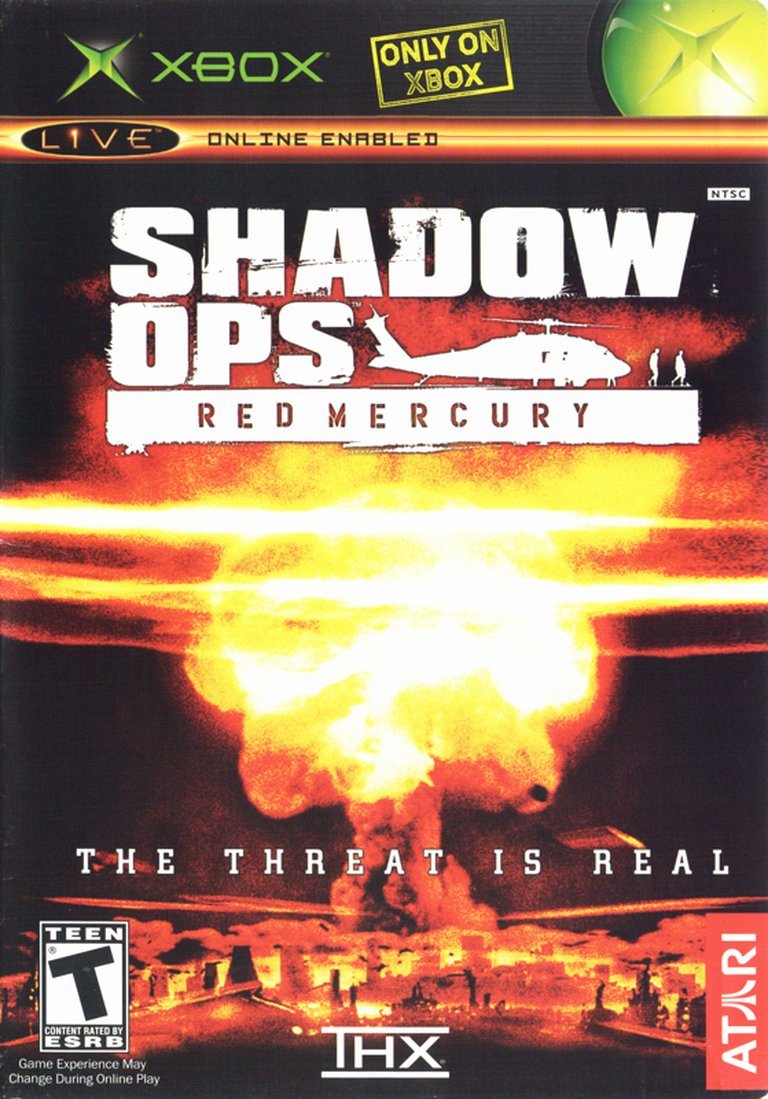
Description
Shadow Ops: Red Mercury is a first-person shooter set in the near future, where players assume the role of a Delta Force operative tasked with preventing the creation of nuclear weapons by tracking down a volatile substance known as Red Mercury. The game features intense action sequences, scripted events, and a cinematic approach to storytelling. Available on Xbox and Windows, the Xbox version supports online multiplayer for up to sixteen players, offering competitive modes like deathmatch and capture-the-flag.
Gameplay Videos
Where to Buy Shadow Ops: Red Mercury
Shadow Ops: Red Mercury Free Download
Shadow Ops: Red Mercury Cracks & Fixes
Shadow Ops: Red Mercury Patches & Updates
Shadow Ops: Red Mercury Mods
Shadow Ops: Red Mercury Guides & Walkthroughs
Shadow Ops: Red Mercury Reviews & Reception
gamingpastime.com : the action-packed gameplay make for a decent romp even if the gameplay is more flash than substance.
gamefaqs.gamespot.com : Red Mercury is a fun game, if you are able to overlook its many flaws.
Shadow Ops: Red Mercury Cheats & Codes
PC
Type these codes in the Options/Cheats menu:
| Code | Effect |
|---|---|
| madminute | Unlimited Ammo |
| greenlight | Unlock All Levels |
| intelsitrep | Unlock All Cinematics |
| firstlaw | God Mode |
| corpsman | Reincarnate Mode |
| peterpan | Fly Mode |
PC (Console Commands)
Edit the ‘rm.ini’ file in the ‘\shadow ops red mercury\system’ folder. Locate the [Engine.Console] heading and change the value for the ‘ConsoleKey=’ line to ‘223’. Then, press ~ during gameplay and enter one of the following codes:
| Code | Effect |
|---|---|
| god | God mode |
| allweapons | All weapons |
| allammo | Unlimited ammunition |
Xbox
Select the ‘CHEATS’ option at the main menu, then enter one of the following codes:
| Code | Effect |
|---|---|
| PACKMULE | Infinite Ammo |
| happycamper | All Single Player Levels |
| filmcritic | All FMV Sequences |
| wanderlust | All Cooperative Levels |
Shadow Ops: Red Mercury: A Flawed Fragment of Post-9/11 Military Shooter Obsession
Introduction
In the crowded landscape of mid-2000s military shooters, Shadow Ops: Red Mercury arrived as a curious artifact—a game that desperately wanted to be a Hollywood blockbuster yet stumbled over its own ambition. Released in 2004 by Zombie Studios, this Xbox and PC title promised cinematic intensity with its Delta Force protagonist racing to prevent nuclear terrorism, but critics dismissed it as a derivative imitation of genre giants like Call of Duty and Halo. Drawing from exhaustive analysis of archival reviews, developer histories, and cultural context, this review argues that Red Mercury represents a fascinating case study in the tension between technical ambition and creative bankruptcy—a game that mirrors post-9/11 anxieties while failing to innovate beyond its peers.
Development History & Context
Studio and Vision
Zombie Studios—a Seattle-based developer known for the Spec Ops series—positioned Red Mercury as a “summer action movie” in game form. Director Bill Wright prioritized Hollywood spectacle, hiring real screenwriters (alumni of straight-to-video films) and composers like Inon Zur (Dragon Age) for a live orchestral score. The narrative’s focus on stolen nuclear weapons and Middle Eastern terrorists reflected post-9/11 fever dreams, capitalizing on geopolitical fears amplified by the Iraq War.
Technological Constraints
Built on Unreal Engine 2, Red Mercury pushed for cinematic immersion with motion-captured animations and ragdoll physics. Yet hardware limitations of the original Xbox led to frequent framerate drops, while PC ports suffered from stability issues. As noted in MobyGames reviews, developmental compromises were evident: levels were heavily scripted to mask AI shortcomings, and the absence of manual saves reflected design concessions to console memory constraints.
Industry Landscape
Launching months before Halo 2 and Half-Life 2, Red Mercury entered a hyper-competitive market where military shooters were transitioning toward realism (Rainbow Six) and narrative sophistication (Call of Duty). Atari’s marketing leaned into comparisons to Michael Bay films, but Zombie’s execution lacked the polish of contemporaries like Project: Snowblind—a tactical misstep that doomed its commercial prospects.
Narrative & Thematic Deep Dive
Plot and Characters
The story follows Delta Force operative Frank Hayden across global hotspots—Syria, Chechnya, Paris—in pursuit of “Red Mercury,” a McGuffin enabling portable nukes. The script, penned by Neil Alphonso and stuntman-turned-writer David Womark, delivers B-movie tropes: a disgruntled ex-operative (Vlady the Vicious), nuclear brinkmanship, and a last-minute twist revealing CIA agent Kate Daniels as the true antagonist. Despite attempts at moral complexity (questioning U.S. interventionism), character motivations remain shallow, with Hayden’s “cocky prick” persona (per player reviews) clashing with the game’s jingoistic tone.
Thematic Undercurrents
Red Mercury’s plot echoes early-2000s anxieties about WMDs and stateless terrorism, yet its politics are muddled. Missions in Syria and Chechnya frame locals as disposable threats, reinforcing Orientalist stereotypes. The Russian scientist Boris—forced to arm the bombs before being executed—hints at Cold War-era paranoia, but these ideas drown in explosions and machismo. As critic Depeche Mike noted on MobyGames, the story’s assertion of “Hollywood professionalism” rings hollow when villains lack depth beyond cartoonish malice.
Dialogue and Pacing
Cutscenes use in-engine graphics that GameCritics likened to “PlayStation One-quality,” undermining dramatic tension. Voice acting oscillates between earnest (Hayden’s gravelly baritone) and laughable (Vlady’s Bond-villain monologues). The non-linear structure—flashing back to Hayden’s earlier missions—only confuses the stakes, undercutting urgency in a plot about preventing nuclear Armageddon.
Gameplay Mechanics & Systems
Core Loop and Combat
Red Mercury adheres to early-2000s FPS conventions: linear levels, health pickups, and fixed weapon loadouts per mission. Combat emphasizes cover-based shooting, with a lean mechanic allowing players to peek around corners—a rare innovation. However, enemy AI oscillates between “dim-witted” (per Game Vortex) and unfairly precise, spawning in waves that punish players for advancing. The absence of weapon pickups and restricted arsenal (assault rifles, shotguns, sniper rifles) feels archaic next to Halo’s sandbox flexibility.
Progression and Flaws
No XP system or unlocks exist—a missed opportunity for depth. Levels drag due to repetitive objectives (activate bombs, clear rooms), compounded by infrequent checkpoints. The “Delta Force” difficulty mode, requiring a full campaign restart upon death, feels punitive rather than challenging.
Multiplayer and Co-Op
Xbox Live support for 16-player deathmatch and capture-the-flag modes was marketed heavily, but bland maps and unbalanced classes (e.g., snipers dominating close-quarters arenas) led to dwindling interest. Co-op missions suffered from poor teammate AI, with allies often blocking paths or ignoring threats.
World-Building, Art & Sound
Visual Design
Red Mercury’s settings—Syrian towns, Kazakh research facilities, Paris’ Eiffel Tower—are rendered with utilitarian detail. Texture work varies wildly: jungle foliage impresses, but indoor spaces reuse assets relentlessly. Weapon models are meticulously crafted, yet animations feel stiff, undermining immersion.
Atmosphere and Audio
The game’s sole triumph is its audio design. Inon Zur’s orchestral score amplifies tension with brass-heavy action themes, while environmental sounds (helicopter rotors, echoing gunfire) leverage Dolby 5.1 surround impressively. As Gamesmania.de noted, “The soundscape feels ripped from a blockbuster.” However, this polish clashes with visual shortcomings—a “paved turd” of presentation (per Depeche Mike’s review).
Thematic Cohesion
While levels like the Paris metro bombing channel post-9/11 fears of urban terrorism, the art direction lacks symbolic depth. Destruction feels weightless, with explosives triggering scripted debris rather than systemic chaos.
Reception & Legacy
Launch and Reviews
Red Mercury earned a middling 61% average from critics (Metacritic) and 6.4/10 on MobyGames. Praise centered on audio and “Hollywood-esque” set pieces, while pans targeted AI glitches, narrative banality, and technical instability. GameSpot lamented its “generic action,” and IGN called it “forgettable in a month.” The Xbox version sold poorly, buried by Halo 2’s late-2004 dominance.
Evolving Reputation
Retrospectives like Gaming Pastime’s 2025 review framed it as a “flawed curiosity”—a time capsule of post-9/11 militarism. Its 2015 re-release via Tommo’s Retroism label sparked minor interest among FPS historians, but modding communities ignored it, unlike contemporaries like Star Wars: Battlefront II.
Industry Influence
Red Mercury’s legacy is one of caution: a reminder that cinematic aspirations demand more than licensed tech and genre clichés. Its failure likely steered Zombie Studios toward experimental titles like Blacklight: Tango Down, while the industry at large embraced the narrative depth of Call of Duty 4: Modern Warfare.
Conclusion
Shadow Ops: Red Mercury is neither a triumph nor a disaster—it is a profoundly average game that encapsulates the creative growing pains of its era. Its competent sound design and occasional set pieces cannot redeem clumsy AI, derivative mechanics, and a narrative that confuses noise for gravitas. For historians, it offers insight into post-9/11 game design and the pitfalls of Hollywood envy. For players, it remains a bargain-bin oddity—best appreciated as a footnote in the FPS genre’s evolution rather than a lost classic. In the pantheon of military shooters, Red Mercury is less a red alert and more a muffled footnote.