
- Release Year: 2006
- Platforms: Windows
- Publisher: Niels Bauer Games
- Developer: Niels Bauer Games
- Genre: Role-playing, Strategy, Tactics
- Perspective: Top-down
- Game Mode: Single-player
- Gameplay: Base building, Dungeon-crawling, Random dungeon generation, Resource Management, Strategy, Turn-based combat
- Setting: Fantasy
Description
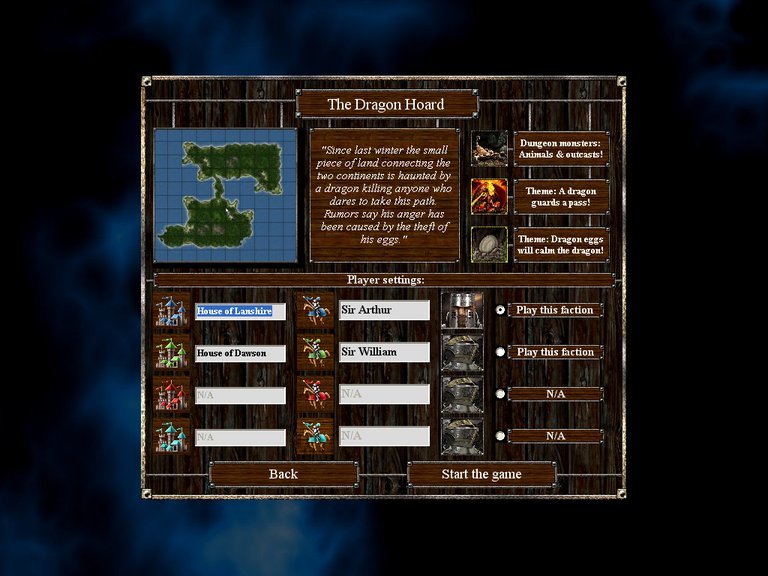
Empires & Dungeons is a medieval fantasy strategy RPG where players compete as rival lords vying for control of a kingdom after the king’s death. Combining turn-based kingdom management with real-time combat, players must build armies, conquer enemy castles, and explore randomly generated dungeons to gather gold, items, and honor points. The game features two distinct gameplay phases: strategic overworld conquest and solo dungeon crawling, where the lord gains experience and equipment. Victory hinges on balancing army strength with personal hero progression, while defending your sole castle from enemy takeover across twelve progressively challenging scenarios.
Empires & Dungeons Reviews & Reception
gnomeslair.blogspot.com : It plays surprisingly well, for it manages to be as simple and intuitive as Diablo, almost as rightly paced as rogue and as one-more-turn-syndrome evoking as HOMM or even Civ.
mobygames.com : Empires & Dungeons is a medieval fantasy game that combines elements of Heroes of Might and Magic-type turn-based strategy games and dungeon-crawling RPGs.
jayisgames.com : Empires and Dungeons successfully pulls some of the best aspects from several rather complex genres and distills it into something every gamer can enjoy.
Empires & Dungeons: Review
Introduction
In the shadow of gaming giants like Heroes of Might and Magic and Diablo, a lesser-known gem emerged in 2006: Empires & Dungeons. Developed by German indie studio Niels Bauer Games (creators of the Smugglers series), this hybrid of turn-based strategy and dungeon-crawling RPG carved a niche by marrying the empire-building tension of a HOMM-esque war for succession with the solitary thrill of rogue-like exploration. While lacking mainstream recognition, Empires & Dungeons remains a fascinating artifact of indie ambition—a flawed yet audacious experiment in genre fusion that deserves dissection. This review argues that the game’s innovative dual-loop design and accessible mechanics are undermined by repetitive gameplay and technical jank, yet its DNA persists in modern indie hybrids like Loop Hero and Crown Trick.
Development History & Context
Empires & Dungeons was born in an era when indie development was still a fledgling movement, practiced by small teams operating under significant constraints. Niels Bauer Games, founded by designer Niels Bauer, had previously found moderate success with the Smugglers series of trade-and-combat simulators. Their pivot to fantasy strategy represented both a creative leap and a technical gamble.
Technological Constraints
Built for Windows PCs in 2006, the game leveraged rudimentary 2D sprites, grid-based maps, and simple UI elements—a necessity given limited budgets. The engine prioritized functionality over flair, with turn-based overworld navigation coexisting with real-time combat sequences. Notably, the game’s “Deutsch-English” script (a mix of German and English phrasing) reflected the studio’s localization challenges, often criticized but strangely charming in its idiosyncrasy.
The Gaming Landscape
The mid-2000s saw the rise of digital distribution platforms like Big Fish Games, creating opportunities for smaller titles to bypass traditional publishers. Empires & Dungeons arrived alongside contemporaries like Dungeons of Dredmor and King’s Bounty: The Legend, though it lacked their polish. Bauer’s vision was clear: democratize the depth of HOMM and Rogue for casual players through streamlined systems and randomized content, a precursor to today’s roguelite renaissance.
Narrative & Thematic Deep Dive
Empires & Dungeons forgoes a traditional campaign for a series of 12 scenarios, each framed as a power struggle following the death of a childless king. Players choose a lord vying for the throne, navigating a cutthroat political landscape where alliances are temporary and victory demands both military might and personal valor.
Characters and Dialogue
The lords lack defined personalities, serving as blank-slate avatars. Storytelling emerges through environmental cues:
– Random Events: Wandering merchants, resource caches, and dungeon entrances appear fleetingly, implying a living world beyond the player’s control.
– Scenario Briefings: Text-based intros (e.g., “The Orcish Horde Descends”) establish stakes but offer little narrative payoff.
– Thematic Undercurrents: Power, honor, and sacrifice recur—gold funds armies, but “honor points” gate advanced structures, forcing moral trade-offs.
The writing, while functional, suffers from awkward phrasing (e.g., “You need go now into dungeon!”), yet this unintentionally reinforces the game’s B-movie charm.
Gameplay Mechanics & Systems
Empires & Dungeons splits its design into two interconnected loops:
Overworld Strategy
- Turn-Based Empire Building: Players expand territory, construct castles, recruit units (archers, knights), and tax conquered cities. Each lord owns one castle—lose it, and the game ends.
- Resource Management: Gold sustains armies, while honor points (earned via dungeon victories) unlock upgrades like the “Adventurer’s Guild” for item shops.
- Dynamic Map: Randomly generated events (e.g., dungeons, merchants) vanish after a few turns, creating urgency.
Dungeon Crawling
- Procedural Generation: Dungeons randomize layout, enemies (rats, goblins, dragons), and loot. Defeat means losing all gold/honor from that dive—a Rogue-like punishment.
- Real-Time Combat: Choose actions (attack, block, flee), then watch auto-resolved skirmishes. Battles can be paused for tactical adjustments, a half-step toward Darkest Dungeon’s intentionality.
- Character Progression: Lords level up (max level 8-9 in early scenarios), gaining stats and equipping gear found in dungeons.
Critical Flaws
- Repetition: Overworld activities grow tedious; dungeon layouts lack visual variety.
- UI Clunk: Menus bury key functions (e.g., equipping items required navigating nested prompts).
Make sure not to write ‘Character Progression’ or the other header with quotes.
World-Building, Art & Sound
Visual Design
The game adopts a minimalist, top-down aesthetic:
– Overworld: Hex-grid maps rendered in vibrant greens and browns evoke a fantasy board game.
– Dungeons: Wireframe corridors with repetitive tilesets, reminiscent of Eye of the Beholder but less detailed.
– Units and Lords: Pixel-art sprites lack animation flourishes but convey clear identities (e.g., knights in plate, robed mages).
Atmosphere
Randomized events (a merchant offering “magic elixir,” a sudden dragon attack) create emergent storytelling, though the static visuals limit immersion.
Sound Design
Giovanni Vindigni’s score blends synth strings and medieval motifs—comparisons to Heroes of Might and Magic III’s iconic soundtrack are inevitable but undersell its adequacy. Combat SFX (clashing swords, monster growls) are serviceable but repetitive.
Reception & Legacy
Initial Reception
The game flew under the radar critically. MobyGames lists no professional reviews, while player anecdotes praise its novelty but lament:
– Technical Issues: Vista compatibility bugs crippled item management (equipping gear often failed).
– Repetition: “After 2-3 dungeons, it’s the same clicks, same fights, same rewards” (JayIsGames commenter, 2006).
– Underbaked Strategy: Army battles lacked depth compared to HOMM’s tactical chessboard.
Long-Term Influence
Despite flaws, Empires & Dungeons laid groundwork for indie hybrids:
– Genre Fusion: Its dual-strategy/RPG loop inspired later titles like Darkest Dungeon and Crown Trick.
– Procedural Storytelling: The ephemeral events foreshadowed FTL’s encounter system.
– Niche Cult Status: Retro enthusiasts (e.g., Gnome’s Lair) laud its “simple and intuitive” ethos amid modern gaming bloat.
The 2011 sequel, Empires & Dungeons 2: The Sultanate, refined systems but failed to escape cult obscurity.
Conclusion
Empires & Dungeons is a paradoxical relic: ambitious in blending strategy and RPG elements yet hamstrung by limited resources and repetitive design. Its randomized dungeons and honor-driven economy remain clever innovations, while clunky UI and translation quirks date it unmistakably. For historians, it exemplifies early indie daring—a bridge between Rogue’s austerity and modern roguelites. For players, it’s a curiosity best appreciated through nostalgia-tinted lenses. Final Verdict: A flawed but fascinating footnote in gaming history, reminding us that even imperfect genre hybrids can inspire future revolutions.
[[Rating: 6/10]]—Worth a play for retro enthusiasts; others may find its roughness prohibitive.