
- Release Year: 1998
- Platforms: Macintosh, Windows
- Publisher: BBS Interactive Multimedia
- Developer: BBS interactive, Karel Tvrdík
- Genre: Adventure
- Perspective: 1st-person
- Game Mode: Single-player
- Gameplay: Puzzle elements
- Setting: Futuristic, Sci-fi
- Average Score: 85/100
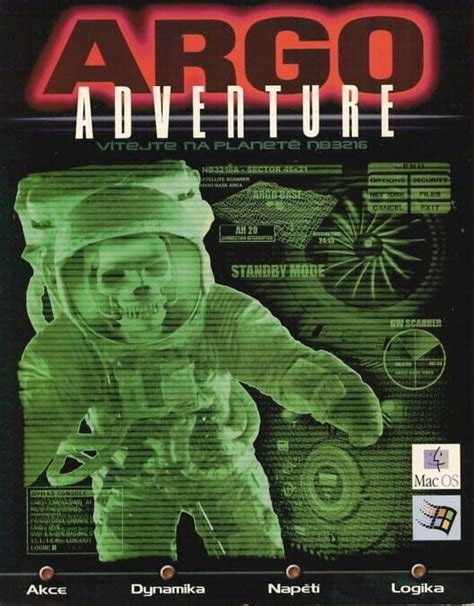
Description
Set in the year 2270 during a corporate war over space resources, ‘Argo Adventure’ follows the last surviving member of a scout unit investigating a mining disaster on planet NB3216A. Players explore a 3D-rendered, Myst-like environment in first-person perspective, solving puzzles while managing survival elements like oxygen levels, hunger, thirst, and weight-limited inventory, with time-sensitive challenges such as reactor overheating adding urgency to the sci-fi narrative.
Gameplay Videos
Argo Adventure Free Download
Argo Adventure Reviews & Reception
mobygames.com (85/100): A triumphant return to form for the series.
Argo Adventure Cheats & Codes
PC
Press ‘~’ ingame and type in ‘sv_cheats 1’ to enable cheats. Requires enabling Developer Console in Options > Keyboard > Advanced.
| Code | Effect |
|---|---|
| god | Immortality/God Mode |
| noclip | Fly around the map and through objects |
| notarget | Enemy won’t target you |
| bind w kill | Kill entire enemy team |
| ai_disable | NPCs are turned off |
| give item_battery | Receive 15 battery points |
| give item_healthkit | Receive 25 health points |
| kill | Character eliminates himself |
| npc_create | Create NPCs |
Argo Adventure: A Forgotten Czech Odyssey in Sci-Fi Survival Horror
Introduction
In the shadow of late-’90s gaming giants like Half-Life and Myst, a little-known Czech gem quietly carved its niche. Argo Adventure (1998), developed by BBS Interactive Multimedia, is a first-person sci-fi survival adventure that blends claustrophobic cosmic horror with punishing resource management. This review argues that Argo Adventure deserves recognition not just as a regional curiosity, but as a visionary—if flawed—experiment in environmental storytelling and immersive simulation, predating titles like Dead Space by a decade.
Development History & Context
A Small Studio’s Cosmic Ambition
BBS Interactive Multimedia, a Prague-based studio, operated under tight budgetary constraints typical of post-Communist Eastern European game development. Led by Karel Tvrdík—who single-handedly handled design, script, and graphics—the team crafted Argo Adventure during a transitional era for Czech gaming, where indie PC titles often prioritized atmospheric storytelling over technical polish.
Technological Constraints and Innovations
Released in 1998, the game’s pre-rendered 3D environments (akin to Myst) were a pragmatic choice, avoiding the computational demands of real-time 3D while still evoking a haunting, tactile world. The decision to implement survival mechanics—oxygen depletion, hunger, and weight-based inventory limits—reflected a bold attempt to merge adventure puzzles with simulation realism, albeit within the era’s hardware limitations.
The Gaming Landscape
Argo Adventure emerged alongside Western blockbusters like Grim Fandango and System Shock 2, yet its focus on desolate isolation and corporate dystopia aligned more with Eastern Europe’s post-Soviet disillusionment. Notably, it was one of the few Czech games of its time to secure partial international distribution, with 21st Century Fox briefly publishing it abroad.
Narrative & Thematic Deep Dive
Plot Synopsis
Set in 2270, players assume the role of Dan Lewis, the sole survivor of a corporate scouting team sent to investigate the titular Argo base on planet NB3216A. After a botched landing (your shuttle is downed by the base’s own defenses), you must unravel the mystery behind the facility’s sudden radio silence while fighting for survival against environmental hazards.
Themes of Corporate Exploitation and Existential Horror
The game’s narrative critiques unchecked capitalism: the I.D.C. corporation’s greed for a rare military resource leads to ecological disaster and human extinction. The base’s decaying corridors, littered with crew logs and abandoned machinery, evoke a Alien-esque sense of dread, while the lack of combat (a deliberate choice) shifts focus to psychological tension.
Characters and Dialogue
Voiced in Czech with optional English dubbing, the sparse dialogue underscores isolation. NPC interactions are nonexistent; instead, the environment itself becomes a character. Terminal entries and discarded memos reveal subtle worldbuilding, such as cost-cutting measures that doomed the base’s crew—a meta-commentary on the game’s own budget limitations.
Gameplay Mechanics & Systems
Core Loop: Survival as Puzzle
The gameplay revolves around three interlocking systems:
1. Resource Management: Oxygen tanks deplete steadily, hunger/thirst meters demand rationing, and inventory slots are limited by both size and weight.
2. Environmental Puzzles: Fixing reactors, bypassing security systems, and jury-rigging equipment often involve timed sequences (e.g., preventing a meltdown).
3. Exploration: The labyrinthine base requires careful navigation, with some areas inaccessible unless carrying specific items.
Innovations and Flaws
– Time Pressure: Certain puzzles impose invisible deadlines, ratcheting tension but occasionally frustrating players through trial-and-error repetition.
– Inventory Realism: Larger items (e.g., fire extinguishers) physically block narrow passages—a novel idea hampered by clunky UI.
– No Combat: While refreshing, the total absence of enemies sometimes leaves the world feeling static.
World-Building, Art & Sound
Visual Design: Brutalist Decay
Tvrdík’s pre-rendered backdrops blend Soviet-era industrial aesthetics with sci-fi futurism. Crumbling concrete, flickering fluorescent lights, and bloodstained control panels create a palpable sense of entropy. The limited animation (mouse-driven node-based movement) paradoxically enhances immersion by forcing players to linger on each haunting vista.
Soundscape of Isolation
Miroslav Zahajský’s soundtrack oscillates between oppressive silence and dissonant synth drones. Ambient noises—distant machinery, hissing steam—are precisely timed to unsettle. The English voice acting (though uneven) adds to the B-movie charm, evoking Event Horizon’s campy gravitas.
Reception & Legacy
Initial Reception
Critics praised its atmosphere and challenge (scoring 85% in Czech outlets like Bonusweb), but limited marketing confined it to cult status. Western reviewers largely ignored it, though its English dub hinted at unrealized ambitions for broader appeal.
Long-Term Influence
While commercially obscure, Argo Adventure’s fusion of survival mechanics and environmental storytelling foreshadowed indie darlings like Amnesia: The Dark Descent. Its emphasis on “simulated” vulnerability—hunger, fatigue, claustrophobia—resonates in modern immersive sims.
Preservation Status
Abandonware sites like MyAbandonware and Archive.org have kept it accessible, sparking renewed interest among retro horror enthusiasts.
Conclusion
Argo Adventure is a time capsule of late-’90s ambition—a game that dared to marry survival realism with sci-fi horror despite its technical and budgetary shackles. While its UI frustrations and opaque design prevent it from achieving classic status, its atmospheric mastery and thematic grit cement its place as a fascinating artifact of Czech gaming history. For patient players, it remains a haunting, if uneven, journey into the void.
Final Verdict: A flawed but visionary relic, Argo Adventure is best experienced as a historical deep dive—a testament to the creative risks small studios took long before the indie revolution.