
- Release Year: 2010
- Platforms: Macintosh, PlayStation 3, Windows, Xbox 360
- Publisher: Cenega Poland Sp. z o.o., Ubisoft Entertainment SA
- Developer: Eugen Systems
- Genre: Strategy, Tactics
- Perspective: Diagonal-down
- Game Mode: Online Co-op, Online PVP, Single-player
- Gameplay: Base building, Deception Mechanics, Real-time strategy, Zoomable Maps
- Setting: World War II
- Average Score: 78/100
Description
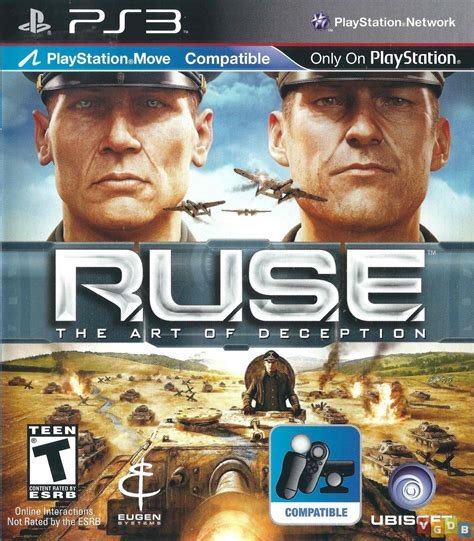
R.U.S.E.: The Art of Deception is a World War II real-time strategy game centered around tactical deception. Players command forces through the intertwined stories of American officer Joe Sheridan and German commander Erich von Richter across European and North American theaters, while unraveling a spy-focused narrative. Its unique mechanics feature large-scale maps with dynamic zoom: close views show detailed unit models, while zooming out transforms units into abstract ‘poker chip’ markers for broad strategic control. Core gameplay emphasizes deception tactics like hiding units, creating fake armies, or disguising unit strengths, supplemented by minimal base-building (production structures and captured resource depots). The game includes campaign missions, co-op maps, and AI-driven challenges.
Gameplay Videos
R.U.S.E.: The Art of Deception Free Download
R.U.S.E.: The Art of Deception Cracks & Fixes
R.U.S.E.: The Art of Deception Reviews & Reception
mobygames.com (78/100): R.U.S.E.: The Art of Deception is a real-time strategy game set in World War II
R.U.S.E.: The Art of Deception: Review
Introduction
In a genre dominated by blitzkriegs and brute-force tactics, R.U.S.E.: The Art of Deception dared to redefine the rules of engagement. Released in 2010 by Eugen Systems and published by Ubisoft, this World War II real-time strategy (RTS) game weaponized subterfuge, psychological warfare, and misdirection as core mechanics. Set against a backdrop of Allied and Axis conflict, R.U.S.E. challenged players to outthink rather than overpower opponents—a fresh thesis in an era saturated with conventional RTS titles. This review delves into the game’s innovative design, its execution of historical warfare, and its contested legacy as a cult classic that balanced ambition with technical constraints.
Development History & Context
Studio Vision & Technological Ambition
Eugen Systems, fresh from the success of Act of War: Direct Action (2005), sought to disrupt the WWII RTS genre with R.U.S.E. Creative Director Alexis Le Dressay envisioned a game where intelligence outweighed ordnance, leveraging the studio’s proprietary IrisZoom Engine to render sprawling battlefields with seamless zoom transitions—from a bird’s-eye strategic view (where units resembled abstract “poker chips”) to ground-level tactical command. This technology enabled dynamic deception mechanics, such as camouflaging troops or fabricating phantom armies, and supported multitouch interfaces and PlayStation Move integration at launch.
The 2010 Gaming Landscape
R.U.S.E. arrived amidst fierce competition (StarCraft II, Company of Heroes) and WWII fatigue. Ubisoft initially planned restrictive DRM but pivoted to Steamworks post-beta backlash. Despite innovative features, its console ports (PS3, Xbox 360) struggled with control schemes, highlighting the era’s tension between PC-centric RTS complexity and accessibility demands. The game’s focus on asymmetric warfare and psychological manipulation distinguished it but also alienated players expecting traditional base-building or fast-paced combat.
Narrative & Thematic Deep Dive
Plot & Characters: Espionage Over Heroism
The single-player campaign follows Major Joseph Sheridan, a Harvard dropout turned U.S. Army commander, and his German counterpart Erich von Richter, across WWII’s pivotal theaters—North Africa, Normandy, and the Bulge. Framed as a Colditz Castle interrogation flashback, the story orbits a spy hunt for Prometheus, a mole leaking intel to the Axis. While the narrative ambitiously weaves betrayal and moral ambiguity (e.g., Sheridan collaborates with von Richter post-war to thwart Soviet nukes), critics lambasted its bland dialogue and pacing. Supporting characters like the pragmatic British spymaster Andrew Campbell and double-agent Kate Garner felt underdeveloped, their arcs lost in disjointed cutscenes.
Themes: The Fog of War as Gameplay
R.U.S.E. eschewed jingoism for metatextual commentary on wartime deception. Missions emphasized reconnaissance, misinformation, and bluffing—mirroring real Allied ops like Operation Fortitude. The campaign’s slower tempo reinforced the weight of command, though some players found it plodding compared to contemporaries. Thematic cohesion peaked in sequences where false intel led to devastating ambushes, underscoring the game’s mantra: “Don’t believe what you see.”
Gameplay Mechanics & Systems
The RUSE System: Deception as a Weapon
The game’s cornerstone was its 10+ ruses—time-limited abilities split into categories:
– Revelation: Decryption exposed enemy movement arrows; Spy Plan unmasked hidden units.
– Concealment: Radio Silence cloaked troops; Camouflage Net hid buildings.
– Deception: Decoy Offensive spawned fake tanks; Reverse Intel disguised light units as heavies.
Ruses demanded resource management (earned via map control) and strategic timing. For instance, masking a flanking force with Radio Silence before ambushing artillery became a multiplayer staple.
Combat & Economy: Streamlined but Shallow
Unit dynamics followed rock-paper-scissors logic: anti-tank guns countered armor, infantry overran artillery. The absence of base-building (only factories and supply depots) shifted focus to unit positioning and ruse synergy. However, factions (USA, UK, Germany, Italy, France, USSR, Japan via DLC) lacked depth. While U.S. forces prioritized speed and airpower, and Germany heavy tanks, imbalances emerged online—Japan’s Ha-Go “medium” tank was outclassed by other factions’ lights.
Interface & Multiplayer: Ambition vs. Execution
The IrisZoom Engine allowed fluid map navigation but strained console controls (Play.tm praised the Xbox 360’s “elegant” port, while GameZone called it “fummelbedienung” [fiddly]). Multiplayer thrived with 8-player battles and co-op vs AI, though the 2017–2024 server shutdowns crippled longevity. AI behavior polarized reviewers; german outlet 4Players.de lauded its “hardnäckige KI” (tenacious AI), while others noted predictable patterns exploitables blitzes.
World-Building, Art & Sound
Visual Design: A Board Game Comes Alive
R.U.S.E.’s aesthetic blended pulp-era bravado with functional minimalism. Zoomed out, its battlefields resembled war-room maps—hexagonal grids, unit tokens like chess pieces—creating a uniquely tabletop feel. Zoomed in, detailed unit models (Shermans, Tiger Tanks) and destructible villages added immersion, though environments lacked texture variety. The art style’s cleanliness contrasted sharply with Call of Duty’s grit, emphasizing clarity over realism.
Sound & Music: Functional but Forgettable
Tom Salta’s orchestral score amplified tense offensives but lacked iconic motifs. Voice acting leaned into WWII-movie clichés (gruff generals, clipped British accents), with Sheridan’s protagonist bordering on stoic monotony. Sound design shone in tactical feedback: artillery barrages rumbled, while radio chatter signaled unit readiness—a subtle cue for multiplayer veterans.
Reception & Legacy
Launch & Critical Divide
R.U.S.E. earned a 78% MobyScore, praised for innovation but criticized for pacing. PC Gamer UK hailed its “taktische Tiefe” (tactical depth), while Eurogamer noted “rubbery” cutscenes. Console versions underperformed, blamed on controls (GameSpot: “foibles”). Commercial reception was tepid, with Ubisoft delisting the PC version in 2015 due to expired military licenses—a blow to preservation.
Influence & Cult Status
Despite flaws, R.U.S.E. pioneered psychological RTS mechanics, echoed in Eugen’s later Wargame and Steel Division series. Its zoom-centric UI inspired titles like Total War: Three Kingdoms, and deception mechanics resurfaced in Deceive Inc. Its legacy persists in niche communities; modders still create custom maps, and its emphasis on intellect over reflexes secures its place as a thinking player’s RTS.
Conclusion
R.U.S.E.: The Art of Deception remains a paradox—a game ahead of its time yet shackled by it. Its bold reimagining of strategy through deception and scale deserves commendation, even as clunky controls, uneven pacing, and a forgettable narrative drag it short of greatness. For historians, it represents a creative zenith in WWII RTS innovation; for players, it endures as a cerebral alternative to bombast. Though its servers have fallen silent, R.U.S.E. stands as a testament to the art of war—where the sharpest weapon is often the mind. 7.5/10