
- Release Year: 1989
- Platforms: Amiga, Atari ST, DOS, FM Towns, PC-98, Windows
- Publisher: Cosmi ValuSoft, Imagineer Co., Ltd., Ocean Software Ltd.
- Developer: Digital Image Design Ltd.
- Genre: Aviation, Flight, Simulation, Vehicular combat, Vehicular
- Perspective: 1st-person
- Game Mode: Single-player
- Gameplay: Combat missions, Dynamic cockpit interface, Flight Simulation, Weapon management
- Setting: Arizona, Contemporary, Europe, Middle East, Pacific
- Average Score: 87/100
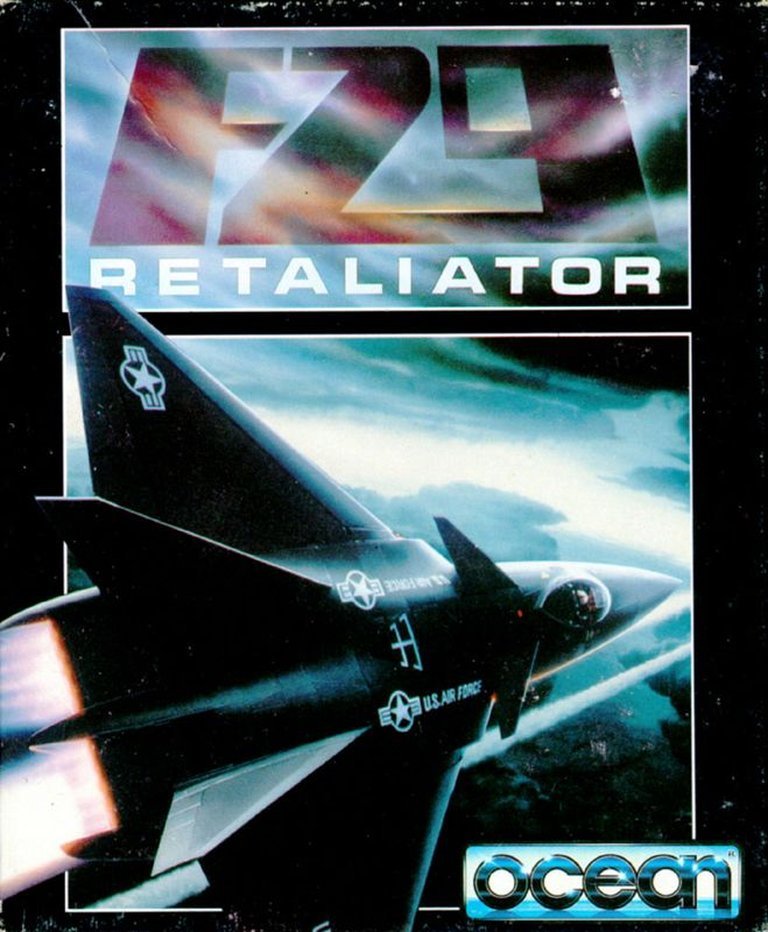
Description
F29 Retaliator is a combat flight simulator released in 1989, placing players in the cockpit of advanced aircraft like the experimental F-29 fighter and the F-22. The game offers a blend of realistic flight dynamics and accessible controls, set against a backdrop of fictional conflicts across various regions. Players engage in a variety of missions, from dogfights to precision strikes, across four campaigns of escalating difficulty, each featuring diverse mission types and strategic objectives.
Gameplay Videos
Where to Buy F29 Retaliator
PC
F29 Retaliator Cracks & Fixes
F29 Retaliator Patches & Updates
F29 Retaliator Guides & Walkthroughs
F29 Retaliator Cheats & Codes
Amiga
During the enrollment screen, type the code as the pilot name and press [Enter]. For auto‑landing, click the Colonel icon and press [Enter] after the name is entered.
| Code | Effect |
|---|---|
| CIARAN | Unlimited Thunderbolt missiles and a full power‑up. |
| THE DIDYMEN | Auto‑landing: press [Keypad Enter] during gameplay to land automatically. |
PC (NEC PC‑98 / DOS)
When starting a new game, type the code as your pilot name; the screen will change to “OCEAN OK” to confirm.
| Code | Effect |
|---|---|
| CIARAN | Unlimited Thunderbolt missiles and a full power‑up. |
| THE DIDYMEN | Auto‑landing: press [Keypad Enter] during gameplay to land automatically. |
F29 Retaliator: A Cold War Arcade-Sim Hybrid That Defined a Generation
Introduction
In the twilight of the Cold War, when the lines between speculative fiction and military technology blurred, F29 Retaliator (1989) soared onto the Amiga and Atari ST as a groundbreaking fusion of arcade action and flight simulation. Developed by Digital Image Design (DID) and published by Ocean Software, it promised gamers the thrill of piloting cutting-edge fighter jets—the real-world F-22 and the experimental Grumman X-29—in global conflict scenarios. While later overshadowed by more complex simulators, F29 Retaliator carved its legacy as a bridge between hardcore flight sim enthusiasts and mainstream players. This review argues that despite its technical limitations and design compromises, F29 Retaliator remains a pivotal work in aviation gaming history—a bold experiment that democratized the genre while exposing the tension between realism and playability.
Development History & Context
Studio Vision & Technological Ambition
Manchester-based DID, led by Martin Kenwright and Phillip Allsopp, aimed to create a flight sim that balanced “authentic flight dynamics with streamlined controls” (MobyGames). Released in 1989—a year marked by F-19 Stealth Fighter’s success—the game arrived amid a boom in military-themed simulations. DID’s choice of aircraft reflected Cold War futurism: The F-22 existed only in Lockheed Martin concept art (painted by Blade Runner designer Syd Mead), while the F-29 borrowed loosely from the real-world Grumman X-29 experimental jet.
Technical Constraints and Innovation
Targeting the Amiga and Atari ST’s modest hardware, DID leveraged vector-based 3D polygons to render terrain, aircraft, and dynamic cockpits—a revolutionary feat praised by Zzap! as “the best-look flight sim around.” Yet compromises were inevitable: Maps were small (criticized by Amiga Joker for feeling “cramped”), and textures lacked detail. The twin goals of accessibility and realism strained the design, leading to simplified physics and AI behavior. As programmer Russell Payne noted, “We prioritized fluid movement over strict aerodynamic modeling.”
The Gaming Landscape
F29 Retaliator entered a market dominated by MicroProse’s hardcore sims (Falcon) and arcade shooters (After Burner). Its dual “Arcade/Simulation” mode was a calculated risk—appealing to newcomers without alienating veterans. While Ocean Software’s marketing touted “100+ missions,” the rushed development cycle (evident in its bug-ridden launch) mirrored industry pressures to capitalize on Cold War intrigue.
Narrative & Thematic Deep Dive
Plot and Characterization: Minimalism as a Virtue
F29 Retaliator eschewed narrative complexity. Players assumed the role of an unnamed NATO pilot thrust into four campaigns: Arizona training, Pacific skirmishes, Middle East conflicts, and a European WWIII scenario. Missions ranged from dogfighting MiGs to bombing naval fleets, linked only by geopolitical tension—a “greatest hits” of Cold War flashpoints.
Dialogue and Themes
With no voice acting and minimal briefing text, the game leaned into environmental storytelling. The manual’s techno-jargon (e.g., AIM-9X “Backwinder” missiles) and mission codenames (“Desert Hammer”) evoked Tom Clancy-esque military fiction. Thematically, it mirrored late-’80s anxiety about superpower brinkmanship, casting players as technological saviors in conflicts escalating toward nuclear annihilation.
Satire or Sincerity?
Unlike Metal Gear Solid’s critique of militarism, F29 unabashedly celebrated Western military prowess—a product of its era. The inclusion of alien fighters in ZERO magazine’s 1990 “Special Mission” add-on (a crossover with DID’s Epic) hinted at self-awareness, but the core experience remained a straight-faced power fantasy.
Gameplay Mechanics & Systems
Core Loop: Accessible Chaos
– Mission Structure: Four campaigns with 100+ missions, from training sorties (“School Flight”) to escort operations. Players progressed by completing ~70% of objectives in each “War Update.”
– Aircraft Handling: Simplified physics favored responsiveness over realism. Players praised the “gentle learning curve” (possinboots, MobyGames), though veterans lamented identically handling F-22/F-29 jets.
– Combat & Arsenal: The weapons system shone despite quirks. Heat-seeking missiles, cluster bombs, and the gimmicky rear-firing “Backwinder” offered tactical variety—though players noted discrepancies between manual descriptions and in-game behavior (e.g., cruise missiles limited to 10-mile ranges).
UI and Customization
The cockpit’s three MFDs (Multi-Function Displays) allowed radar, damage, and weapon loadout monitoring—a precursor to modern sims’ modular interfaces. However, the absence of a save feature mid-campaign and clunky keyboard controls drew ire.
Bugs and Quirks
F29’s rushed release left infamous glitches: Ejected pilots could still control their jets (“you can hit yourself with it”—MobyGames Trivia), and collision detection fluctuated wildly. Later patches fixed crashes but couldn’t salvage superficial damage modeling (e.g., battleships shrugging off missile strikes).
World-Building, Art & Sound
Visual Design: Polygons with Personality
DID’s vector graphics impressed critics for their fluidity, with Computer and Video Games praising “the most realistic 3D graphics seen on the Amiga.” Landmarks like Pacific coral reefs and Middle Eastern oil rigs added vibrancy, though repetitive textures and sparse urban landscapes revealed hardware constraints. The F-22’s design—based on Syd Mead’s concept art—became iconic, despite bearing little resemblance to the real aircraft.
Sound: A Tale of Two Experiences
– Music: Matthew Cannon’s rock-inspired menu theme earned acclaim, with one player noting it “almost [matched] Wing Commander” (Joel Segerbäck, MobyGames).
– In-Game SFX: Engine roars, missile launches, and radio static immersed players but lacked depth. The Amiga version’s sampled audio outpaced tinny DOS counterparts.
Atmosphere: Cold War Tension
The game’s muted color palette (desert tans, ocean blues) and radar blips conveying unseen threats amplified post-Cold War paranoia. Escort missions underscoring fragile alliances further deepened immersion.
Reception & Legacy
Critical Reception
F29 debuted to acclaim, earning an 81% average from critics (MobyGames). Generation 4 hailed it as “above all that came before,” while Zzap! lauded its “infinite depth.” However, ST Format dissented, calling it “a lousy simulator” for veterans. Players praised its fun factor but critiqued its lack of realism (Feem: “hardly worth playing today”).
Commercial Impact
It ranked among Ocean’s top sellers in 1990, spawning ports to DOS and FM Towns. Bundled in compilations like Flight Action Pack (1992), it remained accessible for years.
Enduring Influence
Though eclipsed by DID’s later sims (TFX, F-22: Air Dominance Fighter), F29’s DNA endured. Its “Arcade/Simulation” toggle inspired titles like Ace Combat, while mission variety foreshadowed H.A.W.X. The game also pioneered polygonal 3D on home computers—a tech milestone later refined in Epic (1992).
Conclusion
F29 Retaliator is a contradiction—a product of its time that transcended limitations through sheer ambition. Its blend of speculative aircraft, Cold War theater, and approachable mechanics resonated with 1989 audiences, even as bugs and compromises tarnished its polish. Today, it stands not as a pinnacle of simulation, but as a cultural artifact: a game that dared to make flight sims fun while laying groundwork for future innovations. For historians, it’s a snapshot of late-Cold War gaming; for players, an exhilarating—if flawed—arcade dogfighter. While franchises like Falcon and DCS advanced realism, F29 Retaliator remains a nostalgic testament to the era when polygons could still evoke awe. As The One Magazine declared in 1989: “Don’t hang up your flying helmet until you take one of these babies for a test flight.” Final verdict: A flawed yet foundational classic—7.5/10.