
- Release Year: 2005
- Platforms: Macintosh, Windows
- Publisher: EMME Interactive SA
- Developer: EMME Interactive SA, Lexis Numérique SA
- Genre: Action, Adventure, Educational
- Perspective: Third-person
- Game Mode: Single-player
- Gameplay: Mini-games
- Setting: Kenya
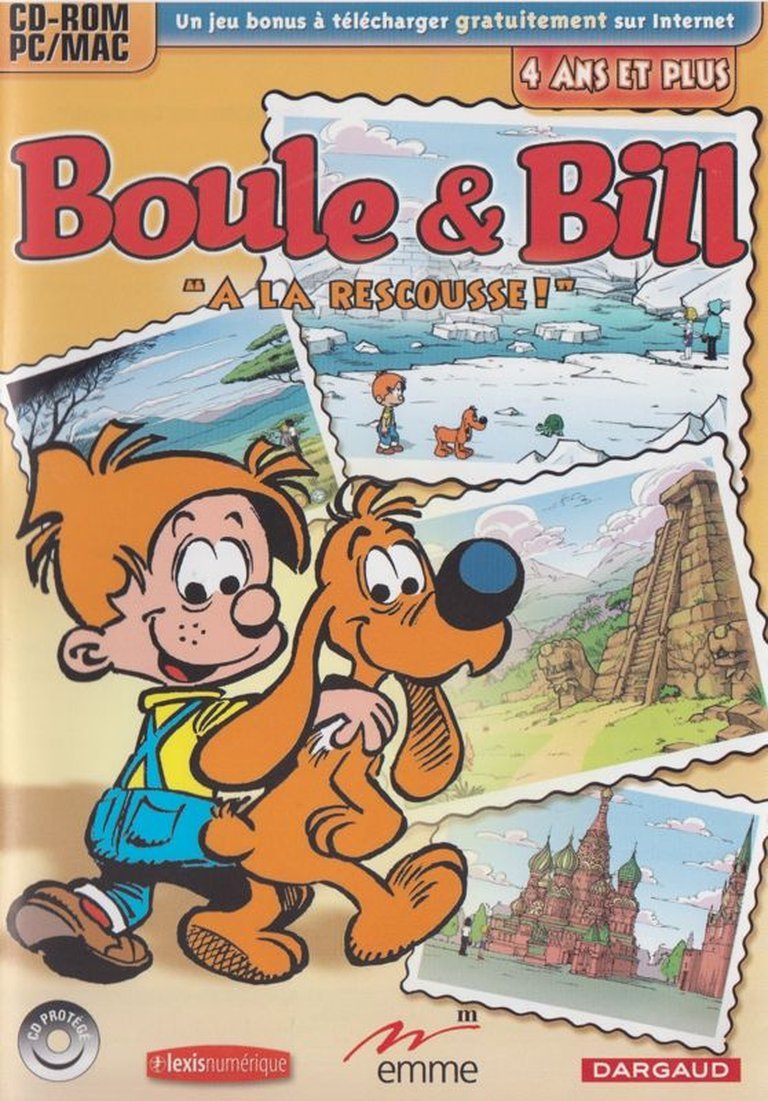
Description
Boule & Bill: A la Rescousse! is an action-adventure game inspired by the popular comics series of the same name. The game follows Boule, a young boy, and his loyal dog Bill as they embark on a global journey to find Boule’s missing friend, Pouf. Traveling through various countries like Belgium, Kenya, and the USA, players engage in mini-games that not only entertain but also educate, focusing on geography and math/logic. The story unfolds as Boule and Bill uncover the mystery behind Pouf’s disappearance, revealing that he has become a treasure seeker.
Boule & Bill: A la Rescousse!: A Deep Dive into the 2005 Comic Adaptation
Introduction
In 2005, developers Lexis Numérique and EMME Interactive attempted to translate the whimsical charm of the iconic Franco-Belgian comic Boule et Bill into a video game with Boule & Bill: A la Rescousse!. This playful adventure sought to capitalize on the franchise’s six-decade legacy as one of Europe’s most beloved children’s comics—a legacy of over 25 million albums sold and adaptations spanning TV, film, and educational media. Yet, as we’ll explore, this globe-trotting rescue mission exemplifies the pitfalls of rushed licensed games: a shallow mini-game compilation buoyed by familiarity but lacking in substance, innovation, or staying power.
Development History & Context
Studio Vision & Constraints
Developed by Lexis Numérique—a studio known for early 2000s experimental titles like The Experiment—and published by EMME Interactive, A la Rescousse! targeted a niche audience: children aged 5–10 already enamored with Jean Roba’s comic series. Released in 2005 for Windows and Macintosh, the game arrived during a surge in mini-game compilations for younger players (Mario Party, Rayman Raving Rabbids). However, it faced technical limitations typical of budget CD-ROM titles: static 2D art, rudimentary animations, and simplistic mechanics reflecting its commercial focus over creative ambition.
The Licensing Landscape
As part of the Boule & Bill licensees group—which includes only two other games (2002’s Boule a rétréci ! and 2008’s DS title Vive les vacances !)—A la Rescousse! epitomized a broader trend of Franco-Belgian comics (Tintin, Lucky Luke) receiving low-risk digital adaptations. Unlike ambitious projects such as The Adventures of Tintin: The Secret of the Unicorn (2011), EMME’s approach prioritized accessibility over depth, banking on brand recognition rather than gameplay innovation.
Narrative & Thematic Deep Dive
A Paper-Thin Plot
The story mirrors the comics’ episodic silliness: Boule’s best friend, Pouf, disappears, prompting Boule and his cocker spaniel Bill to traverse the globe (Belgium, Kenya, the USA) to uncover his fate. The narrative serves as a flimsy pretext for mini-games, culminating in a twist—Pouf became a treasure hunter—that lacks emotional weight. Dialogue and character interactions are minimal, with no voice acting and text boxes delivering forgettable quips. Unlike the comics’ rich ensemble (Caroline the tortoise, neighbor Caporal the cat), the game sidelines supporting cast members, reducing them to background props.
Themes in Translation
While the comics emphasize familial warmth and anthropomorphic humor (Bill’s ear-based “language,” Caroline’s insomnia), A la Rescousse! dilutes these themes into generic “friendship” and “adventure” beats. The absence of Jean Roba’s satirical wit—such as Bill’s critiques of human absurdity—renders the experience toothless, failing to leverage the source material’s charm beyond superficial aesthetics.
Gameplay Mechanics & Systems
Structure & Core Loop
The gameplay revolves entirely around mini-games, each tied to a real-world location:
– Geography-focused challenges (e.g., mapping Kenyan landmarks)
– Math/logic puzzles (counting treasures, pattern recognition)
– Action segments (simple platforming, item collection)
These activities are threadbare, lacking difficulty scaling or depth. Progression is linear, with no character customization or branching paths. The UI is functional but dated, featuring static menus and cursor-driven navigation reminiscent of early 2000s edutainment titles.
Flaws & Friction
– Repetition: Mini-games recycle assets and mechanics, leading to tedium.
– Educational Disconnect: Geography/math elements feel grafted onto the adventure, lacking integration with the narrative.
– Lack of Innovation: Compared to contemporaries like Where in the World Is Carmen Sandiego?, the game offers no fresh twists on the travel-puzzle format.
The promised “online content enhancements” (per the CD-ROM description) are undocumented and likely amounted to trivial extras, not transformative updates.
World-Building, Art & Sound
Visuals: Faithful but Flimsy
The game adopts the comics’ anime/manga-inspired art style, with Boule’s signature blue overalls and Bill’s floppy ears rendered in bright, static 2D sprites. Environments (e.g., Belgian forests, Kenyan savannas) are colorful but lack interactivity, feeling like flat backdrops for mini-games. Unlike the comics’ detailed panels, the art feels budget-constrained, with limited animation and recycled assets.
Sound Design: Missed Opportunities
The soundtrack features cheerful, generic loops that evoke children’s TV shows but lack the comics’ playful identity. Bill’s barks and Caroline’s absence from audio cues further dilute the IP’s personality. No voice acting amplifies the low-budget feel.
Reception & Legacy
Commercial Silence
At launch, A la Rescousse! received zero critic reviews (per Metacritic and MobyGames), suggesting minimal marketing or press outreach. Player engagement was equally scarce, with only two users logging it in their MobyGames collections. Its commercial performance remains unrecorded but likely mirrored its obscurity, buried beneath mid-2000s juggernauts like LEGO Star Wars.
Fading into Oblivion
The game’s legacy is nonexistent. Unlike the comics’ enduring popularity—evidenced by a 2013 live-action film and ongoing animated series—A la Rescousse! is a footnote even within its franchise. It exemplifies a recurring issue with licensed children’s games: disposable design that prioritizes quick sales over lasting appeal. Its sole contribution was expanding the Boule & Bill IP’s multimedia footprint, however modestly.
Conclusion
Boule & Bill: A la Rescousse! is a relic of early 2000s licensed game cynicism—a rushed mini-game collection coasting on a beloved brand’s nostalgia. While its cheerful visuals and educational elements might have briefly entertained young fans, its lack of depth, innovation, and soul cement it as a forgettable cash-in. For historians, it serves as a case study in the challenges of adapting narrative-driven comics into interactive media. For players? Stick to the comics.
Final Verdict: A charming license trapped in a middling game, destined for—and deserving of—obscurity.