
- Release Year: 2010
- Platforms: Windows
- Publisher: TopWare Interactive AG
- Genre: Compilation
- Perspective: Third-person
- Game Mode: Single-player
- Average Score: 74/100
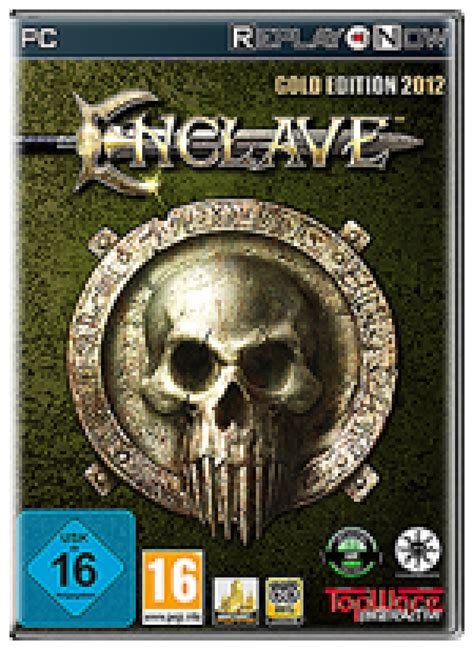
Description
Enclave: Gold Ed. 2010 is a compilation that includes two notable strategy games: Enclave (2002) and Jagged Alliance 2: Wildfire (2004). Enclave is set in a medieval fantasy realm where players can choose to be either a ‘Warrior of Light’ or a ‘Minion of Darkness’, each with unique missions. Jagged Alliance 2: Wildfire is a turn-based tactical game known for its deep strategy and engaging gameplay. This compilation offers a rich experience for fans of strategy and fantasy genres.
Enclave: Gold Ed. 2010 Cracks & Fixes
Enclave: Gold Ed. 2010 Mods
Enclave: Gold Ed. 2010 Reviews & Reception
metacritic.com (68/100): This game is the definition of hidden gem.
gamepressure.com (80/100): The hack-and-slash gameplay is straightforward and enjoyable, making it accessible for casual gaming sessions.
Enclave: Gold Ed. 2010 Cheats & Codes
PC
To enable cheat mode, make a copy of environment.cfg. Then text edit the original document, adding the line: CON_ENABLE=1. Once this is done, start the game. Press ~ to bring up the console, then enter one of the codes below to trigger its function:
| Code | Effect |
|---|---|
| cg_menu cheatmenu | Cheat Menu (Once you activate, use the ~ key to see a menu that allows for god mode and more) |
| cmd giveall | Give All |
| cmd noclip | No Clipping Mode |
| fuciormam | God mode |
| fffwater | Gives fire sword to all characters(except the archers) |
| dbdarck | Gives Sword of Mordesa to all characters (except the archers) |
| theconfesion | Gives READEAMER crossbow to all characters |
| IN_HARDCORE=1 | Enable cheat key combinations in the game. View the “config.mpp” and look under the “Keyboard & mouse” section for combinations. |
Xbox
Pause the game and press the following sequence.
| Code | Effect |
|---|---|
| X, Y, X(2), Y(2), X, Y, X(2), Y(2) | Unlock “God Mode” and “Complete Mission” options at the pause menu. |
| X, Y, X, X, Y, Y, X, Y, X, X, Y, Y | Access cheats menu with God Mode and Complete Current Level options. |
| AXYBAXYB | Unlock Unlimited Gold (Go to options, type the code) |
Xbox
At the episode selection screen after starting a new game, enter the code.
| Code | Effect |
|---|---|
| X, Y(2), X(2), Y, X, Y | Dark Campaign |
Xbox
Create a new profile.
| Code | Effect |
|---|---|
| IMEVIL | Unlock the evil campaign without finishing the light campaign (enter as profile name) |
Enclave: Gold Ed. 2010: Review
Introduction
In an era dominated by trilogies and franchise juggernauts, Enclave: Gold Ed. 2010 stands as a curious artifact—a compilation that bundles Enclave (2002), Starbreeze Studios’ cult-classic action-adventure game, with the lesser-known Jagged Alliance 2: Wildfire (2004). This review focuses primarily on Enclave, a divisive but ambitious medieval fantasy title that dared to blend punishing combat with a dual morality system long before Fable or Dark Souls popularized such concepts. Though flawed, Enclave remains a fascinating time capsule of early 2000s game design, offering a glimpse into the creative risks of a pre-Riddick Starbreeze.
This review argues that Enclave deserves recognition not for polish, but for its bold ideas—its stark depiction of Light vs. Darkness, its hybrid gameplay systems, and its atmospheric world-building—that foreshadowed trends in modern action RPGs.
Development History & Context
Studio Origins and Vision
Developed by Swedish studio Starbreeze (pre-The Chronicles of Riddick), Enclave emerged during a transitional period for action games. The studio, founded in 1998, aimed to marry Severance: Blade of Darkness’ tactical combat with Die by the Sword’s chaotic charm. Producer Nick Kyriakidis and designers Magnus Högdahl and Jens Andersson envisioned a game where player choice—both narratively and mechanically—shaped the experience.
Technological Constraints
As a 2002 Xbox/PC title, Enclave pushed hardware limits with its detailed textures and dynamic lighting, but suffered from technical growing pains. The Xbox version struggled with framerate dips, while the PC port faced optimization issues. Despite this, the game’s art direction leveraged these constraints to create a visually distinct, if occasionally clunky, medieval dystopia.
Gaming Landscape
Enclave debuted alongside giants like The Elder Scrolls III: Morrowind and Kingdom Hearts. Its focus on linear, mission-based storytelling and arcade-style combat felt out of step with open-world trends, but its dual-campaign structure (Light vs. Darkness) offered novelty. The GameCube cancellation in 2003 and legal disputes with publisher Swing! Entertainment further hindered its reach, relegating it to cult status.
Narrative & Thematic Deep Dive
Plot and Characters
The story revolves around the titular Enclave, a bastion of light besieged by demonic hordes after a millennia-old rift begins to close. Players choose between two campaigns:
– Light: A ragtag alliance of knights, archers, and mages defending Celenheim’s queen.
– Darkness: Vatar’s monstrous legion, including orcs, zombies, and a half-demon assassin.
The plot is minimalist—a scaffold for gameplay—but the worldbuilding shines through environmental details: crumbling cathedrals, sulfurous mines, and villages choked by war. Characters lack depth, serving more as archetypes (e.g., the noble paladin, the scheming necromancer), but their designs are memorably grotesque or heroic.
Themes
Enclave explores moral absolutism. The Light campaign frames heroism as sacrifice, while Darkness relishes in nihilistic conquest. Yet neither side is nuanced—good is righteous, evil is decadent. This binary approach feels dated today but resonates as a deliberate contrast to grayer contemporaries like Planescape: Torment.
Gameplay Mechanics & Systems
Core Loop
Missions are linear, level-based romps blending hack-and-slash combat, light puzzles, and treasure hunting. Players select a character (12 classes total, including unlockable bonus heroes), equip gear using gold earned in prior missions, and fight through hordes of enemies.
Combat and Progression
- Strengths: The weapon variety—flails, bows, fireballs—allows experimentation. First-person mode (a rarity in 2002) adds versatility.
- Flaws: Clunky hit detection, erratic AI, and sparse checkpoints amplify difficulty to frustrating levels. Character progression is shallow, with gear upgrades feeling incremental.
UI and Innovation
The UI is functional but austere, prioritizing readability over flair. The gold system—forcing players to budget resources—adds strategic depth, though rote grinding dampens its impact.
World-Building, Art & Sound
Visual Direction
Enclave’s pre-rendered backgrounds and grim aesthetic evoke Diablo II’s gothic despair. The Light’s sun-drenched citadels contrast with the Dark’s corroded warrens, creating a striking duality. While textures aged poorly, the art design’s commitment to atmosphere remains compelling.
Sound Design
Gustaf Grefberg’s score oscillates between choral hymns and industrial dissonance, mirroring the moral split. Voice acting is hammy but endearing—think Heretic II’s earnest cheese. Environmental sounds (clanging steel, distant screams) immerse players in the fray.
Reception & Legacy
Initial Reception
Critics praised its ambition but panned its execution. The PC version scored 71/100 on Metacritic, with outlets like GameSpot calling it “rough around the edges.” The Xbox iteration fared worse (66/100), criticized for framerate dips and unbalanced combat.
Cult Revival
Post-2013 Steam re-release, Enclave found new life, selling 1.5 million copies by 2017. Its influence echoes in Dark Souls’ bleak tone and Dragon Age: Origins’ dual-perspective storytelling. The cancelled Enclave II—reworked into Knights of the Temple: Infernal Crusade—remains a bittersweet “what-if.”
Conclusion
Enclave: Gold Ed. 2010 is less a definitive package than a historical curiosity, bundling Starbreeze’s flawed gem with an unrelated strategy title. Yet Enclave itself endures as a testament to early 2000s ambition—a game unafraid to juxtapose beauty and jank, philosophy and frustration. While not a masterpiece, it’s a vital artifact for historians and masochists alike, proving that even middling scores can birth enduring legends.
Final Verdict: A 7/10 experience in its heyday, now elevated to 8/10 for its audacity and nostalgia. Essential for action-RPG completists; optional for others.