
- Release Year: 2000
- Platforms: Windows
- Publisher: 1C Company, On Deck Interactive, Take-Two Interactive Software, Inc.
- Developer: Fragile Bits
- Genre: Adventure
- Perspective: Third-person
- Game Mode: Single-player
- Gameplay: Puzzle elements, Sliding block, Tile puzzle, Timed segments
- Setting: Earth’s Moon, Futuristic, Sci-fi
- Average Score: 50/100
Description
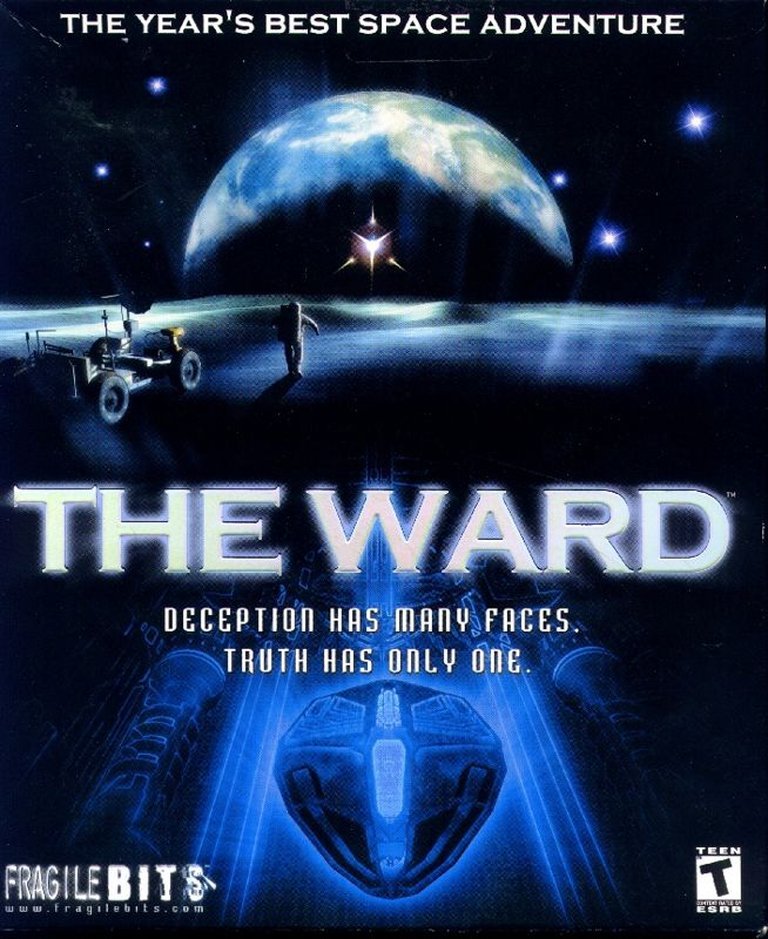
In ‘The Ward’, players assume the role of an astronaut from the Apollo XIX mission sent to investigate lunar seismic activity. After a mysterious entity kills a crewmate, the protagonist must survive an alien threat while uncovering a conspiracy that endangers all of humanity. This 3rd-person sci-fi adventure features multi-camera perspectives, puzzle-solving elements, and a futuristic setting on the moon where players navigate eerie environments and manipulate alien technology to prevent Earth’s downfall.
Gameplay Videos
Where to Buy The Ward
PC
The Ward Cracks & Fixes
The Ward Guides & Walkthroughs
The Ward Reviews & Reception
en.wikipedia.org (57/100): The game received mixed reviews upon its international release.
mobygames.com (58/100): Surprise, surprise! Finally … a challenging adventure game!
neoseeker.com : The Ward will most likely either frustrate you to no end or send you to sleep in the first half hour.
gamerevolution.com (30/100): If you’re looking to game for relaxation, steer clear of this headache disk.
metacritic.com (57/100): Mixed or Average reviews with a Metascore of 57.
The Ward Cheats & Codes
PC
Enter the following key sequence.
| Code | Effect |
|---|---|
| F9, CTRL+SHIFT+E | Return to an earlier difficulty mode |
The Ward: A Forgotten Gem of Early 2000s Sci-Fi Adventure Gaming
Introduction
In an era dominated by flashy 3D graphics and action-packed gameplay, The Ward (2000) dared to be different. Developed by Croatian indie studio Fragile Bits, this point-and-click adventure eschewed modern trends to deliver a dense, puzzle-driven narrative steeped in cosmic horror and Cold War-era alien mythology. Though its reputation is divisive—celebrated by hardcore adventure fans for its brutal challenge and criticized for its technical limitations—The Ward remains a fascinating artifact of early 2000s indie ambition. This review argues that while the game stumbles in execution, its labyrinthine plot, thematic depth, and unapologetic dedication to cerebral gameplay cement its place as a cult classic for patient players.
Development History & Context
A Small Team with Big Ambitions
Born from the trenches of Croatia’s nascent game development scene, The Ward was the passion project of Fragile Bits, a six-person team led by Leonardo Magdić. Developed over three years with minimal funding, the game’s creation was a labor of love: Magdić himself handled programming, design, and project leadership, while artist Vjekoslav Brkić crafted its haunting pre-rendered environments. Released domestically as Poslanik in 2000 and internationally in 2001 via On Deck Interactive, The Ward entered a market where the golden age of point-and-click adventures was waning. Competing against genre titans like The Longest Journey and Grim Fandango, it stood out not through polish but through sheer narrative audacity.
Technological Constraints
Limited resources forced creative compromises. The game’s 2D backdrops and chunky 3D character models felt dated even at release, while the lack of widespread voice acting (outside of cutscenes) leaned heavily on text-based dialogue. Yet these constraints birthed inventive solutions, such as the memorizer—a handheld device used to hack systems—which became a cornerstone of its puzzle design. The Ward exemplifies the scrappy ingenuity of indie developers fighting to carve space in an industry increasingly dominated by AAA budgets.
Narrative & Thematic Deep Dive
A Cosmic Conspiracy Unfolds
Players assume the role of David Walker, an astronaut on the fictional Apollo XIX mission who awakens in an alien morgue after his crew is massacred. What begins as a fight for survival escalates into a galaxy-spanning conflict between two ancient races: the enigmatic Fraction (benevolent Greys) and the tyrannical Reptilians. Walker learns he is the Ward, a prophesied figure whose DNA holds the key to the Makers’ Technology, an artifact capable of reshaping reality. The plot sprawls across a moonbase, a Martian colony, and an alien spacecraft, weaving in UFO lore, government cover-ups, and metaphysical musings on free will.
Themes of Identity and Trust
At its core, The Ward explores the fragility of human agency in a universe teeming with unseen manipulators. Walker’s transformation from pawn to messiah mirrors the game’s fixation on duality: allies deceive, enemies empathize, and every dialogue choice carries weight. The Mars colony segment—a Blade Runner-esque hub of gamblers, hackers, and cultists—asks players to question who to trust, a theme underscored by the game’s recurring Communicator item, a badge that ostensibly identifies allies but often proves unreliable.
Flaws in the Fabric
While the narrative’s ambition is laudable, it buckles under its own complexity. Pacing issues plague the Mars section, where excessive dialogue trees and fetch quests dilute tension. Key plot points, such as the purpose of the Quickener artifact, are left unresolved, and the rushed finale on the alien planet Draco feels anticlimactic. Yet these missteps are tempered by moments of brilliance, such as a dream sequence where Walker’s psyche is literally dissected by shadowy interrogators.
Gameplay Mechanics & Systems
A Puzzle Lover’s Playground
The Ward is unyielding in its commitment to cerebral challenges. The moonbase opening sets the tone with a gauntlet of inventory puzzles, logic tests, and timed escape sequences. Standouts include:
– The Engraving Puzzle: A color-matching ritual requiring players to align alien glyphs using rotating tiles.
– Biocontainer Integration: A multi-step process involving blood samples, microscopes, and randomized codes to implant a McGuffin in Walker’s hand.
– Mars Colony Sliders: Five unique sliding-block puzzles, each tied to cryptic clues (e.g., Tarot cards or star charts).
The memorizer adds depth, letting players hack robots and security systems via a mini-OS interface. However, the lack of hints frustrated many; even the Universal Hint System called it “brutally challenging.”
Friction in the Framework
For all its ingenuity, the gameplay often fights against itself. Walker’s sluggish movement turns timed sections into exercises in frustration, while inconsistent item labeling (e.g., a “necklace” vs. “security collar”) leads to unnecessary trial-and-error. The Mars chapter’s blackjack minigame, required to progress, overstays its welcome, and the final space-ship segment—where players control both Walker and an NPC—feels undercooked.
World-Building, Art & Sound
Aesthetic Ambition on a Budget
The Ward’s pre-rendered environments oscillate between evocative and crude. The moonbase’s sterile labs and flickering holograms ooze retro-futurism, while the Martian colony’s grungy casinos and churches channel Alien’s lived-in dystopia. Character models, however, are robotic and expressionless, their jerky animations reminiscent of Resident Evil’s infamous door-loading sequences.
Sound as a Saving Grace
Composer Marko Banjac’s synth-heavy score is the game’s unsung hero. Ominous drones underscore the moonbase’s claustrophobia, while Martian ambient tracks blend Middle Eastern motifs with eerie electronic pulses. The lack of voice acting (outside of cutscenes) is a double-edged sword: while text dialogue allows for intricate storytelling, it also highlights stiff writing in exchanges like, “BRBL OKHL BLA TLA… we don’t want to hurt you.”
Reception & Legacy
A Polarized Response
Critics praised The Ward’s ambition but savaged its execution. IGN (6.4/10) called it “amusing yet visually outdated,” while GameSpot (6.2/10) lamented its “lackluster progression.” The MobyScore settled at 6.0/10, reflecting its niche appeal. Yet patient players found rewards: Adventure Gamers championed its “imaginative sliders,” and Jeanne’s user review (MobyGames) hailed it as “a worthy play for fans of Dark Side of the Moon.”
Influence and Aftermath
Though The Ward sold nearly 300,000 copies, it left little mainstream legacy. Fragile Bits disbanded shortly after, and the game faded into obscurity. Yet its DNA lives on in indie titles like Iron Lung, which similarly marry lo-fi aesthetics with high-concept sci-fi. For historians, The Ward is a testament to the global reach of early 2000s game development—a Croatian David swinging at the Goliaths of Rockstar and LucasArts.
Conclusion
The Ward is a game of contradictions. It is brilliant and baffling, innovative and infuriating, a relic of its time yet timeless in its ambition. While its dated graphics, uneven pacing, and brutal difficulty will deter casual players, its rich narrative tapestry and inventive puzzles offer a rewarding experience for those willing to endure its flaws. In an industry increasingly risk-averse, The Ward stands as a monument to what small teams could—and still can—achieve with vision and grit. It may not be “the year’s best space adventure,” as its box claimed, but it is unquestionably unforgettable.