
- Release Year: 1999
- Platforms: Windows
- Publisher: Focus Multimedia Ltd., Hasbro Interactive, Inc., Mindscape SA
- Developer: Minds Eye Productions, Moby Score
- Genre: Educational
- Perspective: Diagonal-down
- Game Mode: Single-player
- Gameplay: Mini-games
- Setting: Island of Sodor
- Average Score: 92/100
Description
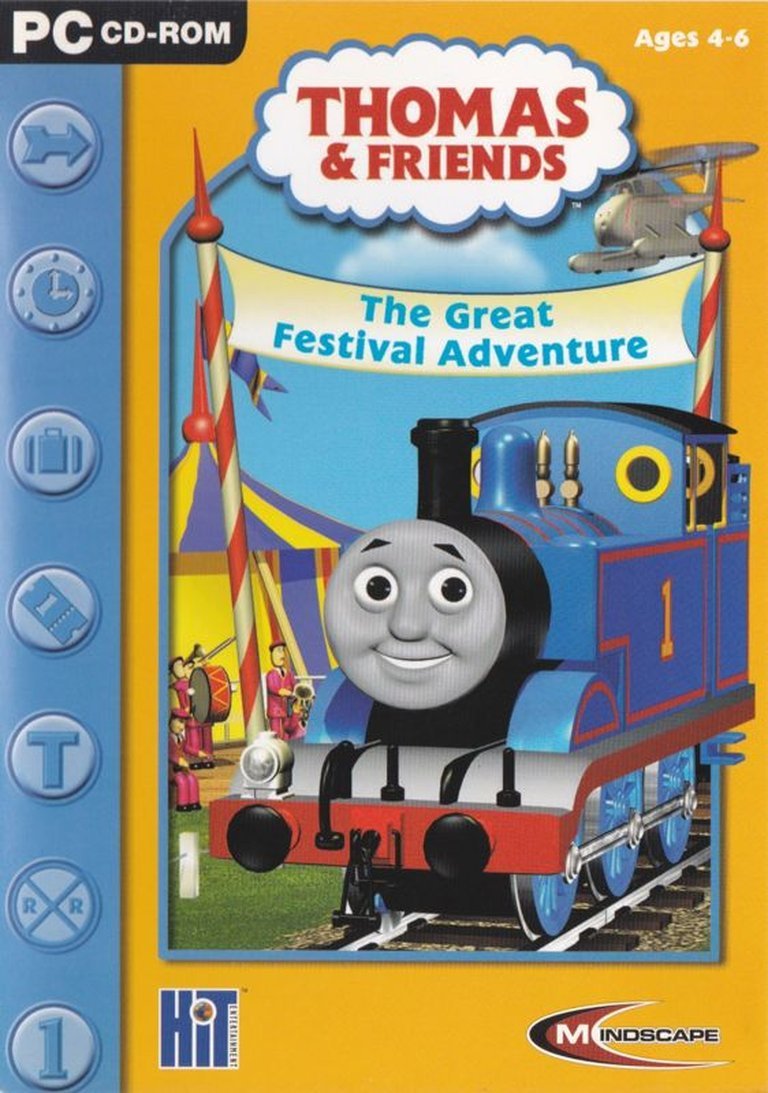
Thomas & Friends: The Great Festival Adventure is an educational game designed for young children, featuring seven engaging mini-games based on the popular British-American children’s television series Thomas & Friends. Players join Thomas on a journey around the island of Sodor, participating in activities such as color matching, shape sorting, and counting. Each location offers a unique mini-game, such as helping Thomas prepare for the day at the engine shed, unloading cargo at the harbor, and herding cows with Terence the Tractor. Sir Topham Hatt provides assistance throughout, and players receive printable certificates upon completing tasks. The game is available in both English and German.
Gameplay Videos
Where to Buy Thomas & Friends: The Great Festival Adventure
PC
Thomas & Friends: The Great Festival Adventure Patches & Updates
Thomas & Friends: The Great Festival Adventure Reviews & Reception
mobygames.com (92/100): Average score: 92% (based on 1 ratings)
Thomas & Friends: The Great Festival Adventure: Review
Introduction
In the golden age of late-’90s educational software, Thomas & Friends: The Great Festival Adventure chugged onto Windows PCs as a charming yet mechanically simplistic entry in the genre. Targeted squarely at preschoolers, this 1999 title from Minds Eye Productions and Hasbro Interactive sought to translate the whimsical world of Sodor into an interactive experience. While it lacks the complexity of contemporary games, its legacy lies in its faithfulness to the beloved Thomas & Friends franchise and its ability to engage young players with bite-sized educational tasks. This review argues that The Great Festival Adventure succeeded as a niche product for its audience, even if its design and technical execution now feel dated.
Development History & Context
Developed by Minds Eye Productions—a studio known for licensed children’s titles like Monopoly Junior—The Great Festival Adventure emerged during a boom in CD-ROM-based educational games. Hasbro Interactive, its publisher, leveraged its portfolio of family-friendly franchises (e.g., Sesame Street, Tonka) to capitalize on the growing edutainment market. The game’s creation involved a 92-person team, including Michael Craighead (Director of QA) and David Walls (Creative Director), who prioritized accessibility over innovation, given the technological constraints of the era.
Released alongside titles like Elmo’s Number Journey, the game faced competition but stood out through its integration of Thomas & Friends’ lore. Early ’90s advancements in 3D modeling allowed for rudimentary polygonal renders of characters like Thomas and Harold, though these visuals paled in comparison to the TV series’ detailed models. The decision to include bilingual support (English/German) reflected Hasbro’s broader European localization strategy.
Narrative & Thematic Deep Dive
The game’s plot revolves around preparing for Sodor’s Great Festival, framed by Sir Topham Hatt assigning tasks to Thomas and his fellow engines. Each of the seven mini-games ties into this narrative:
– Engine Shed Cleanup: Teaches responsibility through maintaining locomotives.
– Rock Fall at the Quarry: Introduces problem-solving via Harold the Helicopter.
– Passenger Pickup with Annie & Clarabel: Emphasizes categorization (e.g., selecting “children” or “farmers”).
The writing, overseen by Janet Leonard, mirrors the TV series’ episodic simplicity, with light-hearted conflicts (e.g., Gordon’s turntable mishap) and moral lessons about teamwork. Notably, the game features dual narrators: Michael Angelis (UK) and Robin Smith (US), marking Smith’s debut in the franchise. While dialogue is minimal, Sir Topham Hatt’s encouragement (“Well done! I wish all my engineers worked as efficiently as you!”) reinforces positive reinforcement—a cornerstone of preschool education.
Gameplay Mechanics & Systems
The game’s core loop centers on seven mini-games, each with three escalating difficulty levels:
1. Engine Maintenance: Click-based interactions for oiling and cleaning.
2. Cow Roundup with Terence: Spatial awareness via mouse-driven herding.
3. Festival Ride Assembly: Jigsaw puzzles requiring shape recognition.
While mechanically shallow, these activities align with early childhood developmental milestones (e.g., color matching, counting). The UI is deliberately minimalist, with Sir Topham Hatt occupying a corner to provide hints—a design choice that avoids overwhelming young players.
However, the game falters in progression. Levels unlock linearly, offering little replay value beyond printable certificates. Technical flaws, such as inconsistent animation (e.g., missing side rods on trains) and crashes (noted in MyAbandonware user reviews), further limit its longevity.
World-Building, Art & Sound
The Great Festival Adventure captures Sodor’s cozy aesthetic through diagonal-down perspective environments like Tidmouth Sheds and Ffarquhar Quarry. While character models are primitive by today’s standards—Gordon appears half Thomas’ height in one scene—they retain the series’ charm.
The soundtrack, composed by Mike O’Donnell and Junior Campbell, repurposes classic Thomas themes, including Percy’s jaunty first-series tune. Sound effects, like Cranky the Crane’s creaks, enhance immersion, though occasional glitches (e.g., Edward using Gordon’s whistle) betray rushed production.
Reception & Legacy
At launch, The Great Festival Adventure earned a 92% score from FamilyPC Magazine, praised for its age-appropriate challenges and rewarding structure. Player reviews on MobyGames echo this sentiment, with an average 5/5 rating from caregivers citing its child-friendly design.
Despite its commercial obscurity, the game holds nostalgic value for ’90s kids and persists through abandonware communities. Its influence is evident in later Thomas titles like Thomas Saves the Day (2003), which expanded on its mini-game formula. However, its legacy is hampered by technical flaws and the franchise’s eventual shift toward mobile platforms.
Conclusion
Thomas & Friends: The Great Festival Adventure is a product of its time—a mechanically rudimentary but lovingly crafted edutainment title. Its strengths lie in its faithfulness to the source material and its understanding of preschool pedagogy. Yet, dated visuals, repetitive gameplay, and technical hiccups prevent it from standing alongside classics like Reader Rabbit. For retro enthusiasts and Thomas completists, it remains a curious artifact; for modern players, it serves as a reminder of how far children’s gaming has come.
Final Verdict: A quaint, if flawed, relic of late-’90s edutainment—best enjoyed by its target demographic or as a nostalgic curiosity.