
- Release Year: 2006
- Platforms: Windows
- Publisher: Della
- Developer: mouser
- Genre: Adventure, Choose-Your-Own-Adventure, Interactive fiction, Text adventure
- Perspective: Audio game
- Game Mode: Single-player
- Gameplay: Choose-Your-Own-Adventure, Interactive fiction, Quick-time events, Text adventure
- Setting: Dark Forest
- Average Score: 66/100
Description
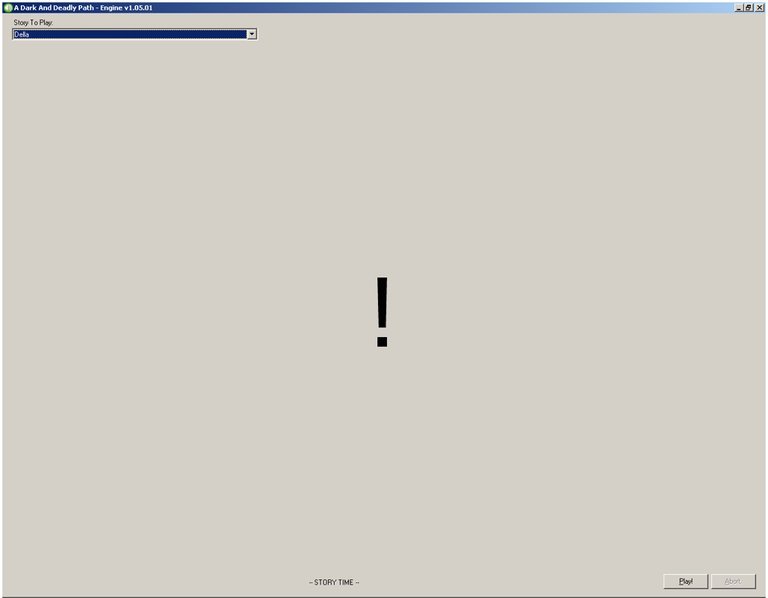
A Dark and Deadly Path (ADAP) is an experimental audio-driven game engine that enables the creation of Choose Your Own Adventure-style experiences with time-sensitive, Dragon’s Lair-esque decisions. Players navigate branching narratives through quick inputs like pressing numbered keys, responding to spoken narration delivered via MP3 files. The included whimsical sample game, set in a dark forest haunted by a monster, features improvised storytelling and references to programming community figures, offering a short but unique interactive experience reminiscent of telephone-based adventure games.
A Dark and Deadly Path Reviews & Reception
mobygames.com (52/100): A curious oddity, an engine allowing the production of Choose Your Own Adventure-type games with Dragon’s Lair-style snap-decisions.
retro-replay.com : ADAP transforms storytelling into an electrifying, hands-on adventure engine that invites you to craft and play Choose Your Own Adventure–style games with heart-pounding, Dragon’s Lair–inspired snap decisions.
myabandonware.com (80/100): A Dark and Deadly Path (aka ADDP) is a video game published in 2006 on Windows. It’s an adventure game, set in an interactive fiction theme.
A Dark and Deadly Path: Review
An Audio Experiment Lost in the Woods of Interactive Fiction
Introduction
In the annals of video game oddities, few titles are as conceptually intriguing yet fundamentally flawed as A Dark and Deadly Path (2006). Developed as a freeware passion project by programmer “mouser” (Bradley Phillips) and writer Della, this Windows-based experiment masquerades as a game engine for creating “Choose-Your-Own-Adventure” narratives with a twist: It eschews visuals entirely, relying solely on audio prompts and rapid-fire keyboard inputs. A curious hybrid of Dragon’s Lair‘s reflex-driven design and Steve Jackson’s 1980s F.I.S.T. telephone adventures, ADDP stands as a footnote in gaming history—a daring but clumsy attempt to marry interactive fiction with real-time audio puzzles. This review explores its triumphs, tragedies, and the eerie solitude of navigating a dark forest guided only by disembodied voices.
Development History & Context
Origins of an Acoustic Oddity
Released on December 31, 2006, ADDP emerged from the indie programming community, specifically the forums of DonationCoder.com. Built by Phillips as an XML-driven engine, it aimed to democratize interactive audio storytelling. The concept was radical for its time: Scripts could be written with simple XML tags, while audio files (MP3 narration) served as the sole “graphics.” This minimalist approach reflected both ambition and constraint—a project born from technical curiosity rather than commercial intent.
The mid-2000s were a renaissance for indie experimentation, with platforms like Newgrounds hosting Flash games and Twine still years away. Yet ADDP’s stripped-down ethos clashed with mainstream trends. While AAA studios chased cinematic 3D worlds (Half-Life 2, Oblivion), Phillips and Della embraced limitation, crafting an experience closer to dial-up-era voice-mail mazes than contemporary adventures. The sample game included—a 15-minute improvisational fairy tale—served as both proof-of-concept and creative playground, featuring cameos from coding peers and an aesthetic akin to a campfire ghost story gone rogue.
Narrative & Thematic Deep Dive
A Whimsical Dead End
ADDP’s bundled adventure follows a protagonist navigating a monster-infested forest, with branching paths dictated by timed numerical inputs (e.g., “Press 3 to talk to the witch”). The narrative, self-aware and whimsical, leans into its own artifice: Della’s ad-libbed delivery evokes a parent inventing bedtime scares on the fly. Characters include tongue-in-cheek references to programming personalities, while plot beats spoof fairy-tale tropes (a looming beast, cryptic NPCs).
Yet thematic depth is scarce. The story functions as a skeletal framework for testing the engine—offering a single “correct” path surrounded by abrupt dead ends. Unlike The Path (Tale of Tales, 2009), which used Little Red Riding Hood to explore themes of innocence and predation, ADDP’s lore is cosmetic. Dialogue veers into programmer in-jokes (“Press 2 to debug the narrative”), undermining immersion. The true “horror” here isn’t the monster but the existential frustration of retracing steps after a mistimed button press.
Gameplay Mechanics & Systems
Dragon’s Lair Meets Voice-Mail Hell
At its core, ADDP is a rhythm game without music. Players listen to narration and react within seconds by pressing 1, 2, or 3—a system evoking Dragon’s Lair’s infamous QTE sequences but stripped of visuals. Success demands memorization; failure triggers instant death or comedic non sequiturs (e.g., narra
“`