
- Release Year: 2017
- Platforms: PlayStation 4, Windows, Xbox One
- Publisher: Ubisoft Entertainment SA
- Developer: Ubisoft
- Genre: Action, Adventure, Open World
- Perspective: Third-person
- Game Mode: Single-player
- Gameplay: Combat, Crafting, Exploration, Open World, Stealth
- Setting: Ancient Egypt
Description
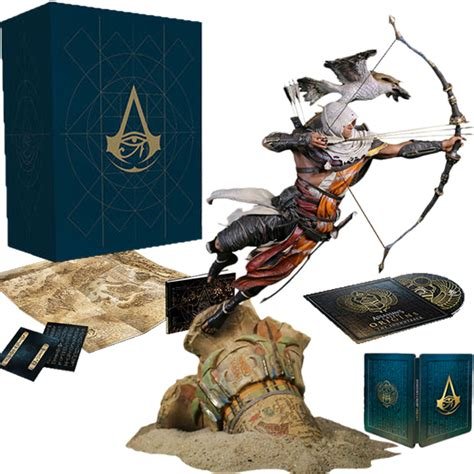
Assassin’s Creed: Origins (Dawn of the Creed Edition) is a special collector’s edition of the action role-playing game set in Ptolemaic Egypt, telling the origin story of the Assassin Brotherhood. Players follow Bayek, a Medjay warrior, and his wife Aya as they seek vengeance against a shadowy order responsible for their son’s death, unraveling a conflict that spans millennia. This Ubisoft Store-exclusive edition includes the Deluxe Edition base game, the Season Pass, a Bayek & Senu figurine, artbook, soundtrack, steelbook case, map, and other premium physical collectibles exploring ancient Egypt’s open world.
Gameplay Videos
Assassin’s Creed: Origins (Dawn of the Creed Edition) Cracks & Fixes
Assassin’s Creed: Origins (Dawn of the Creed Edition) Guides & Walkthroughs
Assassin’s Creed: Origins (Dawn of the Creed Edition) Cheats & Codes
PC
Enter codes at the main menu.
| Code | Effect |
|---|---|
| RT+Y | Change Beard |
| LT+Y | Change Hair |
| right mouse button + interact key | Change Beard |
| left mouse button + interact key | Change Hair |
PlayStation 4
Enter codes at the main menu.
| Code | Effect |
|---|---|
| R2 + Triangle | Change Beard |
| L2 + Triangle | Change Hair |
Xbox One
Enter codes at the main menu.
| Code | Effect |
|---|---|
| RT + Y | Change Beard |
| LT + Y | Change Hair |
Assassin’s Creed: Origins (Dawn of the Creed Edition): Review
Introduction
Assassin’s Creed: Origins (2017) marked a pivotal rebirth for Ubisoft’s flagship franchise, transforming it from a stealth-action series into a full-fledged action-RPG. Set in the visually stunning and politically turbulent Ptolemaic Egypt, Origins explores the genesis of the Assassin Brotherhood through the eyes of Bayek of Siwa, a Medjay warrior seeking vengeance. With its Dawn of the Creed Edition—a collector’s package featuring a deluxe version of the game, season pass, and lavish physical extras like a Bayek figurine and artbook—the game offered fans a deep dive into its mythos. This review argues that Origins not only revitalized the series with its ambitious design but also set a new standard for historical open-world storytelling.
Development History & Context
Developed by Ubisoft Montreal over four years with support from nearly 1,000 contributors worldwide, Origins emerged as a response to criticisms of franchise fatigue following Assassin’s Creed Unity (2014) and Syndicate (2015). Creative directors Jean Guesdon and Ashraf Ismail (veterans of Black Flag) sought to modernize the series by embracing RPG mechanics and a “hitbox-based” combat system. Ancient Egypt, a long-requested setting, was chosen for its rich history and cultural duality—a civilization in decline under Roman and Greek influence.
The game’s delay from its annual release schedule allowed Ubisoft to refine its vision, consulting Egyptologists like Jean-Claude Golvin to balance historical authenticity with creative liberty. Procedural generation filled vast deserts, while handcrafted cities like Alexandria and Memphis reflected meticulous research. This “co-development” model, involving studios like Ubisoft Sofia (tombs) and Ubisoft Singapore (naval combat), ensured each region felt distinct.
Narrative & Thematic Deep Dive
Set between 49–38 BCE, Origins follows Bayek and his wife Aya as they dismantle the Order of the Ancients, proto-Templars manipulating Pharaoh Ptolemy XIII and his sister Cleopatra. Bayek’s personal tragedy—the murder of his son, Khemu—fuels a revenge quest that spirals into a broader conflict between free will and authoritarian control. The narrative deftly intertwines historical events (Caesar’s assassination, Cleopatra’s rise) with the founding of the Hidden Ones, the Brotherhood’s precursor.
Themes of grief, sacrifice, and ideological evolution dominate. Bayek’s journey from vengeful father to reluctant leader contrasts with Aya’s transformation into Amunet, a calculating strategist. The modern-day storyline introduces Layla Hassan, an Abstergo scientist whose discoveries via the Animus hint at a looming catastrophe. Expansions like The Hidden Ones (38 BCE) and The Curse of the Pharaohs (34 BCE) further explore the Brotherhood’s moral code and Egyptian mythology, though some critics noted pacing issues in the main campaign.
Gameplay Mechanics & Systems
Origins abandoned the series’ traditional paired-animation combat for a Dark Souls-inspired hitbox system. Players wielded eight weapon types (swords, bows, heavy blades) with distinct speed and damage profiles, complemented by dodges, parries, and adrenaline-powered finishers. The skill tree—split into Hunter (ranged), Warrior (melee), and Seer (tools)—allowed for diverse playstyles, while crafting upgrades (e.g., Hidden Blade damage) encouraged exploration.
The open world introduced Senu, Bayek’s eagle companion, replacing Eagle Vision with aerial reconnaissance. Quests ranged from gladiatorial arena battles to naval skirmishes (as Aya), though side activities occasionally felt repetitive. RPG elements like level-gating and loot tiers drew criticism for forcing grind, but innovations like a dynamic day/night cycle and faction-based AI routines added depth.
World-Building, Art & Sound
Ubisoft’s rendition of Egypt remains a masterclass in environmental design. From the sun-baked dunes of Siwa to the bustling streets of Alexandria, every locale breathed with authenticity. Raphaël Lacoste’s art direction blended historical accuracy—Pergamon-inspired architecture—with mythical flourishes, particularly in expansions featuring undead pharaohs and cursed tombs.
The score, composed by Sarah Schachner, mixed haunting vocals with period-appropriate instrumentation, enhancing the game’s epic tone. Sound design shone in ambient details: market hubbub, desert winds, and the roar of hippos in Nile waterways. The Discovery Tour mode, later released as a standalone educational tool, underscored Ubisoft’s commitment to merging entertainment with history—though some historians critiqued its gender-inclusive revisions.
Reception & Legacy
Upon release, Origins earned “generally favorable” reviews (Metacritic: 81–85/100), praised for its world design, combat overhaul, and emotional storytelling. Critics lauded Bayek as one of the series’ most compelling protagonists, though divisive elements included uneven quest design and a lackluster modern-day plot. Commercially, it sold over 10 million copies, outperforming Syndicate and revitalizing the franchise.
Its influence permeated successors like Odyssey (2018) and Valhalla (2020), which doubled down on RPG mechanics. The game also garnered nominations at The Game Awards and BAFTA, while its 60fps patch for next-gen consoles in 2022 extended its longevity. Despite flaws, Origins proved that the Assassin’s Creed formula could evolve without losing its identity.
Conclusion
Assassin’s Creed: Origins is a landmark title that redefined its franchise and elevated open-world RPG storytelling. The Dawn of the Creed Edition, with its tactile artifacts and artbook, embodies the game’s dedication to immersion. While not without missteps—grindy progression, pacing hiccups—its lush world, innovative systems, and humanizing narrative cement its place as a modern classic. For both series veterans and newcomers, Origins is not just a prequel but a rebirth, proving that even ancient tales can feel thrillingly new.