
- Release Year: 2017
- Platforms: Linux, Macintosh, Windows
- Publisher: AZIMUT Games
- Developer: AZIMUT Games
- Genre: Puzzle
- Perspective: Fixed
- Game Mode: Single-player
- Gameplay: Board game, Cards, Tile matching puzzle, Tiles
- Average Score: 44/100
Description
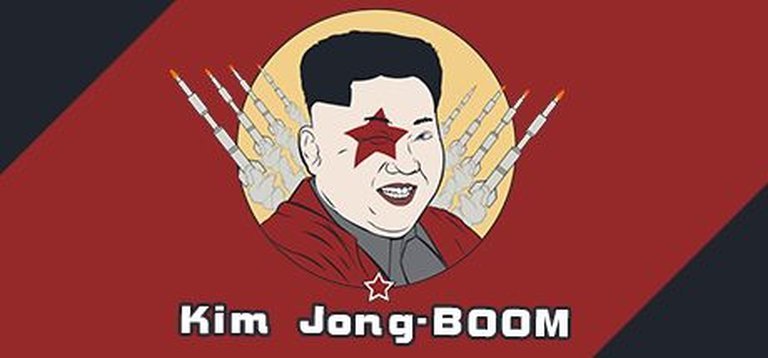
Kim Jong-Boom is a puzzle arcade game released in 2017, where players assume the role of either Kim Jong-un or Donald Trump in a humorous, politically charged showdown. The gameplay revolves around matching pairs of cards under time pressure, with each round culminating in typing a password to launch a rocket. The goal is to progress through levels, demonstrate superior ‘nuclear potential,’ and destroy the opponent, all while earning achievements in this satirical time-killer.
Where to Buy Kim Jong-Boom
PC
Kim Jong-Boom Cracks & Fixes
Kim Jong-Boom Guides & Walkthroughs
Kim Jong-Boom Reviews & Reception
steambase.io (42/100): Kim Jong-Boom has achieved a Steambase Player Score of 42 / 100. This score is calculated from 106 total reviews on Steam — giving it a rating of Mixed.
games-popularity.com (47.83/100): 47.83% positive (11/23)
mobygames.com : Get achievements and just spend time cheerfully together with the timekiller Kim Jong-Boom!
playtracker.net : The Popularity Score uses data like the amounts of total players and active players to summarize how popular a game is in short numerical fashion. It scales up linearly, so a score of 10 is twice as good as a score of 5.
Kim Jong-Boom: A Nuclear-Powered Satire That Fizzles Out
Introduction
In an era where geopolitical tensions between North Korea and the United States reached fever pitch, Kim Jong-Boom emerged as a curious artifact—a digital caricature of diplomacy gone ludicrous. Released in October 2017 by the obscure AZIMUT Games, this tile-matching puzzle game leveraged the larger-than-life personas of Kim Jong-un and Donald Trump as rival leaders in a nuclear-themed arcade skirmish. Boasting a price tag of $0.99 and a premise ripped from headlines, Kim Jong-Boom aimed to weaponize absurdity for entertainment. Yet, beneath its provocative veneer, the game exemplified the pitfalls of exploiting real-world drama without substantive gameplay or meaningful critique. This review dissects its fleeting legacy as a footnote in the annals of politically charged indie experiments.
Development History & Context
Studio Vision & Technological Constraints
AZIMUT Games, a developer with no discernible pedigree beyond a handful of low-profile titles, positioned Kim Jong-Boom as a “timekiller” rather than a serious commentary. The choice to satirize Trump and Kim Jong-un in 2017—a year defined by nuclear posturing, Twitter feuds, and the Nintendo Switch’s revitalization of casual gaming—felt timely but cynical. Technologically, the game adhered to simplicity, employing a fixed-screen, 2D framework reminiscent of early mobile puzzle games. Its minimalist design suggested constraints typical of small studios: limited budgets, reliance on asset-store aesthetics, and an aspiration to capitalize on viral trends.
The 2017 Gaming Landscape
2017 was a watershed year for gaming, dominated by critical darlings like The Legend of Zelda: Breath of the Wild and PlayerUnknown’s Battlegrounds, which redefined open-world exploration and battle royale genres, respectively. Indie breakouts like Cuphead and Hollow Knight elevated artistry and challenge, while mobile gaming surged with Honor of Kings raking in billions. Against this backdrop, Kim Jong-Boom’s crude caricatures and rudimentary mechanics felt incongruous—a throwback to Flash-era shock humor in an industry increasingly prioritizing polish and narrative depth.
Narrative & Thematic Deep Dive
Plot & Characters
The game’s “narrative” is wafer-thin: Kim Jong-un and Donald Trump face off in a series of arcade challenges, culminating in rocket-launching mini-games. Dialogue is nonexistent; characterizations rely entirely on static portraits and exaggerated stereotypes. Kim scowls with cartoonish menace, while Trump’s likeness borders on meme fodder. The absence of voice acting or textual exposition reduces its satire to lazy mimicry, stripping away any potential for sharp political critique.
Themes: Satire or Exploitation?
Kim Jong-Boom gestures toward themes of nuclear brinkmanship and ideological clash but lacks the wit to transcend shock value. Unlike Papers, Please (2013), which used bureaucratic drudgery to interrogate authoritarianism, or Tropico’s tongue-in-cheek dictatorship simulators, this game reduces global instability to a frivolous matching game. The act of typing rocket codes—a shallow nod to nuclear paranoia—feels dissonantly casual, undermining any attempt at gravitas.
Gameplay Mechanics & Systems
Core Loop & Innovations
Players engage in a timed tile-matching system, flipping cards to reveal paired images (e.g., missiles, flags). Each successful round unlocks a password-entry mini-game to “launch rockets,” ostensibly escalating the comic conflict. The gameplay loop is functional but monotonous, devoid of strategic depth or escalating complexity. Innovations like typing sequences are underdeveloped—more tedious than tense—and lack fail states beyond time pressure.
Progression & Flaws
With no discernible skill tree, unlockable content, or difficulty scaling, progression feels meaningless. Achievements serve as hollow carrots, rewarding repetition rather than mastery. The UI is utilitarian but clunky, with tiny text and awkward mouse controls. Most damningly, the absence of multiplayer or leaderboards squanders its competitive premise, confining the experience to solitary, forgettable sessions.
World-Building, Art & Sound
Visual Direction & Atmosphere
Kim Jong-Boom’s art style is a pastiche of clip-art aesthetics and garish colors. Backgrounds depict generic war rooms and pixelated explosions, while character sprites resemble amateurish DeviantArt submissions. The lack of animation or environmental detail reinforces its budget-tier origins. Unlike Metal Slug’s vibrant satire or Disgaea’s absurdist charm, this game’s visuals fail to commit to a cohesive tone, oscillating between slapstick and superficial edginess.
Sound Design
The soundtrack leans heavily on repetitive MIDI tunes evoking militaristic marches, but without memorable motifs or dynamic shifts. Sound effects—clicking tiles, typing clacks—are functional but uninspired. The absence of voice lines or ambient audio leaves the world feeling sterile, a stark contrast to the chaotic subject matter.
Reception & Legacy
Critical & Commercial Performance
MobyGames lists no critic reviews, while player engagement was negligible—only six users logged it in their collections. Its Steam page languished in obscurity, buried beneath 2017’s avalanche of high-quality indies. Commercially, it was a non-starter, failing to capitalize on controversy in an era where games like Hatred (2015) at least courted infamy through deliberate provocation.
Industry Impact
Kim Jong-Boom left no discernible legacy. Its thematic cousins—Tropico Jong (2008), Stop! Dictator Kim Jong-un (2018)—similarly fizzled, proving that political satire in games demands nuance this title lacked. It serves as a cautionary tale: leveraging real-world figures requires more than cheap caricatures; it demands thoughtful systems that engage with the subject matter meaningfully.
Conclusion
Kim Jong-Boom is less a game than a curiosity—a hastily assembled jumble of concepts that mistook topicality for substance. Its tile-matching mechanics are forgettable, its satire toothless, and its presentation amateurish. In a year brimming with masterclasses in design and storytelling, this title epitomizes the chasm between ambition and execution. For historians, it underscores the risks of politically charged games that prioritize provocation over craft. For players, it remains a relic best left buried in Steam’s discount bin—a nuclear dud in an era of gaming giants.
Final Verdict: A fleeting, forgettable misfire that fizzles faster than a faulty firework. Kim Jong-Boom earns its place not as commentary, but as a cautionary footnote.