
- Release Year: 2005
- Platforms: BREW, iPad, iPhone, J2ME, Macintosh, Nintendo 3DS, Windows
- Publisher: MumboJumbo, LLC, Real Networks, Inc., Tulip Games
- Developer: MumboJumbo, LLC
- Genre: Action, Puzzle
- Perspective: Top-down
- Game Mode: Single-player
- Gameplay: Tile matching puzzle
- Setting: Egypt (Ancient)
- Average Score: 73/100
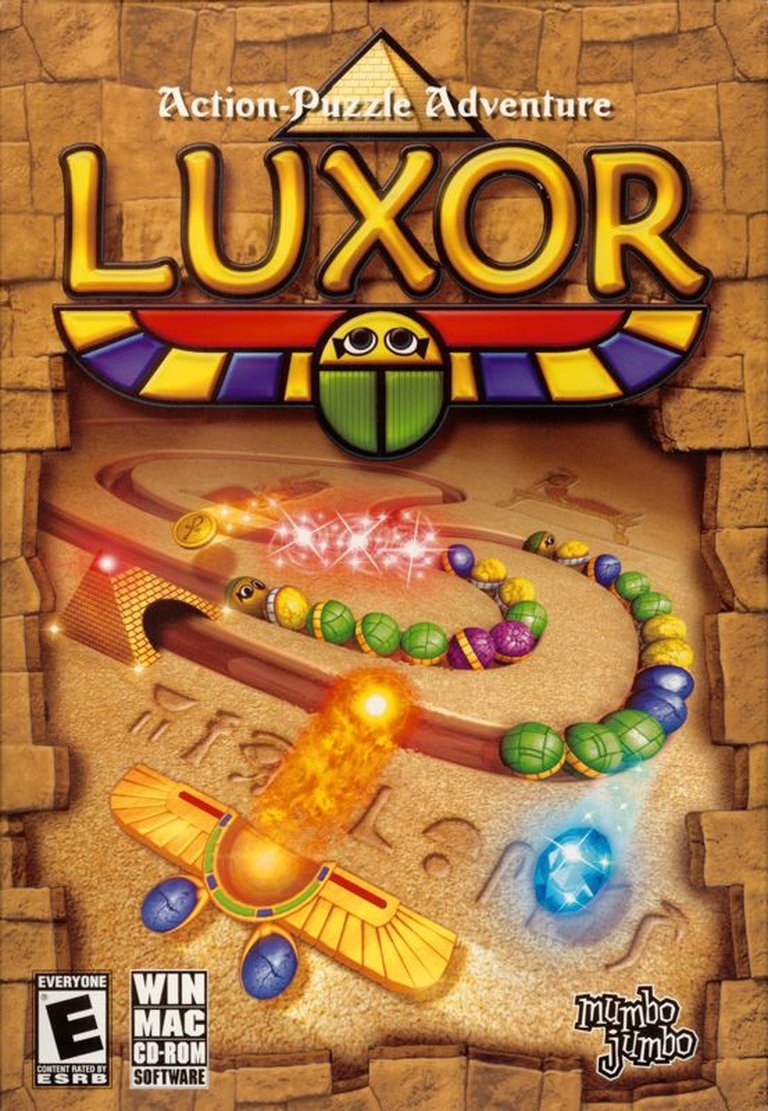
Description
In Luxor, players embark on a journey through ancient Egypt to aid the goddess Isis in her battle against Set. The gameplay revolves around stopping scarab minions from delivering colored spheres to pyramids by shooting matching spheres into their advancing queues. Creating groups of three or more matching spheres eliminates them, destroying the scarab. With 88 levels across 12 stages, the challenge intensifies as multiple pyramids and scarab groups appear simultaneously. Players can use power-ups like fireballs, lightning bolts, and time-slowing effects to overcome obstacles. Failure occurs if any scarab enters a pyramid, costing a life.
Gameplay Videos
Where to Buy Luxor
PC
Luxor Free Download
Luxor Cracks & Fixes
Luxor Mods
Luxor Guides & Walkthroughs
Luxor Reviews & Reception
gamespot.com (71/100): This is a good Zuma clone, but most players will probably prefer the original.
pocketgamer.com : Despite their differing backgrounds, both games are equally accessible, maddeningly addictive and worthy of a place on your mobile.
ign.com (78/100): Adventurers must brave more than 80 levels of fast‑paced puzzle action, destroying chains of rolling colored spheres unleashed by Set’s evil minions.
Luxor Cheats & Codes
Luxor 2 (PC)
Press [Page Up] and [Page Down] at the “Options” menu to enable cheat mode. A new button labeled “Cheats” will appear for the current profile. Once enabled, you can go to Options > Cheats to access the cheats.
| Code | Effect |
|---|---|
| [F3] | Unlimited lives |
| [F4] | Stop Luxors |
| [F5] | One match power-ups |
| [F6] | Permanent Speed Shot |
| [F7] | Permanent Daggers |
| [F8] | Next Ball |
| [F9] | Permanent Lightning Ball |
| [F10] | Permanent Fire Ball |
| [F11] | Permanent Wild Ball |
| [F12] | Color Cloud |
| [End] | Return to normal |
Luxor (PC)
Start the game.exe using following command-line parameters.
| Code | Effect |
|---|---|
| -unlocklevels | Unlock levels in currently unlocked stages |
| -unlockstages | Unlock all stages |
Luxor v1.0.3.32 (PC)
Start the game using a code as the command line parameter (argument).
| Code | Effect |
|---|---|
| -unlocklevels | Unlock All Levels of just the CURRENTLY Unlocked Stages for your selected Profile |
| -unlockstages | Unlock All 13 Stages (starting at Level 1) |
| -unlocklevels -unlockstages | Unlock All 13 Stages and All Sub-Levels |
Luxor (PC)
Start the game with one of the following case-sensitive command line parameters:
| Code | Effect |
|---|---|
| -unlockstages | Unlock all stages |
| -unlocklevels | Unlock levels in currently unlocked stages |
Luxor 3 (PC)
Type this at the store:
| Code | Effect |
|---|---|
| lotsankh | You will get 5000000000 ankh coins. |
Luxor 3 and Quest For The Afterlife (PC)
After the game started, press [Ctrl] + [Shift] + [~] in order to launch the console, then type “Developer true” without the quotation marks.
| Code | Effect |
|---|---|
| upgradepowerup (powerup) | Upgrades the selected powerup. This still affects your Ankh coins. Powerups with spaces (e.g. Lightning Bolt) must have their space removed. |
| givecoins (amount) | Gives the amount of ankh coins. |
| givepowerup (powerup) | Gives a powerup. Powerups with spaces (e.g. Lightning Bolt) must have their space removed. |
| spawnpowerup (powerup) | Spawns the specified powerup. Powerups with spaces (e.g. Lightning Bolt) must have their space removed. |
| setpoweruplevel (powerup) (level) | Sets the powerup level. Powerups with spaces (e.g. Lightning Bolt) must have their space removed. 3 is enough, 4 above won’t work. |
| D | Rescue all spheres in screen |
| F | Spawn Fireball |
| L | Spawn Lightning Bolt |
| P | Show the level’s paths |
| C | Show the winged shooter’s hitbox |
| R | Retry Level |
| N | Skip to next level |
| Scroll Lock | Screen Editing Mode |
| O | Explosion effect test |
| F11 | Show FPS |
| F6 | Turn off all effects |
Luxor 2, Luxor HD, Luxor: Amun Rising HD, Evolved (PC)
Go to Options. Press BOTH [Pg Up] and [Pg Down] at THE SAME TIME to activate cheats. After the dialog appears, accept it.
| Code | Effect |
|---|---|
| Unlock all Levels | Unlock all levels in all modes. Doesn’t affect Adventure if you already have progress. |
| Unlock all Stages | Unlock all stages in all modes. Doesn’t affect Adventure if you already have made progress. |
| Unlock Challenge of Horus / Elite / Insane difficulty | Unlocks the highest locked difficulty available. (Challenge of Horus [Luxor 2], Elite [Evolved], and Insane [Amun Rising HD]. |
| Enable Super Easy Mode | Launches only one sphere. If matched, level will be automatically complete. If the level is a dual-curve, balls of seperate colors will be released (Not in Evolved). Unavailable in Luxor 2 SD. |
| Autoplay | Was intended for a CPU perfect autoplay, but doesn’t work. |
| Time Scale | Sets the time. If the slider is set to the minimum time available, it will; Freeze the loading sequence (2). Freeze the game (Evolved). |
Luxor: The Marble-Shooting Odyssey That Defined a Casual Gaming Era
In the pantheon of early 2000s casual puzzle games, Luxor (2005) emerged as a pharaonic titan—a deceptively simple concept wrapped in shimmering Egyptian mystique. Developed by the now-defunct MumboJumbo, this sphere-matching phenomenon blended addictive mechanics with thematic grandeur, selling 500,000+ copies and spawning a 20-title franchise. Our excavation reveals why this scarab-armed shooter remains a cornerstone of digital Egyptomania.
Development History & Context
The Architect’s Blueprint: Dallas’ Puzzle Revolution
Emerging from Dallas in 2001, MumboJumbo transitioned from developing action titles like Gearz to capitalize on the burgeoning casual market dominated by PopCap’s Bejeweled and Zuma. With a team led by Scott Hansen (design) and Darren Walker (programming), Luxor targeted shareware portals like MSN Games, exploiting low technological barriers—its 2D engine ran smoothly on Pentium III-era PCs. Released as a $20 CD-ROM/download hybrid on April 5, 2005, it leveraged Big Fish Games’ distribution network to reach mid-2000s office PCs and Walmart shelves. The studio’s gamble paid off: within two years, Luxor surpassed 40 million trial downloads, funding sequels and an eventual Ritual Entertainment acquisition.
The Zuma Conundrum
Though mechanically indebted to Mitchell Corporation’s Puzz Loop (1998) and PopCap’s Zuma (2003), Luxor differentiated itself through narrative framing and tactile innovation. Where Zuma starred a static Aztec frog idol, Luxor’s winged scarab shooter maneuvered horizontally, demanding spatial awareness as players darted between dual pyramid threats in later levels. This subtle shift—paired with an upgrade from Zuma’s 60 to 88 levels—forestalled accusations of plagiarism, though critics like GameSpot noted, “New players should start with Zuma’s stone frog.”
Narrative & Thematic Deep Dive
Mythology as Gameplay Motivator
Luxor weaponizes Egyptology. Players serve Isis, goddess of magic, defending her temples from Set—deity of chaos—whose minions march color-coded spheres toward sacred pyramids. Each of the 12 stages (Alexandria to Philae) mythologizes progression: Tanis’ dunes, Karnak’s pillars, and Nile cataracts aren’t backdrops but battlegrounds against entropy. While dialogue-free, the game weaves environmental storytelling: ruined obelisks imply Set’s devastation, while power-ups like the Eye of Horus tie mechanics to lore. This veneer of purpose elevated Luxor above abstract peers—transforming color-matching into divine intervention.
Gameplay Mechanics & Systems
The Alchemy of Addiction
1. Core Loop: Players shoot marbles from a horizontally mobile scarab into advancing chains, forming 3+ color matches to eliminate spheres. Chains split and merge across labyrinthine paths—a hydraulic pressure system where indecision proves fatal.
2. Risk/Reward Architecture: Letting spheres enter a pyramid costs 1 of 5 lives, but clearing entire chains spawns Ankh coins (30 = extra life) and gems worth 1,000-15,000 points. Consecutive matches trigger combo multipliers, rewarding precision over randomness.
3. Power-Up Pantheon:
– Fireballs/Lightning Bolts: Wipe swathes of spheres
– Slow/Stop/Reverse: Temporal manipulation tools
– Wild Ball: Universal color match
– Color Bomb: Erases all spheres of one hue
Flaws in the Sarcophagus
While praised for its “fiendish addiction” (Pocket Gamer), Luxor’s difficulty curve stumbles. Later levels introduce purple (Stage 4), white (Stage 7), and black (Stage 10) spheres—amplifying complexity without tutorials. The progress bar mechanic (fill to advance) occasionally misjudges pacing, and mobile ports suffered from imprecise touch controls. Yet, these quirks underscore its arcade DNA: brutal but fair.
World-Building, Art & Sound
A Digital Thebes
Artist Chad Woyewodzic bathes Luxor in ochres, lapis lazulis, and gilded hieroglyphs, evoking 19th-century Orientalist paintings. Each stage layers parallax-scrolling dunes, lotus pools, and sandstone ruins—fixed-screen but dynamically lit. The shooter’s metallic sheen contrasts with the organic decay of Set’s forces, while FMOD-driven audio by DSonic merges ouds, tablas, and synth choirs into a “perpetually escalating” (MobyGames) soundscape. Danger themes accelerate with encroaching spheres, marrying aesthetic to urgency.
Reception & Legacy
From Critical Praise to Legal Battles
Launch reviews averaged 72% (MobyGames), lauding its “pick-up-and-play brilliance” (MACWORLD) while noting derivativeness. The 2009 Codeminion lawsuit—where MumboJumbo lobbied Apple to remove rival StoneLoops! from the App Store—underscored Luxor’s market dominance. Despite controversies, it birthed sequels (Luxor 2’s dual shooters, Luxor 3’s 3D reflectors), HD reboots, and console ports (Switch/PS4/Xbox One).
Industry Impact
Luxor’s 88-level template became casual gaming’s Rosetta Stone, influencing titles from Peggle to Tumblebugs. Its Egyptian aesthetic persists in App Store algorithms, proving theme transcends mechanics. When MumboJumbo dissolved in 2018, Accelerate Games resurrected the IP—testament to its enduring allure.
Conclusion
The Eternal Obelisk
Nearly two decades later, Luxor remains a masterclass in casual game alchemy—transforming simple inputs (click, match, repeat) into archaeological odysseys. While technologically eclipsed, its fusion of mythic stakes, strategic depth, and sensory opulence secures its legacy as the Tetris of the Nile. For historians, it exemplifies mid-2000s casual gaming’s golden age; for players, it’s eternally “just one more level.”
Final Verdict: A flawed yet foundational pillar of puzzle design—7.5/10.