
- Release Year: 2009
- Platforms: Nintendo 3DS, Nintendo DS, Nintendo DSi, Windows
- Publisher: astragon Software GmbH, iWin, Inc., MSL-INTENIUM BV, Tulip Games
- Developer: iWin, Inc.
- Genre: Puzzle
- Perspective: Side view
- Game Mode: Single-player
- Gameplay: Falling block puzzle, Tile matching puzzle
- Average Score: 35/100
Description
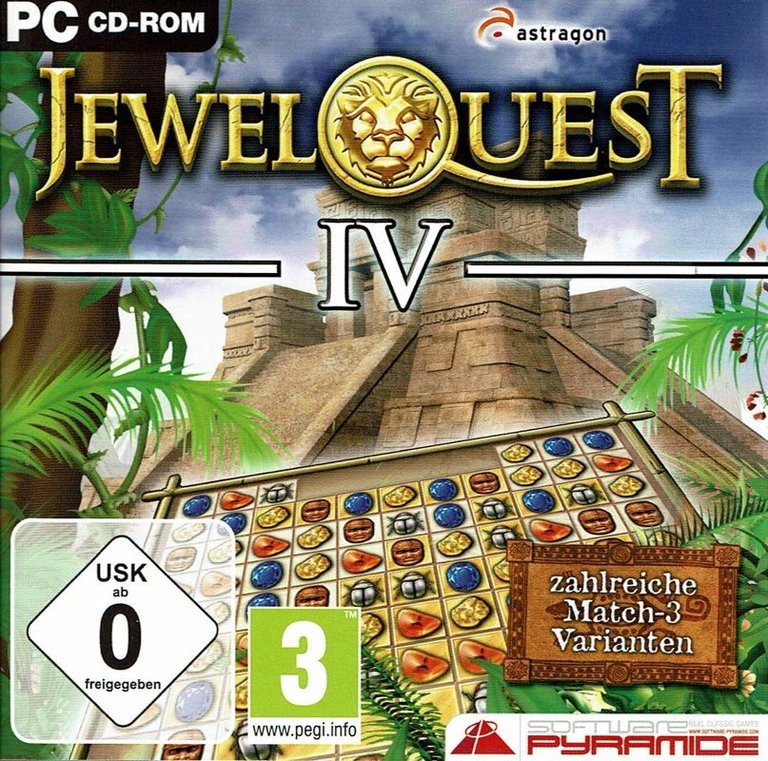
Jewel Quest IV: Heritage is a puzzle game that follows the adventures of Rupert and Emma as they travel the world to collect magical jewels and uncover ancient artifacts. The game features a tile-matching mechanic where players swap adjacent jewels to create matches and clear the board. With a variety of levels and challenges, players must strategically plan their moves to achieve high scores and progress through the game’s story. The setting spans different cultures and historical periods, adding depth to the gameplay experience.
Jewel Quest IV: Heritage Guides & Walkthroughs
Jewel Quest IV: Heritage Reviews & Reception
gamezebo.com : The story is dull and the time limits often seem just a little too severe.
mobygames.com (41/100): Average score: 41% (based on 2 ratings)
eshopperreviews.com : Jewel Quest IV is a Match-3 Puzzle game that’s pretty much just an off-brand version of Bejeweled with some minor gameplay differences and a laughably dumb story.
honestgamers.com (30/100): Average score: 3
Jewel Quest IV: Heritage Cheats & Codes
Nintendo 3DS
| Code | Effect |
|---|---|
| D3000000 00000000 00147834 E2922EFF D2000000 00000000 | Many points per combination |
| D3000000 00000000 00176370 EA000010 D2000000 00000000 | Timer stopped |
Jewel Quest IV: Heritage: Review
Introduction
In the crowded pantheon of match-3 puzzle games, Jewel Quest IV: Heritage (2009) stands as a curious relic—a title caught between the legacy of its predecessors and the seismic shadow of genre titans like Bejeweled. Developed by iWin, Inc., this fourth installment in the Jewel Quest series attempts to marry its jewel-swapping formula with a sprawling family saga, but does it shine bright or crumble under the weight of its ambitions? This review unpacks the game’s history, mechanics, and legacy, arguing that while Heritage delivers functional puzzle-solving, its lack of innovation and narrative depth relegates it to a footnote in match-3 history.
Development History & Context
Studio Vision & Constraints
iWin, Inc., a studio known for casual and puzzle games like Coconut Queen and Mah Jong Quest, sought to expand the Jewel Quest series with Heritage. Warren Schwader (Game and Level Designer) and Joanna Ricco (Story) led a team of 31 contributors, including Art Director Bill Davis and composer Michael Scott. Released initially on Windows in 2009 and later ported to Nintendo DS, DSi, and 3DS, the game emerged during a boom era for match-3 games, with Bejeweled dominating the market.
Technological Landscape
As a budget-friendly title, Heritage leaned on 2D art and pre-rendered cutscenes, avoiding the flashy 3D effects of contemporaries. Its multiplatform release—spanning mobile, PC, and handheld consoles—reflected iWin’s strategy to capitalize on casual gamers across devices. However, the game’s simplistic visuals and lack of hardware-pushing features underscored its niche appeal in an increasingly competitive genre.
Narrative & Thematic Deep Dive
Plot & Characters
Heritage follows Rupert Pack, a museum curator battling his rival Sebastian Grenard over ownership of the mystical Golden Jewel Board. The narrative spans centuries, tracing Rupert’s lineage back to Aztec times via a family tree mechanic. Each ancestor unlocks new puzzle boards, theoretically tying progression to genealogical discovery.
Thematic Execution
While the premise—exploring heritage through puzzles—is novel, the execution falters. Dialogue is stiff and forgettable, with voice-acted cutscenes (a series first) undermined by melodramatic delivery. Characters like archivists and maids serve as narrative wallpaper, offering little beyond exposition. The Aztec lore and ancestral ties feel underbaked, reducing the “heritage” theme to a cosmetic backdrop.
Gameplay Mechanics & Systems
Core Loop & Innovations
The game retains the series’ signature mechanic: matching gems to turn tiles gold, with completion requiring full board coverage. New modes include:
– Limited Jewels: Finite gems force strategic planning.
– Swap Mode: Trade gems without matches, but with move limits.
Flaws & Frustrations
Critics lambasted Heritage for punishing time limits and erratic difficulty spikes. The “auto-Special” power-up—triggered when the game mistakenly detects no remaining moves—often sabotaged player agency. While the 175+ boards and “Expert Mode” post-campaign add longevity, repetitive objectives and rigid design alienated players seeking depth.
World-Building, Art & Sound
Visual Design
The game’s 2D art oscillates between vibrant jewel boards and drab, static cutscenes. Ancestor portraits and European castle backdrops lack detail, rendering the familial journey visually monotonous. Nonetheless, the gem-sparkle animations and gold-transformation effects remain satisfyingly tactile.
Soundscape
Michael Scott’s orchestral soundtrack clashes with the low-stakes gameplay, swerving between melodrama and mundanity. Sound effects—crunching gems, ticking clocks—are serviceable but unremarkable.
Reception & Legacy
Launch Reception
Heritage garnered a meager 42% aggregate score from critics. eShopper Reviews dismissed it as a “laughably dumb” Bejeweled clone, while Gamezebo praised its challenge but panned its “depressingly derivative” structure. Commercial performance was tepid, with VGChartz reporting underwhelming sales.
Long-Term Impact
The game’s legacy is minimal. While its family-tree progression hinted at narrative potential for puzzle games, Heritage failed to inspire successors. Today, it’s remembered (if at all) as a case study in squandered ambition—a title that prioritized quantity (175+ levels) over quality.
Conclusion
Jewel Quest IV: Heritage is a paradox: a game bursting with content yet starved of soul. Its puzzle mechanics are competent but shackled by archaic design choices, while its narrative aspirations crumble under weak writing and pacing. For diehard match-3 fans, it offers a challenging, if repetitive, diversion. For everyone else, it stands as a relic of an era when “more levels” outweighed “better ideas.” In the annals of puzzle history, Heritage is less a jewel and more a cubic zirconia—sparkling faintly, but never brilliantly.
Final Verdict: A functional but forgettable entry in the Jewel Quest saga, overshadowed by its genre peers.