
- Release Year: 2008
- Platforms: Windows
- Publisher: Nobilis Group, SouthPeak Interactive Corporation, Toplitz Productions GmbH, United Independent Entertainment GmbH
- Developer: Enlight Software Ltd.
- Genre: Strategy, Tactics
- Perspective: Diagonal-down
- Game Mode: Single-player
- Gameplay: Business simulation, Managerial
- Setting: Hotel
- Average Score: 54/100
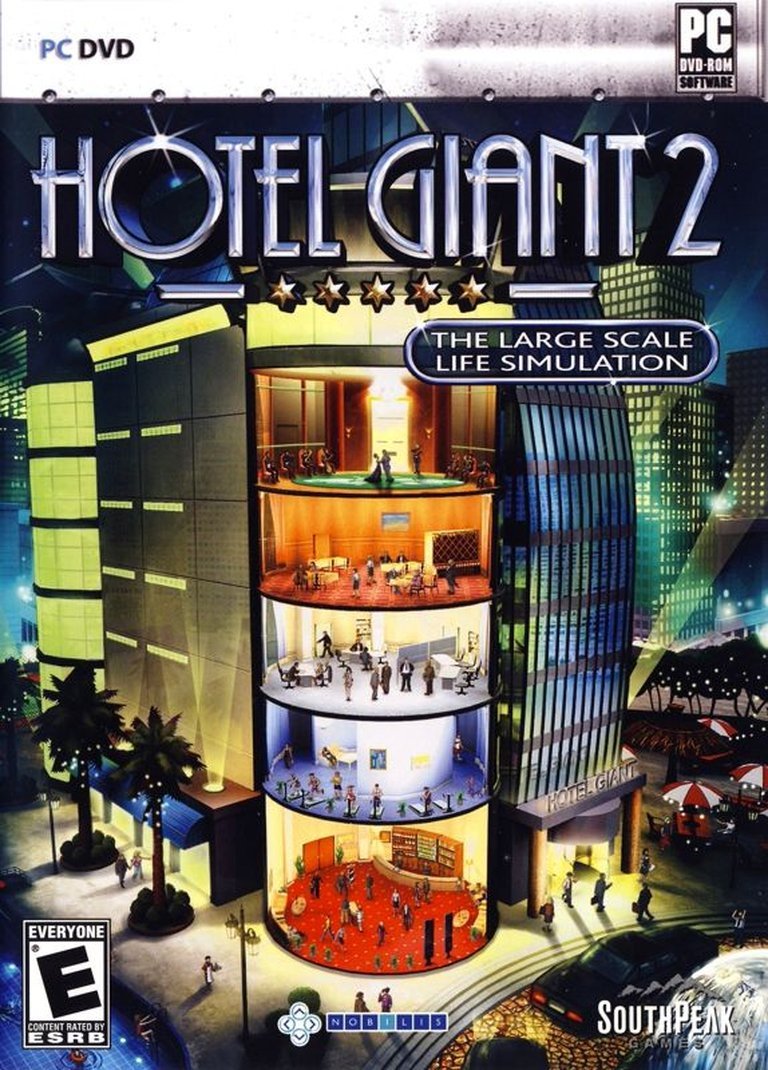
Description
In Hotel Giant 2, players step into the role of a hotel manager, overseeing every aspect of running a hospitality business. The game allows customization with over 1,400 fixtures to design rooms, lobbies, restaurants, and amenities like swimming pools. Players hire and manage staff, attend to guest needs, and adapt to cultural preferences—such as French guests prioritizing gourmet dining or Americans favoring fitness facilities. With real-time gameplay (pausable), three modes—freeplay, sandbox, and goal-oriented campaigns—offer varied challenges across international locations to test managerial skills.
Gameplay Videos
Where to Buy Hotel Giant 2
Hotel Giant 2 Free Download
Hotel Giant 2 Cracks & Fixes
Hotel Giant 2 Patches & Updates
Hotel Giant 2 Guides & Walkthroughs
Hotel Giant 2 Reviews & Reception
metacritic.com (58/100): If you like designing interiors, Hotel Giant 2 will entertain you for hours. Too bad there is nothing else to do but to put overpriced items in rooms.
steambase.io (46/100): Hotel Giant 2 has earned a Player Score of 46 / 100.
gamespot.com (60/100): Big-time micromanagement awaits those who check in to Hotel Giant 2.
vg-reloaded.com : Hotel Giant 2 isn’t the greatest simulation, but it does the job well.
Hotel Giant 2 Cheats & Codes
Hotel Giant 2 PC
At the main menu type “frontoffice” to enable cheat mode, then use the following commands during gameplay.
| Code | Effect |
|---|---|
| ALT + E | $10,000,000 more |
| ALT + D | $1,000,000 more |
| ALT + A | $1,000,000 more |
| ALT + S | $1,000,000 less |
| ALT + W | $10,000,000 less |
| ALT + O | Extra furniture (all items become unlocked) |
| ALT + G | 10 visitors in your hotel |
Hotel Giant 2: Review
Introduction
In the bustling ecosystem of early 2000s managerial simulations, Hotel Giant 2 arrived in 2008 as a belated sequel to its million-selling predecessor, promising deeper customization and global hospitality mastery. Yet, six years after the original, this title provoked a critical shrug—a game caught between its ambition to simulate the granular intricacies of hotel management and its failure to evolve beyond the foundations of 2002. As both a relic of mid-2000s business sim design and a case study in squandered potential, Hotel Giant 2 stands as a paradox: a game that delights micromanagement diehards with its exhaustive systems but drowns casual players in relentless tedium. This review unpacks its legacy, examining how a sequel with such scope became a footnote rather than a landmark.
Development History & Context
Developed by Hong Kong-based Enlight Software—a studio known for eclectic strategy titles like Restaurant Empire II—Hotel Giant 2 emerged in a late-2000s gaming landscape dominated by The Sims and SimCity. Producer Trevor Chan envisioned a hotel management simulator that blended SimCity’s macro-strategy with The Sims’ intimate domesticity, all underpinned by a 3D engine supporting day-night cycles and dynamic guest behaviors.
Technologically, the game targeted modest hardware for 2008: a 1.5 GHz CPU, 512 MB RAM, and DirectX 9-compatible GPUs. These constraints yielded a functional but dated aesthetic, with low-poly models and quasi-isometric camera angles reminiscent of early 2000s titles. Despite a six-year gap from the original, critics noted the sequel felt iterative—jetissoning innovations from contemporaries like RollerCoaster Tycoon 3’s physics-driven sandbox for rigid, spreadsheet-like micromanagement. The result was a game out of step with a genre increasingly prioritizing accessibility and emergent storytelling.
Narrative & Thematic Deep Dive
Hotel Giant 2 eschews traditional narrative in favor of systemic storytelling through its guests and environments. Thematically, it explores globalized capitalism and cultural anthropology, tasking players with managing hotels across 26 locations—from Los Angeles to Munich—each with region-specific guest preferences. French patrons demand haute cuisine; Americans crave fitness centers. These stereotypes, while reductive, superficially reflect real-world hospitality trends.
Yet the game’s “characters”—guests reduced to walking complaint generators—lack depth. They exist solely to voice grievances (e.g., dim lobby lighting, undersized pools) without personalities or narrative arcs. Dialogue cycles through repetitive, utilitarian prompts: “I want a phone in the lobby!” or “Your budget rooms are appalling!” This transforms guests into lifeless data points, undermining any sense of a vibrant hotel community. The absence of staff narratives (maids, chefs, etc.) further saps humanity from the experience, reducing management to cold metrics like “Customer Satisfaction %” rather than human connections.
Gameplay Mechanics & Systems
At its core, Hotel Giant 2 revolves around three pillars: construction, staff management, and guest satisfaction.
-
Construction & Customization
Players design every room using 1,400+ decor items, from urinal styles to bedframe tiers. A templating system lets users clone optimized rooms, a time-saver for sprawling hotels. However, placement logic feels archaic: objects snap to rigid grids, and the UI fights creativity (e.g., refusing to place mirrors in “incompatible” bathrooms). -
Staff & Economy
Hiring employees—cleaners, receptionists—requires balancing salaries against skill levels. Training programs improve efficiency, but staff lack autonomy, forcing players to manually resolve every fender-bender (e.g., a backlog of dirty dishes). The financial model is bizarrely lenient; as HonestGamers noted, “losing money by the barrel load doesn’t seem to affect the game.” -
Guest Management
Guests bombard players with demands via a radial complaint system. Satisfying these boosts hotel ratings (up to 5 stars), but the system feels punitive. GameSpot critiqued the “sheer weight of what you’re called upon to manage,” from fine-tuning restaurant menus to adding arcade cabinets to game rooms. A “Cheat Card” mechanic allows nudging guests toward activities, yet this band-aid fails to alleviate the grind.
The campaign mode tasks players with renovating pre-built hotels, but objectives are buried in menus, and the tutorial—“woefully inept,” per HonestGamers—leaves newcomers adrift. Real-time hours crawl during low-occupancy periods, exacerbated by the inability to speed time meaningfully.
World-Building, Art & Sound
Hotel Giant 2’s global locales are visually distinct but thematically shallow. Parisian hotels feature wrought-iron balconies; L.A. properties lean into Art Deco glitz. Yet these settings lack cultural texture beyond surface-level props. The 3D engine, while a leap from the original’s 2D sprites, renders guests as doll-like figures with stiff animations, sapping the world of vitality.
Art direction oscillates between utilitarian and kitschy. Decor items exhibit a “vergibter DDR-Charme” (yellowed East German charm), as 4Players.de quipped—functional but visually drab. The soundtrack, a looped Muzak-esque instrumental, grows grating within minutes. Sound design is purely utilitarian: clinking silverware, muffled footsteps, and the incessant chirp of complaint notifications.
Reception & Legacy
At launch, Hotel Giant 2 earned a lukewarm 58% Metascore. Critics praised its depth but lambasted its repetitiveness and tech shortcomings:
– Positive: GameCaptain hailed its “solid simulation fundamentals” (72/100), while VG-Reloaded lauded the “1,400+ items for hotel customization.”
– Negative: Gameswelt condemned its “Sisyphean busywork” (65/100), and Gamekult dismissed it as “un jeu d’un autre âge” (3/10).
Commercially, it found a niche audience among managerial sim devotees but faded quickly. Its legacy is one of caution: a sequel that “changed little but the graphics” (Onlinewelten.de) in an era when studios like Maxis redefined player agency. While modding efforts persist on GOG, the game’s influence is negligible—overshadowed by tycoon titans like Two Point Hospital and Planet Coaster.
Conclusion
Hotel Giant 2 is a simulation caught in amber. Its granular customization and template-based room design cater to spreadsheet-loving strategists, yet its refusal to innovate—coupled with tedious micromanagement and technical clunkiness—renders it a relic. For genre historians, it offers a fascinating look at mid-2000s design philosophies: ambitious in scope but shackled by dated mechanics. For modern players, it remains a curiosity—a hotel management sim where the elevators stick, the guests never smile, and the real challenge isn’t earning five stars, but staying awake. 5/10: A niche title for the devout, but no vacation for the rest.