
- Release Year: 2003
- Platforms: Windows
- Publisher: Mis Ladrillos
- Developer: NGD Studios
- Genre: Action, Driving, Racing
- Perspective: Top-down
- Game Mode: Hotseat, Single-player
- Gameplay: Arcade, Building, Helicopter, Puzzle elements, Shooter, Tutorials, Vehicular
- Average Score: 63/100
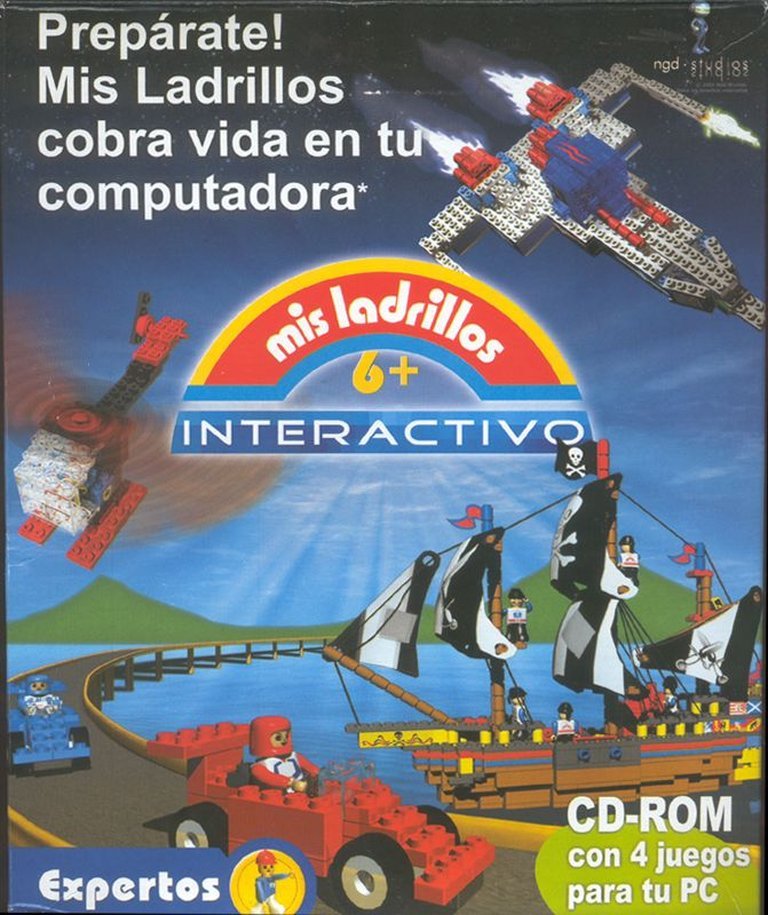
Description
Mis Ladrillos Interactivo is a collection of four distinct games released in 2003, each offering unique settings and gameplay mechanics. Players, primarily kids, face challenges both within the game and in real life, building vehicles and structures using the ‘Mis Ladrillos’ building blocks. The game also includes interactive tutorials featuring over 105 minutes of pre-rendered animations, enhancing the educational and creative aspects of the experience.
Gameplay Videos
Mis Ladrillos Interactivo Reviews & Reception
retro-replay.com : Mis Ladrillos Interactivo offers a unique blend of digital challenges and hands‑on creativity, inviting players to switch between on‑screen missions and real‑life building projects.
Mis Ladrillos Interactivo: Review
Introduction
In an era where digital and physical play often exist in separate realms, Mis Ladrillos Interactivo (2003) dared to merge the two. Developed by Argentina’s NGD Studios and published by toy company Mis Ladrillos, this innovative title combined four arcade-style mini-games with a real-world building block set, aiming to cultivate creativity and problem-solving in young players. While overlooked by mainstream critics, the game represents a fascinating experiment in early 2000s edutainment—one that balanced digital engagement with tactile learning. This review argues that Mis Ladrillos Interactivo, despite its niche status, deserves recognition for its ambitious blending of virtual and physical play, offering a template for later hybrids like LEGO Dimensions.
Development History & Context
Studio Origins & Vision
NGD Studios emerged in Buenos Aires circa 2002 as a fusion of three Argentine development teams. Founded by veterans like Andrés Chilkowski and Juan Linietsky, the studio initially focused on licensed toy adaptations, including Mis Ladrillos—a LEGO-like construction system. Their goal was to create a game that transcended mere marketing: a “digital playground” where on-screen achievements sparked real-world creativity.
Technological Constraints
The early 2000s posed significant challenges for Argentine devs. With limited access to cutting-edge tools, NGD relied on pragmatic solutions. The game’s engine prioritized stability over graphical flair, targeting low-spec PCs (Pentium II, 64MB RAM) common in Latin American households. Pre-rendered animations and a top-down perspective minimized processing demands, while the inclusion of a CD-ROM ensured compatibility with slower optical drives.
Gaming Landscape
At launch, Mis Ladrillos Interactivo entered a market saturated with standalone edutainment titles (Reader Rabbit, Pajama Sam) and toy-based games (LEGO Racers). However, its dual digital-physical model set it apart. By bundling actual building blocks, NGD offered a tangible value proposition—a rarity in an era when “collector’s editions” were still nascent.
Narrative & Thematic Deep Dive
Mini-Game Stories
Each of the four mini-games features a lightweight narrative framing device:
1. Futuristic City: A robot enlists players to rebuild crumbling hover-bridges.
2. Jungle Ruins: An explorer needs watchtowers to deflect rolling boulders.
3. Medieval Fortress: Knights request siege engines to defend their castle.
4. Space Station: Astronauts struggle to repair zero-gravity docking bays.
While simplistic, these scenarios serve a pedagogical purpose. Dialogue (delivered via text boxes) emphasizes cooperation, resilience, and logical thinking. Completing a level unlocks “blueprint challenges,” urging kids to reconstruct their in-game solutions with physical blocks—a clever narrative-device-meets-marketing-tactic.
Themes
The game subtly reinforces STEM concepts: spatial reasoning (via tower construction), basic physics (counterweight puzzles), and iterative design (trial-and-error vehicle builds). Its themes of “repairing” and “rebuilding” mirror Argentina’s post-2001 economic crisis, subtly echoing national resilience narratives.
Gameplay Mechanics & Systems
Core Loop
Players cycle through four genres:
– Top-down racing: Navigate obstacle courses with block-built vehicles.
– Puzzle-solving: Assemble bridges and towers under time limits.
– Helicopter sim: Maneuver cargo lifts in zero-G environments.
– Arcade shooter: Defend structures from enemy projectiles.
Success earns “Golden Bricks,” unlocking bonus stages and advanced blueprints.
Physical Integration
The included Mis Ladrillos set (similar to LEGO) ties directly to gameplay. After virtual missions, animations pause to showcase step-by-step building tutorials. This seamless transition—from screen to tabletop—encourages hands-on experimentation. However, the physical pieces’ quality reportedly varied, with some users noting durability issues.
Flaws
– Repetition: Mini-games lack depth, favoring quantity over polish.
– Control Clunkiness: Helicopter segments suffer from imprecise mouse controls.
– Localization Gaps: Spanish-only text limited its global appeal.
World-Building, Art & Sound
Visual Design
NGD adopted a bright, cartoonish aesthetic tailored to young audiences. Each setting bursts with distinct palettes: neon futurism contrasts with earthy ruins, while chunky, exaggerated structures mirror the blocky Mis Ladrillos pieces. Pre-rendered cutscenes blend seamlessly with gameplay, maintaining visual consistency.
Sound Design
Juan Linietsky’s soundtrack mixes upbeat synth melodies (for racing) and tense ambient loops (for puzzles). Sound effects—clicks, clacks, and engine rumbles—mimic the tactile feedback of physical blocks, reinforcing the game’s hybrid identity.
Reception & Legacy
Launch Reception
The game flew under critics’ radars, with no professional reviews archived. User ratings (3.6/5 on MobyGames) praise its creativity but cite technical limitations. Retrospective analyses, like Retro Replay’s 2023 review, highlight its “innovative edutainment DNA.”
Long-Term Influence
While not a commercial hit, Mis Ladrillos Interactivo foreshadowed trends like:
– Toys-to-life: Later popularized by Skylanders (2011).
– Maker culture: Games encouraging real-world creation (Minecraft’s educational mode).
– Argentine gamedev: Paved the way for NGD’s later hits (Regnum Online).
Conclusion
Mis Ladrillos Interactivo is a time capsule of early 2000s ambition—a game that dared to ask, “What if screens and blocks weren’t rivals?” Though hampered by budget constraints and simplistic design, its core idea remains compelling. For historians, it offers a glimpse into Argentina’s gaming renaissance; for players, it’s a charming relic of when “interactive” meant more than just button presses. While not a masterpiece, it earns its place as a curious, heartfelt hybrid—one that deserves a footnote in the annals of edutainment.
Final Verdict: A flawed but fascinating experiment, best appreciated as a curio for collectors of obscure kidware and Latin American game history.