
- Release Year: 2004
- Platforms: Windows
- Publisher: Halycon Media GmbH & Co. KG
- Developer: Digital Steelworks Inc.
- Genre: Simulation
- Perspective: 1st-person
- Game Mode: Single-player
- Gameplay: City building, construction simulation
Description
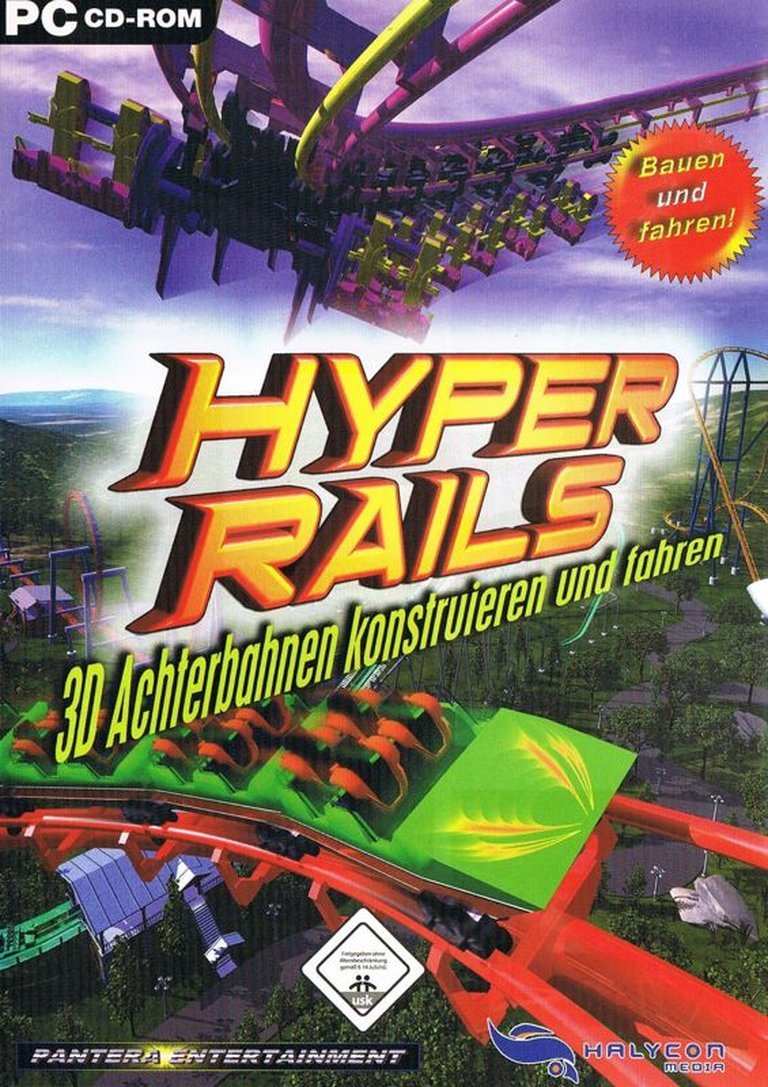
Hyper Rails is a simulation game where players design and construct custom roller coasters using six different coaster types and a variety of elements. The game allows immediate testing of creations and offers online sharing features to trade and experience other players’ designs. Set in a flexible 1st or 3rd-person perspective, it combines city-building elements with hands-on roller coaster experimentation, though criticized for its dated graphics and sound.
Hyper Rails Free Download
Hyper Rails Cracks & Fixes
Hyper Rails Patches & Updates
Hyper Rails: Review
A Cautionary Tale of Ambition and Technical Catastrophe in Early 2000s Simulation Gaming
Introduction
In the golden age of theme park simulators, where RollerCoaster Tycoon reigned supreme, Hyper Rails (2004) arrived as a quixotic experiment—a game with flashes of creative potential buried beneath catastrophic technical failings. This Windows-exclusive coaster constructor, developed by the obscure Digital Steelworks Inc., promised freedom to build “your personal roller coaster” with internet-enabled sharing. Yet, as this review will argue, Hyper Rails serves less as a tribute to player creativity and more as a relic of unrealized vision, exposing how poor execution can undermine even the most enticing premise.
Development History & Context
Studio and Vision
Digital Steelworks Inc., a studio with no discernible pedigree before or after Hyper Rails, pitched the game as a hyper-focused coaster design toolkit. Their goal? To streamline the Tycoon formula into a pure construction sandbox, unburdened by management mechanics. In theory, this narrowed scope would empower players to iterate rapidly on coaster designs—a vision undercut by the studio’s inexperience and the game’s budgetary constraints.
Technological and Industry Landscape
Released in 2004, Hyper Rails entered a market dominated by Chris Sawyer’s RollerCoaster Tycoon 3—a titan renowned for its polished physics, vibrant aesthetics, and robust simulation systems. While indie studios like Digital Steelworks lacked Frontier Developments’ resources, Hyper Rails faced an uphill battle against player expectations. The game’s CD-ROM distribution and rudimentary 3D rendering engine (likely cobbled from pre-existing middleware) cemented its status as a budget title, incapable of competing with contemporaries’ technical flourishes.
Narrative & Thematic Deep Dive
A Vacuum of Story
Hyper Rails possesses no narrative framework—no park tycoon persona, no career mode, no fictional backstory for its “six different types” of coasters. Players are thrust into an anonymous void, left to assemble tracks with minimal context. This absence of thematic scaffolding reduces the experience to a sterile engineering exercise, devoid of the whimsy or charm endemic to genre leaders.
Thematic Implications: Freedom vs. Futility
Beneath its mechanical surface, Hyper Rails inadvertently explores a poignant meta-theme: creative ambition colliding with technical inadequacy. The game’s promise of unfettered construction (“build your personal roller coaster”) clashes with its glitch-ridden reality, mirroring Digital Steelworks’ own struggle to realize their vision. Each snapped rail or physics-defying loop becomes a metaphor for artistic aspiration stifled by limited tools—a theme far more compelling than anything the developers intentionally designed.
Gameplay Mechanics & Systems
Core Loop: Construction Without Consequence
The gameplay loop revolves around three pillars:
1. Piecemeal Assembly: Players connect pre-fabricated track elements (curves, loops, drops) across a flat terrain grid.
2. Instant Testing: Clicking a “test” button spawns a coaster car for a first- or third-person ride.
3. Online Sharing: Designs can be uploaded to a now-defunct server network.
This framework, while functional in theory, collapses under systemic flaws:
– Physics Anarchy: Coasters phase through terrain or defy gravity without penalty.
– Collision Detachment: As PC Action noted, tracks could “intersect or burrow into the ground” with no mechanical repercussions.
– Lack of Metrics: No speed, G-force, or rider satisfaction data exists to inform designs.
Interface: Clunky and Opaque
The UI—a maze of unlabeled icons and context-free menus—fails to guide new players. Rotating track segments feels akin to wrestling with CAD software, exacerbated by camera controls that frequently obscure sightlines. The absence of undo/redo functionality amplifies frustrations.
Innovation or Insanity?
Hyper Rails’ sole innovation—directly riding creations in 3D—was novel for 2004 but executed with such technical ineptitude (jerky animations, texture pop-in) that it produced motion sickness more often than thrill.
World-Building, Art & Sound
Visual Direction: A Study in Austerity
The game’s aesthetic can best be described as early PS1-era minimalism: blocky, low-poly coasters traverse barren landscapes devoid of foliage, buildings, or atmosphere. Textures blur under scrutiny, while lighting effects resemble flat color fills. Coaster cars lack detail, appearing as featureless capsules—a far cry from Tycoon’s charmingly animated peeps.
Sound Design: The Void Screams Back
PC Action’s review brutally summarized the audio: “Where is the sound? At first, we thought the scratches were a sound card test.” Beyond faint track rumbles and mechanical whines, Hyper Rails operates in near-silence. No ambient park noises, no rider screams, no UI feedback clicks—an eerie vacancy that drains excitement from the experience.
Reception & Legacy
Critical and Commercial Collapse
With a 43% score from PC Action (its only recorded review) and no documented sales figures, Hyper Rails vanished from public consciousness upon release. Critics lambasted its “abhorrent graphics” and “nonexistent physics,” while players ignored its existence entirely—a stark contrast to RollerCoaster Tycoon 3’s 84 Metascore and multi-million sales that same year.
Industry Impact: A Footnote of Failure
Hyper Rails left no measurable legacy. Its online sharing feature, though ahead of its time, was crippled by instability. Subsequent coaster sims (Planet Coaster, Parkitect) learned precisely what not to do from its failings: prioritizing usability, visual polish, and systemic depth over hollow “creative freedom.”
Conclusion
Hyper Rails is gaming’s equivalent of a geological curiosity—a fossilized relic of unrealized dreams. Its attempt to democratize coaster design dissolved into a janky, joyless tech demo, exposing Digital Steelworks’ lack of resources and technical acumen. While the game’s underlying premise (a pure construction sandbox) retains conceptual merit, its execution remains a masterclass in how not to build a simulator. For historians, it offers a cautionary artifact; for players, it serves only as a reminder that “freedom” means little without frictionless tools to wield it. Hyper Rails isn’t merely bad—it’s tragic, a coaster that never crested its first hill.