
- Release Year: 1999
- Platforms: DOS, Windows
- Publisher: Novitas GmbH
- Genre: Compilation
- Gameplay: Action Racing, Combat Robot Simulation, Pinball Simulation, Tactical
- Average Score: 83/100
Description
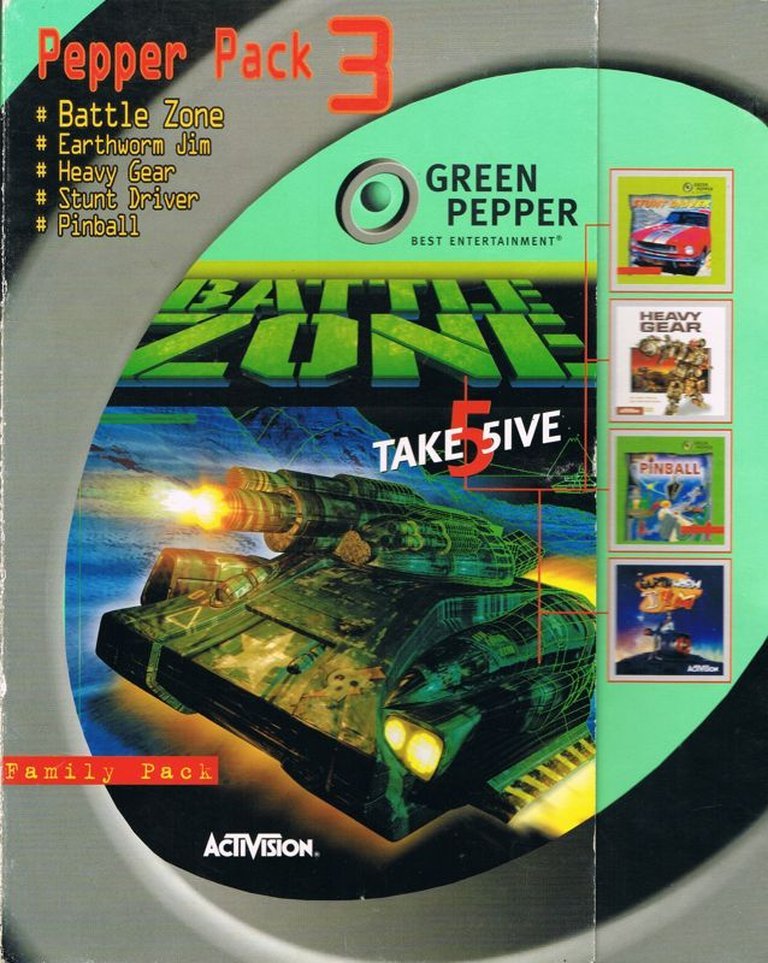
Pepper Pack 3 is the third installment in the Pepper Pack series by Novitas, released in November 1999. This compilation features a diverse selection of five games, including the action-packed Battlezone, the beloved platformer Earthworm Jim, the tactical robot simulation Heavy Gear, the pinball game Pinball: Full-Tilt Fun!, and the classic racing game Stunt Driver. The collection offers a mix of genres and gameplay styles, making it a nostalgic and entertaining package for gamers.
Pepper Pack 3 Reviews & Reception
mobygames.com (87/100): Average score: 87% (based on 2 ratings)
sockscap64.com (80/100): Editor Rating: 8.0
Pepper Pack 3 Cheats & Codes
PC (Battlezone 1998)
| Code | Effect |
|---|---|
| bzview | Easy Link |
| bzradar | Full Map |
| bztnt | Infinite Ammo |
| bzfree | Infinite Pilots |
| bzbody | Infinite Shields |
| iamadirtycheater | Level Select |
PC (Earthworm Jim)
| Code | Effect |
|---|---|
| ITSAWONDERFUL | +1 life |
| POPQUIZHOTSHOT | +1000 ammo |
| BLOATED | Afro Jim |
| SLUGFORABUTT | Arrow head Jim |
| PUSFILLED | Bug Jim |
| IDDQD | Credits 1 |
| IDKFA | Credits 2 |
| SLAUGHTERHOUSE | First 5 levels in file menu |
| MALFORMED | Four-eyes Jim |
| noble | full energy |
| PULSATING | Groucho Jim |
| apollo13 | homingmissle |
| ONANDONANDON | infinite continues |
| getthecheesetosickbay | Level Select |
| SWEATY | Lips Jim |
| threemileisland | max life and energy |
| HATMAN | Pitfall Jim |
| FESTERING | Red Jim |
| framerate: | shows the framerate |
| trustnoone | suicide |
Pepper Pack 3: A Time Capsule of ’90s Gaming – Review
Introduction
Pepper Pack 3, the third installment in Novitas GmbH’s compilation series, is a fascinating artifact of late-’90s PC gaming. Released in November 1999, this collection bundles five disparate titles—Battlezone (1998), Earthworm Jim (1994), Heavy Gear (1997), Pinball: Full-Tilt Fun! (1999), and Stunt Driver (1990)—into a single CD-ROM. While its value hinges on nostalgia and the enduring appeal of its standout titles, the compilation’s uneven quality reflects the experimental nature of game bundles in an era before digital storefronts. This review dissects Pepper Pack 3’s legacy, mechanics, and cultural footprint, arguing that its strengths lie in its ability to preserve (and occasionally elevate) a slice of gaming history.
Development History & Context
Studio and Vision
Novitas GmbH, a German publisher known for budget-friendly compilations, curated Pepper Pack 3 during a transitional period for PC gaming. The late ’90s saw rapid technological advancements, with 3D acceleration and CD-ROM storage reshaping player expectations. Novitas aimed to capitalize on both nostalgia and innovation, pairing older arcade-style games (Earthworm Jim, Stunt Driver) with newer titles leveraging 3D graphics (Battlezone, Heavy Gear).
Technological Constraints
The compilation’s technical demands reflect the era’s limitations. Battlezone (1998), a hybrid of RTS and vehicular combat, required a Pentium-class CPU, while Pinball: Full-Tilt Fun!’s simple 2D physics ran smoothly on modest hardware. Notably, Stunt Driver—a 1990 release—felt archaic by comparison, highlighting the decade’s rapid evolution.
Gaming Landscape
In 1999, compilations served as gateways for players exploring older titles or experimenting with new genres. Pepper Pack 3 arrived alongside franchises like Microsoft Arcade and Capcom Classics, but its eclectic mix of action, strategy, and simulation lacked a cohesive identity. Critics praised its ambition but questioned its target audience: was this a nostalgia trip for retro fans or a sampler for newcomers?
Narrative & Thematic Deep Dive
Earthworm Jim (1994): Cartoon Absurdity
The compilation’s crown jewel, Earthworm Jim, delivers a hilariously nonsensical plot: a worm named Jim gains superpowers from a cyber-suit and battles interstellar foes like Psy-Crow and Queen Slug-for-a-Butt. Its dialogue brims with slapstick humor and fourth-wall-breaking quips (“Groovy!”), while themes of unlikely heroism and cosmic absurdity resonate through its surreal levels (e.g., “What the Heck?”—a hellish realm ruled by Evil the Cat).
Battlezone (1998): Cold War Sci-Fi
A stark contrast, Battlezone reimagines the 1980 arcade classic as a gritty tactical shooter. Players command hover tanks in a secret lunar conflict between the NSDF and Soviet CCA, blending resource management with real-time combat. Its narrative, delivered through mission briefings and eerie radio chatter, evokes The X-Files paranoia, with hints of alien conspiracies.
Heavy Gear (1997): Mecha Militarism
Set in a dystopian future, Heavy Gear drops players into pilotable mechs (Gears) embroiled in planetary warfare. Its story explores class divides and colonial exploitation, though its execution is overshadowed by repetitive mission design.
Pinball and Stunt Driver: Simplicity Reigns
Pinball: Full-Tilt Fun! and Stunt Driver lack narrative depth, relying on arcade-style immediacy. The former offers straightforward pinball physics, while the latter—a rudimentary racing game—feels outclassed by contemporaries like Need for Speed.
Gameplay Mechanics & Systems
Earthworm Jim: Precision Platforming
Jim’s arsenal—a plasma blaster, head whip, and helicopter hover—demands precision. Levels like “New Junk City” combine platforming with Metroidvania-esque exploration, while boss fights (e.g., Chuck the Garbage Can Man) emphasize pattern recognition. The GBA port’s control quirks (e.g., delayed whip inputs) mar the experience slightly, but its core loop remains satisfying.
Battlezone: Strategic Hybridity
Ahead of its time, Battlezone merges base-building, resource scavenging, and vehicular combat. Players juggle constructing turrets, managing AI allies, and executing flanking maneuvers in tanks or walkers. Its difficulty spikes—particularly in later missions—reward patience and strategic foresight.
Heavy Gear: Clunky Mecha Mayhem
Despite its ambitious premise, Heavy Gear suffers from cumbersome controls and repetitive objectives. Customizing Gears with weapons like Splinter Mortars adds depth, but sluggish movement and AI pathfinding undermine its potential.
Pinball and Stunt Driver: Retro Simplicity
Pinball’s physics feel serviceable but uninspired, while Stunt Driver’s blocky visuals and stiff handling reflect its 1990 origins. Both titles lack the polish of their standalone contemporaries.
World-Building, Art & Sound
Earthworm Jim: Acid-Trip Aesthetics
Earthworm Jim’s cartoonish art direction—think grotesque character designs and neon-drenched backdrops—holds up remarkably. Tracks like “What the Heck?” juxtapose orchestral bombast with elevator muzak, amplifying the absurdity.
Battlezone: Sterile Sci-Fi
The game’s lunar landscapes and angular UI evoke a proto-Halo aesthetic, while its ambient soundtrack—all eerie synths and radio static—heightens the isolation of space warfare.
Heavy Gear: Industrial Grunge
Rust-colored deserts and clanking mech animations reinforce its dystopian tone, though low-resolution textures date the experience.
Pinball and Stunt Driver: Functional but Dated
Neither game excels visually or sonically, though Pinball’s table designs offer fleeting charm.
Reception & Legacy
Critical Reception
Pepper Pack 3 earned an 87% average from critics, per MobyGames. PC Games Germany lauded its “action-rich and tactically demanding” titles (Heavy Gear, Battlezone) while dismissing Stunt Driver as “nostalgic at best.” GameStar Germany (74%) echoed this, calling it a “mixed bag” saved by its highlights.
Cultural Impact
While the compilation itself faded into obscurity, Earthworm Jim and Battlezone endure as cult classics. The former spawned sequels and merchandise; the latter influenced hybrid strategy games like Sacrifice (2000).
Industry Influence
Pepper Pack 3 exemplifies the fleeting trend of budget compilations—a concept later supplanted by digital storefronts like Steam. Its uneven curation also underscores the risks of repackaging disparate titles without cohesive vision.
Conclusion
Pepper Pack 3 is a paradoxical time capsule: flawed yet fascinating, dated yet enduring. Its value lies not in uniformity but in its preservation of Earthworm Jim’s anarchic charm and Battlezone’s innovative hybrid gameplay. While Heavy Gear, Pinball, and Stunt Driver drag down the package, the compilation remains a worthy curio for retro enthusiasts and a testament to the ’90s’ experimental spirit. In an age of remasters and retrospectives, Pepper Pack 3 reminds us that even uneven bundles can harbor hidden gems.
Final Verdict: A B-tier compilation with A-tier nostalgia—best enjoyed by those willing to excavate its highs and forgive its lows.