
- Release Year: 2002
- Platforms: Windows
- Publisher: Activision Publishing, Inc., Activision Value Publishing, Inc.
- Developer: FUN Labs Romania S.R.L.
- Genre: Action, Shooter
- Perspective: 1st-person
- Game Mode: Single-player
- Gameplay: Direct control
- Setting: Cyberpunk, dark sci-fi, Futuristic, Sci-fi
Description
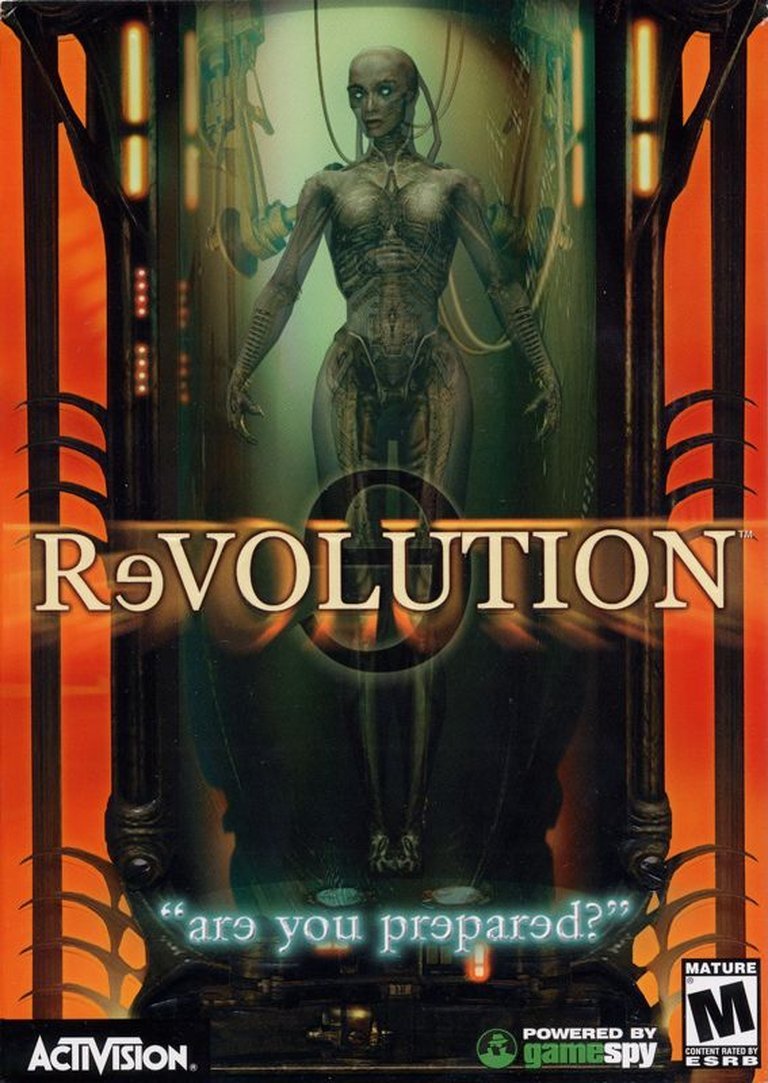
ReVOLUTION is a futuristic first-person shooter set in a dystopian cyberpunk world dominated by ‘The Corporation,’ a mega-corporation controlling every aspect of society. Players begin as a lowly janitor within the organization, only to uncover its sinister agenda and join ‘The Resistance’ to fight back. Featuring dark sci-fi settings and intense combat, the game combines corporate espionage with rebellion in a gritty, dystopian narrative.
Gameplay Videos
Where to Buy ReVOLUTION
PC
ReVOLUTION Cracks & Fixes
ReVOLUTION Patches & Updates
ReVOLUTION Reviews & Reception
gamespot.com : It’s hard to imagine that anyone would deliberately release the game as it is–in fact, it’s easier to imagine that the game somehow escaped from Fun Labs on its own and clawed its way onto store shelves.
ReVOLUTION Cheats & Codes
PC
Start the game with the -cheats -funlabs command line parameter to enable cheat mode. Then, press ~ during game play to display the console window. Note: There is a space before and after the equals sign ‘=’ when it appears in a code.
| Code | Effect |
|---|---|
| godMode = <0 or 1> | God Mode |
| noClip = <0 or 1> | No Clipping |
| give health | Add Health |
| give weapons | Add Weapons |
| aiDisableThink = <0 or 1> | Disable AI Thinking |
| aiDisableAct = <0 or 1> | Disable AI Acting |
| revNextSpawn | Jump to Next Spawn Point |
| spMapList | List Maps |
| help | List All Commands |
ReVOLUTION: Review
A Haunting Case Study of Ambition Undone by Execution
Introduction
Buried beneath the industrial sludge of 2002’s deluge of first-person shooters, ReVOLUTION emerged not as a rallying cry for innovation but as a cautionary tale of unrealized potential. Developed by Romanian studio FUN Labs—better known for Cabela’s Big Game Hunter spin-offs—and published under Activision’s budget label, ReVOLUTION promised a cyberpunk odyssey pitting a lowly janitor against a soul-crushing mega-corporation. Instead, it became a grim artifact of the era’s “Eurojank” experimentation: a title whose Blade Runner aspirations collapsed under clunky mechanics, baffling design choices, and a legacy of infamy among critics. This review dissects ReVOLUTION not merely as a failure but as a fascinating cultural touchstone—a broken mirror reflecting the pitfalls of late-90s FPS ambition colliding with post-Communist development realities.
Development History & Context
In the shadow of giants like Half-Life (1998) and Deus Ex (2000), ReVOLUTION’s development at FUN Labs was a symptom of Eastern Europe’s fraught entry into the post-Soviet gaming industry. Romania’s nascent scene lacked the technological infrastructure and design literacy of Western studios, yet FUN Labs leveraged cheap labor and enthusiasm to carve a niche—albeit one defined by licensed shovelware.
ReVOLUTION was their attempt at legitimacy, banking on Activision’s Value imprint to distribute a dystopian shooter amidst a crowded market. The team’s vision—anchored by project manager Patrick Moraras—borrowed liberally from Blade Runner and System Shock, but technological constraints (LithTech engine limitations) and budgetary pressures crippled their scope. Released alongside genre-defining titans like Metroid Prime, the game’s $20 price tag positioned it as a bargain-bin curiosity, but this only amplified its flaws. The broken English script (translated from Romanian by non-native speakers) and rushed QA cycles underscored the studio’s inexperience, resulting in a title DOA at launch.
Narrative & Thematic Deep Dive
ReVOLUTION’s plot is cyberpunk boilerplate elevated slightly by its satirical edge. Players embody Jack Plummer, a faceless janitor for The Corporation—a monolithic entity whose logo (a winged skull) and propaganda posters (“Power And Control”) telegraph villainy with the subtlety of a sledgehammer. After uncovering the “New Breed” project—a eugenics program creating genetically modified super-soldiers—Jack joins the laughably named Resistance, becoming an unwitting test subject himself.
Thematically, the game gestures at critiques of corporate dehumanization and bioethics. Jack’s transformation into a regenerating “Breed” mutant echoes Deus Ex’s transhumanist dilemmas, yet ReVOLUTION’s script—riddled with grammatical errors and mistranslated subtitles—reduces these ideas to incoherent noise. Characters like Juana (the obligatory Ms. Fanservice resistance fighter) and Marcus (the gruff rebel leader) lack agency, while villains spout cookie-cutter technobabble. The story’s lone twist—a car escaping in the finale, teasing a nonexistent sequel—epitomizes its squandered potential.
Gameplay Mechanics & Systems
At its core, ReVOLUTION is a Frankenstein’s monster of borrowed ideas, clumsily stitched together:
– Combat: The arsenal of 19 weapons (e.g., electrified whip, grenade launcher) sounds diverse on paper, but clunky hit detection and AI that alternates between lobotomized idle states and hyper-aggressive strafing drain tension. Enemies phase through walls or freeze mid-combat, while Jack’s movement feels like “gliding on oil” (GameSpot).
– Progression: Jack’s New Breed abilities (e.g., regenerating health) marginally enhance survivability, but poorly telegraphed platforming sections—requiring pinpoint jumps across molten lead pits—exacerbate controls more suited to a tank sim.
– Level Design: Mazes of identical corridors dominate early sewer/janitorial stages, while objectives oscillate between incomprehensible (“clear rats” with invisible foes) and broken. A notorious bug in Mission 5 locks progression unless patched—a fix that erases saves, forcing replays.
– Multiplayer: DOA on arrival, with zero active servers weeks after launch.
The result is a Sisyphean chore, punctuated by moments of unintentional comedy (e.g., NPCs speed-walking into walls).
World-Building, Art & Sound
ReVOLUTION’s aesthetic is a paradox: ambitious in scope yet tragically half-baked.
– Visuals: Exterior cityscapes channel Blade Runner’s neon-noir allure, with towering skyscrapers and holographic ads, but textures degrade into muddy repetition indoors. The character models—blocky, dead-eyed mannequins—clash with decent lighting effects.
– Audio: Ionut Deliu’s synth-heavy soundtrack is a standout, evoking Vangelis with pulsating cyberpunk beats. Conversely, voice acting veers into absurdity: actors deliver broken-English lines (“We Are the Sun of Your New Life!”) with unsettling earnestness, while weapon sounds lack punch.
These elements coalesce into an atmosphere almost haunting—were it not sabotaged by jarring technical hiccups (floating objects, clipping bugs).
Reception & Legacy
Critics eviscerated ReVOLUTION upon release (MobyScore: 5.3/10), lambasting its “confusion and frustration” (Computer Gaming World) and “broken-by-design” missions (Gamers’ Temple). PC Gamer’s 35/100 review quipped, “This Revolution should not have been computerized.” Sales flatlined, burying FUN Labs deeper in bargain-bin purgatory.
Yet, like many flawed artifacts, ReVOLUTION has accrued a perverse cult intrigue among retro gamers dissecting “Eurojank” curiosities. It’s a textbook example of how not to adapt cyberpunk themes—a cautionary benchmark against which genre lows are measured. While its DNA faintly echoes in titles like The Precursor Legacy (another victim of ambition exceeding execution), ReVOLUTION remains a footnote, notable only as a case study in developmental hubris.
Conclusion
ReVOLUTION is less a game than a digital ghost ship—a vessel stranded between vision and reality. Its Blade Runner aspirations are palpable, suffocated by inexperience, budgetary neglect, and a fundamental misunderstanding of FPS design tenets. While historians may excavate its relics for insights into Eastern Europe’s gaming growing pains, players in 2025 have no reason to revisit its rusted corridors. ReVOLUTION’s final verdict is etched not in its propaganda posters but in its own loading screens: a fleeting, glitchy glimpse of what might have been, lost to the void of corporate indifference. 2/10 – A fossilized relic of unrealized ambition.