
- Release Year: 2002
- Platforms: Windows
- Publisher: Interplay Entertainment Corp.
- Genre: Compilation
- Perspective: Unknown
- Game Mode: LAN, Online Co-op
- Average Score: 80/100
Description
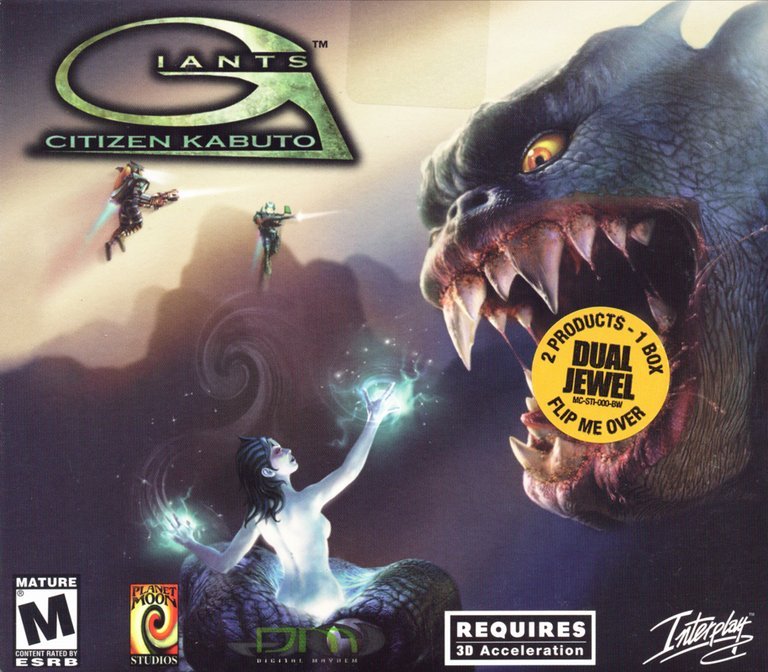
Evolva / Giants: Citizen Kabuto is a dual-CD re-release compilation featuring two unique games: Evolva and Giants: Citizen Kabuto. Giants: Citizen Kabuto is a third-person shooter with real-time strategy elements, developed by Planet Moon Studios and published by Interplay Entertainment. Players can choose from three distinct humanoid races—Meccaryns, Sea Reapers, and Kabuto—each with unique abilities and playstyles. The game offers both single-player missions and multiplayer matches, blending action, strategy, and humor in a visually impressive package.
Gameplay Videos
Evolva / Giants: Citizen Kabuto Cracks & Fixes
Evolva / Giants: Citizen Kabuto Patches & Updates
Evolva / Giants: Citizen Kabuto Mods
Evolva / Giants: Citizen Kabuto Guides & Walkthroughs
Evolva / Giants: Citizen Kabuto Reviews & Reception
metacritic.com (92/100): The huge amount of variety, great storyline, and intuitive gameplay makes this game one that fans of just about every genre should check out.
psx2central.com (60/100): In the end Giants: Citizen Kabuto is a humorous experience that just lacks the depth and gameplay mechanics needed to take it into the next level of action/adventure games.
gamespot.com (90/100): The truly unique premise, coupled with stunning graphics and exciting gameplay, makes Giants: Citizen Kabuto one of the best action games in years.
Evolva / Giants: Citizen Kabuto Cheats & Codes
PC
Press Y or T during gameplay and type:
| Code | Effect |
|---|---|
| basegoveryfast | Faster base building |
| pleasehealme | Full Health |
| Ineedspells | Infinite Mana |
| Gimmegifts | Instant Gift/Spell Shop |
| itsmyparty | Instant Party House |
| basepopulate | Instant smarties |
| Allmissionsaregoodtogo | Level Select |
| mapshowall | map revealed |
| FR | Show Frames Per Second |
| basefillerup | Full energy for base |
| mapshowitall | Full map |
| gimmegifts | Gift shop |
| allmissionsaregoodtogo | Level select |
| basepopulate | Maximum Smarty population |
| itsmyparty | Party house |
| ineedspells | Unlimited mana |
| fr | View frame rate |
| MasterDebug | Debug mode |
PlayStation 2
Use one of the following codes:
| Code | Effect |
|---|---|
| LILBUDY | Access Cheat Giftshop |
| ALPUN | Enable Cheat Menu |
| FALLOUT | Infinite Ammo for the Meccaryns |
| 38HK | Infinite Jet Pack |
| BGDA | Infinite Mana |
| MOLITOR | Invincibility |
| THEHARE | Speedy Player |
| XTRASEE | Enable Front View Mode |
| CLOSEUP | Enhanced Zoom mode |
| KVIEW | Front View mode for Kabuto only |
| UDDOIT2 | Blue screen |
| SNIPEME | Green screen |
| DOROTHY | Many colors |
| ANGRY | Red screen |
| MBP4UJP | Unlock all missions |
Evolva / Giants: Citizen Kabuto: Review
Introduction
In the pantheon of early 2000s cult classics, few games embody ambition, humor, and technical audacity quite like Giants: Citizen Kabuto. Originally conceived as two separate titles—Evolva and Giants—this Interplay compilation bundles a divisive genetic-action hybrid and a genre-defying comedic masterpiece. Giants shines brightest, blending third-person shooter mechanics, real-time strategy elements, and slapstick storytelling into a bizarre yet unforgettable experience. Developed by Planet Moon Studios (a team of MDK alumni), Giants dared to be different, even as it stumbled over technical limitations and uneven execution. This review unpacks its legacy as a flawed but visionary gem that left an indelible mark on action-strategy hybrids.
Development History & Context
The Studio & Vision
Planet Moon Studios emerged in 1997 from the ashes of Shiny Entertainment’s MDK team. Co-founders Nick Bruty, Bob Stevenson, and Tim Williams sought to create games that prioritized fun and innovation over convention. Giants: Citizen Kabuto was their debut project—a “spacemen vs. pirates vs. giants” romp designed to subvert expectations. The team’s goal was to fuse frantic action with strategic depth, all wrapped in a absurdist wrapper.
Technological Constraints
Developed during the late 1990s GPU revolution, Giants faced constant hardware upgrades. Initially targeting Voodoo 1 cards, the team scrambled to support NVIDIA’s GeForce series, rewriting their custom “Amityville” engine to leverage OpenGL and Direct3D. The result was a visually demanding game that pushed PCs to their limits, with lush environments, bump mapping, and dynamic lighting—features that often caused performance woes on mid-tier systems.
The Gaming Landscape
Released in December 2000, Giants entered a market dominated by Half-Life, Diablo II, and Deus Ex. Its blend of genres was unconventional, and its humor—ranging from slapstick to dark satire—set it apart. However, its lack of a save feature and rampant bugs at launch frustrated critics, while console ports (PS2, 2001) sacrificed multiplayer and visual fidelity for stability.
Narrative & Thematic Deep Dive
Plot & Structure
The game’s single-player campaign—split into three acts—follows the Meccaryns (cockney space marines), Delphi (a rogue Sea Reaper sorceress), and Kabuto (a colossal, misunderstood beast). The story begins with the Meccaryns crash-landing on a fragmented alien world, only to be embroiled in a war between the amphibious Sea Reapers and their Frankenstein-esque creation, Kabuto. The narrative shifts perspectives, offering tutorial-like missions that escalate into base-building skirmishes and kaiju-sized brawls.
Characters & Dialogue
- The Meccaryns: Led by the gruff Baz, these bumbling soldiers provide comic relief through exaggerated banter and pratfalls. Their quest to save Smarties (the planet’s hapless, hedonistic natives) evolves into a riff on The Magnificent Seven.
- Delphi: A subversion of the “evil sorceress” trope, her arc—a rebellion against Queen Sappho—explores themes of individuality and redemption.
- Kabuto: A tragicomic figure, his desire for belonging (“Citizen” Kabuto) contrasts with his destructive impulses.
The dialogue oscillates between Monty Python-esque absurdity (e.g., Smarties cheering while being eaten) and heartfelt moments, like Timmy’s sacrifice—a scene that underscores the game’s tonal whiplash.
Themes
- Colonialism & Rebellion: The Sea Reapers’ enslavement of Smarties mirrors imperialist exploitation, while Delphi’s defiance critiques authoritarianism.
- Identity & Belonging: Kabuto’s isolation and Delphi’s transformation into a Kabuto-like creature underscore the search for self.
- Humor as Subversion: The game’s irreverence masks deeper commentary on power dynamics and genre tropes.
Gameplay Mechanics & Systems
Core Loop & Combat
- Meccaryns: Jetpack-equipped gunmen with squad commands. Their RTS-lite phases involve gathering Smarties and Vimp meat to build turrets and barracks.
- Sea Reapers: Magic-wielding amphibious fighters with “turbo boost” mobility. Their spellcasting (firestorms, tornadoes) and Reaperski races add variety.
- Kabuto: A pure action experience—devour Smarties to grow, then crush bases with wrestling moves like the “butt flop.”
Innovation & Flaws
- Genre Fusion: The shift from shooter to strategy to kaiju simulator was ambitious but disjointed. Base-building felt undercooked compared to pure RTS titles.
- UI & Controls: Simplified inputs worked for action but limited strategic depth. The PS2 port’s auto-aim couldn’t replicate mouse precision.
- Technical Issues: Crippling bugs, no mid-mission saves, and unstable multiplayer (reliant on GameSpy) marred the PC release.
World-Building, Art & Sound
Setting & Atmosphere
The “Island”—a floating planetary fragment—is a vibrant collage of grasslands, deserts, and volcanic ruins. Distant vistas blurred by atmospheric effects created a sense of scale, while dynamic weather (GeForce 3-exclusive) added immersion.
Visual Direction
Planet Moon’s art leaned into cartoonish exaggeration: oversized Smartie heads, Kabuto’s grotesque musculature, and the Sea Reapers’ elegant brutality. The PS2 version’s lower textures and washed-out colors paled in comparison to the PC’s detail.
Sound Design
Jeremy Soule and Mark Morgan’s score blended orchestral grandeur with whimsical motifs. The Smarties’ gibberish chatter and Kabuto’s earth-shaking roars amplified the game’s comedic and epic tones.
Reception & Legacy
Launch & Reviews
- Critics: Praised the humor, visuals, and originality (PC: Metacritic 85, PS2: 79), but savaged bugs and performance (GameSpot: “frustratingly unstable”).
- Sales: Flopped commercially, though the Mac OS X version sold out quickly.
Cult Status & Influence
Despite its flaws, Giants influenced later titles like Ratchet & Clank and Jak and Daxter with its genre-blending and tone. A 2015 Kickstarter for a spiritual successor, First Wonder, failed to fund but underscored its enduring fanbase.
Conclusion
Giants: Citizen Kabuto is a messy masterpiece—a game that defies categorization and pays the price for its ambition. Its humor, creativity, and willingness to experiment remain infectious, even as technical shortcomings and uneven pacing test modern patience. For those willing to forgive its sins, it stands as a relic of a bolder era in game design, where “fun” trumped polish. In the annals of cult classics, Giants isn’t just remembered—it’s celebrated as a reminder of what games can be when they dare to be weird.