
- Release Year: 2003
- Platforms: Macintosh, Windows
- Publisher: MacPlay, MumboJumbo, LLC
- Developer: MumboJumbo, LLC
- Genre: Action, Puzzle
- Perspective: Behind view
- Game Mode: Single-player
- Gameplay: Arcade
Description
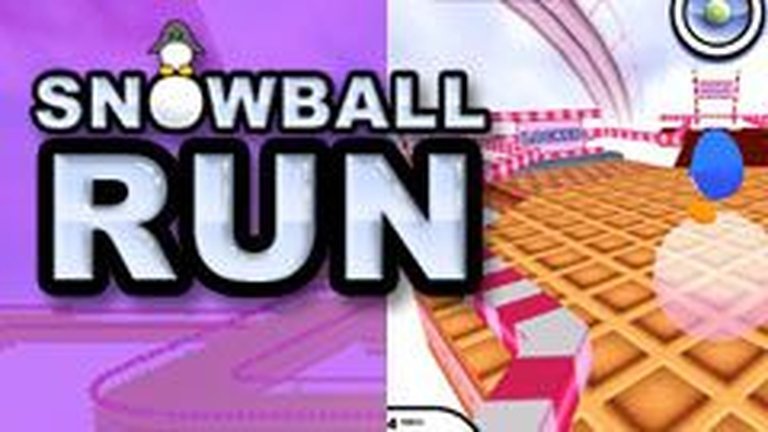
In ‘Snowball Run,’ players control a penguin riding a snowball through a whimsical, skybound amusement park filled with vibrant elements like elephant balloons, roller coasters, and candy stores. The goal is to complete 75 levels across beginner, intermediate, and advanced stages, racing against time and collecting fish for bonus points. Hazards like ramps, barriers, and holes threaten progress, with slippery controls complicating quick maneuvers, while falls off the level result in lost lives. The cheerful yet challenging gameplay blends arcade action with puzzle-like precision.
Gameplay Videos
Snowball Run Free Download
Snowball Run Cracks & Fixes
Snowball Run Guides & Walkthroughs
Snowball Run: A Penguin’s Precarious Amusement Park Odyssey Reviewed
Introduction
In the overcrowded pantheon of early-2000s arcade-puzzle hybrids, Snowball Run (2003) occupies a curious space—a whimsical, pastel-drenched anomaly that dared to ask: What if a penguin rode an ever-growing snowball through floating carnival attractions? Developed by MumboJumbo—a studio better known for casual match-3 titles—this oddity married childlike aesthetics with punishing physics-based navigation. While frequently dismissed as “icky-cutesy” (per Inside Mac Games), its legacy lies in embodying the contradictions of an era transitioning toward accessible digital downloads while clinging to premium pricing models. This review posits that Snowball Run is neither triumph nor disaster, but a flawed curio where meticulous presentation clashes with imprecise mechanics—a snowball perpetually teetering on the edge of greatness and frustration.
Development History & Context
Studio Vision & Technological Constraints
Emerging in the wake of pioneering 3D ball-rollers like Marble Blast Gold (2002), MumboJumbo’s Darren Walker (Lead Programmer) and Chad Woyewodzic (Senior Artist) sought to inject personality into the genre. Built on the Torque Engine—later used in Marble Blast Ultra—the game leveraged early-2000s 3D acceleration to render cotton-candy skies and physics-defying rollercoaster tracks. Yet budget constraints manifested in critical areas: music composer Zak Belica created only one primary track (a looping carousel melody critics deemed “brain cell destroying”), while procedural level design struggled to mask asset reuse.
The 2003 Gaming Landscape
Released amidst a surge in casual digital downloads (PopCap’s Bejeweled exploded that same year), Snowball Run bizarrely clung to CD-ROM distribution ($20 retail), alienating its natural audience. Competing titles like Super Monkey Ball (2001) offered tighter controls and multiplayer modes, casting MumboJumbo’s single-player experience as regressive. Notably, the team’s prior experience on hardcore titles like Myth III: The Wolf Age explains the incongruous difficulty spikes—a DNA clash between casual aesthetics and punishing design.
Narrative & Thematic Deep Dive
Plot & Characters: Minimalism as Virtue (and Vice)
Rejecting exposition, Snowball Run communicates entirely through environmental storytelling. Players control an unnamed penguin—a silent avatar—navigating 75 levels across three skyborne amusement parks. Though devoid of dialogue or narrative text, subtle cues imply a deeper world:
– Elephant Balloons: Gigantic tethered creatures suggest a defunct carnival
– Candy Store Ruins: Dilapidated gumdrop huts hint at ecological decay (sugar-crystal stalagmites invade later levels)
Thematically, the game explores control versus chaos—an apt metaphor for its own design. The penguin’s fragile grip on the snowball mirrors the player’s battle against floaty physics, while hazards like bottomless holes and collapsing ramps evoke existential precariousness. One Mac Gamer critic noted this duality: “an effective 3D skiing emulator […] where satisfaction comes from fleeting mastery.”
Gameplay Mechanics & Systems
Core Loop: Physics as Foe
At its zenith, Snowball Run delivers moments of sublime momentum:
Yet the mechanical execution falters catastrophically:
– Inertial Drift: Momentum frequently overcorrects, causing unwinnable falls
– Collision Detection: Barriers sometimes “grab” the snowball mid-air (a bug masquerading as difficulty)
– Life System: Trial-and-error design demands memorization (per Mac Gamer: “choppy where it should flow”)
Progression & UI
The three-stage difficulty curve (Beginner/Intermediate/Advanced) escalates unpredictably—Advanced Level 12’s spinning windmill blades remain infamous for instant-death hitboxes. The UI, however, shines with “professional” polish (Game Tunnel): clean timers, intuitive retry prompts, and a fish-collection tracker that subtly teaches optimal routing.
World-Building, Art & Sound
Visual Design: Sugary Surrealism
Snowball Run’s skybox artistry remains its crowning achievement:
– Day/Night Cycles: Later levels bathe obstacles in neon-taffeta sunsets
– Asset Juxtaposition: Merry-go-rounds float beneath thunderclouds made of popcorn
– Penguin Animation: Idle shivers and panicked flipper-waves humanize the protagonist
Sound Design: Beauty and Madness
Belica’s carnival waltz—initially charming—becomes psychological warfare by Level 20. The absence of dynamic music (no intensity spikes during near-misses) feels like a lost opportunity. Contrastingly, diegetic sounds excel: snow-crunch acoustics deepen with ball size, while candy-glass barriers emit satisfying pings upon impact.
Reception & Legacy
Launch Controversies
Critics savaged its $20 price point (Clubic: “Un peu cher” compared to free alternatives like Neverball), while audiences debated controls (“floaty” vs “realistic”). Its 70% MetaScore obscures polarized takes:
Long-Term Influence
Though commercially dwarfed by Marble Blast Ultra (2006), Snowball Run’s DNA persists in:
– Whimsical Physics Games: Katamari Damacy (2004) echoed its surreal scale-shifting
– Indie Platformers: A Hat in Time (2017) borrowed its carnivalesque tone
– Speedrunning Culture: Glitch-hunters still dissect infamous barrier-clipping exploits
Its greatest legacy, however, may be as a cautionary tale about audience mismatch—a game too punishing for casuals, too kitschy for hardcore players.
Conclusion
Snowball Run is the gaming equivalent of a haunted carousel: beautiful craftsmanship undermined by structural instability. Its visual splendor and moments of physics-driven euphoria are undeniable, yet these triumphs crumble under imprecise controls, repetitive scoring, and an identity crisis between kid-friendly facade and masocore demands. For historians, it embodies early-2000s experimentalism—proof that Torque Engine could render cotton-candy dreams. For players, however, it remains a fascinating relic best appreciated in retrospect, when its frustrations soften into nostalgia. Not essential, but unforgettable—a snowball preserved in the amber of gaming’s awkward adolescence.