
- Release Year: 2009
- Platforms: Macintosh, Windows
- Publisher: Paper Dragon Games
- Developer: Paper Dragon Games
- Genre: Strategy, Tactics
- Perspective: Top-down
- Game Mode: Single-player
- Gameplay: Board game, Turn-based
- Setting: Futuristic, Sci-fi
Description
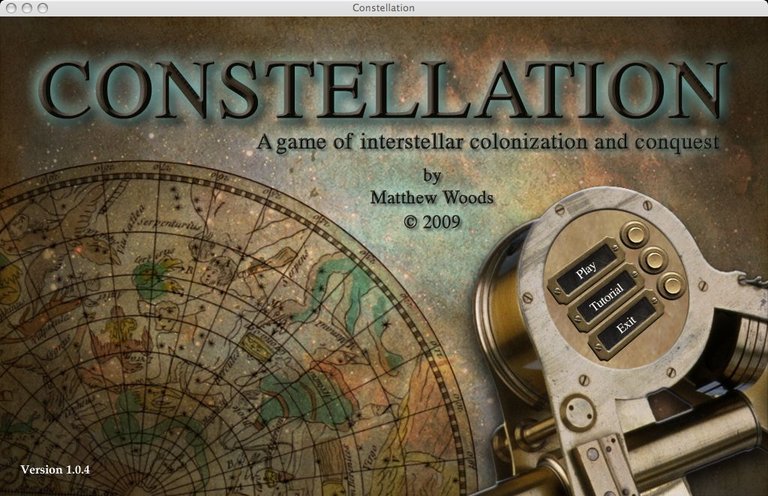
Constellation is a turn-based strategy board game set in a futuristic sci-fi universe, where players compete for galactic dominance by colonizing planets. The game features randomly generated maps with planets of varying sizes, each capable of supporting bases that exert influence on neighboring worlds. Players strategically build bases to claim neutral or contested planets, utilizing larger planets to amplify their influence, while risking destruction if they encroach on enemy-controlled territory. Optional modifiers allow customization of map layout, planet sizes, and game duration, adding layers of tactical depth to the conquest.
Where to Buy Constellation
PC
Constellation: A Tactical Starlight Symphony of Galactic Conquest
Introduction
In the vast cosmos of indie strategy titles, few games capture the elegance of simplicity and emergent complexity like Constellation. Released in 2009 by the small but ambitious Paper Dragon Games, this sci-fi turn-based strategy gem emerged as a cult favorite among board game and 4X enthusiasts. Originally conceived as a contest entry for the 2008 uDevGames competition—where it clinched #2 spots in Best Overall, Gameplay, and Presentation—Constellation distilled grand galactic ambition into a minimalist, top-down ballet of planetary influence. This review positions Constellation as a bridge between the Apple II-era tactical purity of classics like Fortress and modern procedural strategy design, a game whose subtle brilliance lies in its emergent narratives and infinitely replayable systems.
Development History & Context
The Creation of a Cosmic Micro-Masterpiece
Constellation was born from the passion of indie developer Matthew Woods, chronicled in his uDevGames development diary. As a solo endeavor initially crafted for the competition, Woods drew inspiration from Fortress (1981)—an Apple II strategy title notorious for its abstract territorial control—while modernizing its mechanics for a procedural generation-driven era. The late 2000s indie scene, buoyed by digital distribution platforms, allowed small teams like Paper Dragon Games to experiment with niche genres, unburdened by AAA expectations.
Technological Constraints and Innovation
Built as a downloadable shareware title, Constellation leveraged simplicity as its strength. The game’s turn-based, top-down structure prioritized clean UI and rapid iteration over graphical flair, reflecting the resource limitations of a compact team. Procedural generation served as the linchpin: maps, planet sizes, and starting conditions were randomized, ensuring no two playthroughs felt identical. This design ethos echoed earlier pioneers like Starflight (1986), which used similar techniques to craft a dynamic universe on limited hardware.
The Gaming Landscape of 2009
Context is critical: Constellation debuted amid a resurgence of indie strategy titles (Plants vs. Zombies, Defense Grid: The Awakening) and the twilight of board game-inspired PC classics. Its release model—shareware with optional modifiers—harkened back to the 1990s, yet its focus on accessibility (1-4 players offline, digestible rules) aligned with a burgeoning audience seeking “pick-up-and-play” depth.
Narrative & Thematic Deep Dive
A Universe Built Through Mechanics
Constellation eschews explicit storytelling for a thematic backdrop: players are commanders vying for galactic dominance through tactical colonization. The narrative emerges not through cutscenes or dialogue, but through the unfolding chess match of planetary control. Each game becomes a self-contained saga: rival factions expand like inkblots, influence ebbing and flowing across star systems. The absence of scripted lore paradoxically enhances immersion—players project their own rivalries and alliances onto the cold calculus of planetary conquest.
Themes of Power, Expansion, and Austerity
Thematically, Constellation mirrors the zero-sum brutality of empire-building. Planets are not cities to nurture but vectors of control; building a base on an enemy world invites swift annihilation. The “neutral” planets—untouched or contested territories—symbolize the tension between risk and reward. Unlike grandiose 4X titles, Constellation strips away diplomacy and technology trees, reducing its thesis to a pure geometric waltz of influence. Its austerity resonates with the existential scale of Reigns or Go, where minimalism belies infinite strategic permutations.
Gameplay Mechanics & Systems
Core Mechanics: Influence as a Geometric Language
At its heart, Constellation is a game of mathematical elegance:
– Planetary Hierarchy: Larger planets support more bases, radiating stronger influence to adjacent worlds.
– The Snowball Effect: Controlling key “hub” planets amplifies regional dominance, forcing opponents into costly counterattacks.
– Base-Building Calculus: Bases can be placed on neutral or allied worlds instantly, but hostile territory requires overwhelming force—a daring gambit usually doomed by attrition.
Turn-Based Intimacy and Pacing
Turn-by-turn, players balance aggression and consolidation. The lack of fog-of-war makes every move transparent, echoing abstract strategy classics. Optional modifiers—adjusting map density, planet size variance, game length—allow fine-tuning of difficulty and chaos, from tense duels to sprawling free-for-alls.
UI/UX: Clarity Over Clutter
The interface is ruthlessly functional: a top-down starmap with color-coded planetary ownership, numerical values for influence, and minimalist menus. While lacking modern luxuries like undo buttons or tutorials, its intuitive design ensures players grasp core systems within minutes—a testament to Woods’ focus on board-game-inspired immediacy.
Flaws: The Sharp Edges of Minimalism
Constellation’s simplicity occasionally verges on sterility. The absence of asymmetry (identical faction capabilities) and scripted events limits long-term narrative stakes, while late-game dominance often feels inevitable rather than climactic. Multiplayer, though functional, lacks AI customization for solo play, a missed opportunity for varied challenges.
World-Building, Art & Sound
Visual Design: A Retro-Futuristic Palette
Constellation’s aesthetic channels the stark pragmatism of 1980s strategy games: planets are geometric icons, bases mere colored dots, and starmaps rendered in subdued blues and grays. This retro-futuristic approach evokes the utilitarian charm of M.U.L.E. or Starflight, where abstraction sparks imagination rather than stifles it.
Soundscape: Ambience Over Orchestration
Sound design is sparse but deliberate: muted electronic hums underscore the void, while subtle clicks and chimes punctuate base placement and turn transitions. The absence of bombastic scores reinforces the game’s meditative, cerebral tone—though some players may crave more auditory feedback during pivotal moments.
Atmosphere: The Quiet Grandeur of Space
Despite its mechanical focus, Constellation cultivates an eerie sense of scale. The vastness of procedurally generated galaxies—each world a speck in a silent cosmos—invokes a lonely, almost Solaris-like contemplation. This atmospheric mastery elevates it beyond mere board-game digitization into a haunting tactical reverie.
Reception & Legacy
Launch Reception: A Niche Triumph
Critically, Constellation flew under mainstream radar—no formal reviews exist on aggregators, reflecting its indie obscurity. However, its 4.1/5 average player rating (from limited data) and uDevGames acclaim signal a warmly received experiment. Players praised its “deceptively deep” systems and multiplayer dynamism, while critiques centered on repetitive late-game phases.
Evolution of Reputation
In hindsight, Constellation stands as a quiet pioneer. Its procedural, minimalist ethos foreshadowed indie darlings like FTL: Faster Than Light and Into the Breach, while its board-game DNA resonates in modern digital adaptations (Race for the Galaxy, Twilight Struggle). The game’s legacy lies not in industry-shaking innovation, but in demonstrating how constrained tools can birth emergent complexity.
Influence on the Genre
Constellation’s fingerprints surface in later titles: the territorial stress of Reigns, the procedural sprawl of Stellaris’ sector mechanics, and even the abstract conflict of Diplomacy clones. Its most profound impact, however, may be inspiring indie developers to embrace restraint—proving that galactic epics need not sprawl across 100-hour campaigns.
Conclusion: A Tactical Cosmos, Finite Yet Infinite
Constellation is a paradox: a game dwarfed by its contemporaries in budget and scope, yet expansive in strategic possibility. While its lack of narrative scaffolding and asymmetric depth may deter some, its purity of design—each session a crystallized battle of wits—cements it as a clandestine classic. For fans of tactical minimalism, procedural storytelling, and the quiet hum of a universe unfolding turn-by-turn, Constellation remains a starlit benchmark in indie strategy’s firmament. In the annals of gaming history, it occupies not a supernova’s blaze, but the enduring glow of a binary star—small, precise, and brilliantly self-contained.
Final Verdict: Constellation is a masterclass in emergent strategy, a game that transforms simple rules into infinite constellations of rivalry and control. For connoisseurs of thoughtful, replayable tactics, it is nothing less than essential.