
- Release Year: 2009
- Platforms: Windows
- Publisher: astragon Software GmbH
- Developer: EleFun Multimedia Games
- Genre: Action, Simulation
- Perspective: Diagonal-down
- Game Mode: Single-player
- Gameplay: Business simulation, Managerial, Time management
- Setting: Ball rooms, Hollywood, Night clubs, Yachts
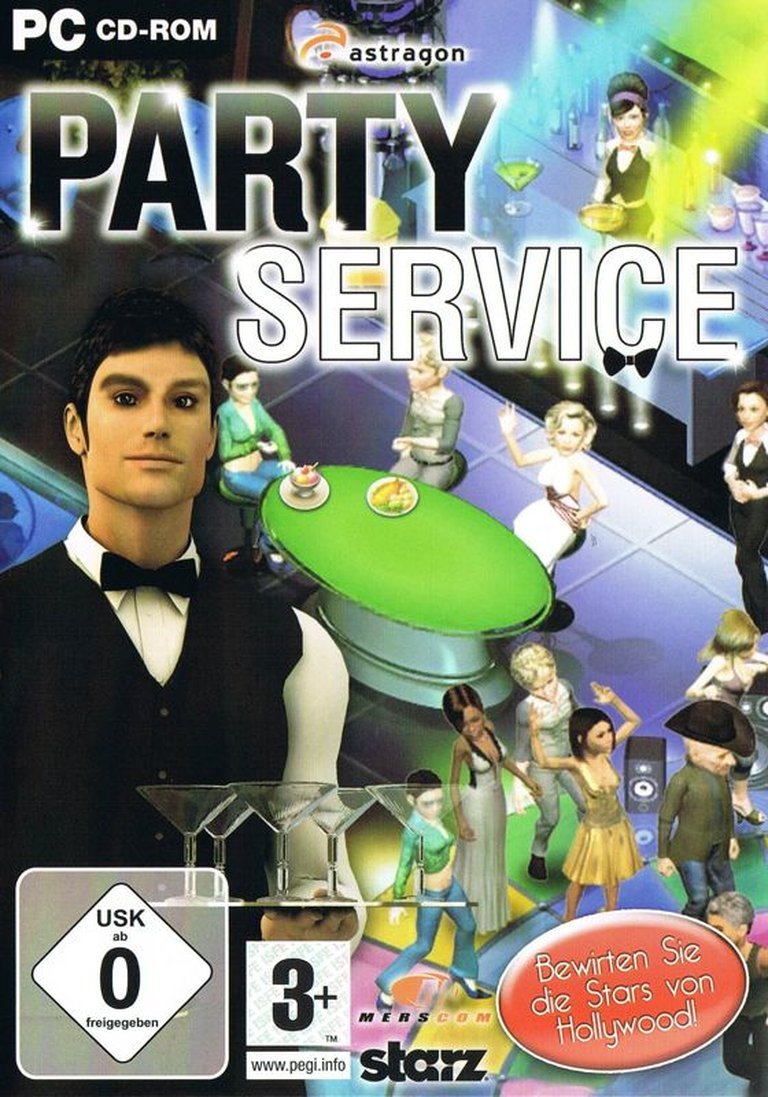
Description
Party Down is a time management game set in Hollywood, where players lead a catering service to success. Choose your character and manage various parties, providing food, drinks, and entertainment to keep guests happy while navigating challenges like paparazzi and wild dogs. Complete eight different parties across yachts, ballrooms, and nightclubs to achieve victory.
Party Down: Review
Introduction
In the bustling landscape of late-2000s casual games, Party Down (2009) emerges as an obscure but fascinating footnote. Developed by EleFun Multimedia Games and published by astragon Software GmbH, this time-management simulator tasked players with navigating the chaotic world of Hollywood catering. While its legacy is overshadowed by the cult-classic Starz TV series of the same name, the game carved out a niche as a lighthearted, if uneven, entry in the managerial simulation genre. This review argues that Party Down is a curious relic—a game that encapsulates the era’s casual gaming trends but struggles to transcend its genre’s limitations.
Development History & Context
Party Down arrived in June 2009, a period dominated by casual gaming phenomena like Diner Dash and FarmVille. EleFun Multimedia Games, a Polish studio known for family-friendly titles such as Cooking Academy, aimed to capitalize on the time-management craze by blending Hollywood glamour with frenetic task-based gameplay. The game’s release coincided with the first season of the TV series Party Down, though the connection between the two is tangential at best—the game lacks the show’s sharp wit and character-driven storytelling, instead opting for a generic catering premise.
Technologically, Party Down was constrained by the standards of its time. Built for Windows XP/Vista, it utilized an isometric perspective common to managerial sims, with minimal 3D rendering. The game’s modest system requirements (a 1.0 GHz CPU and 128 MB RAM) positioned it as accessible for casual players but limited its visual ambition.
Narrative & Thematic Deep Dive
The game’s narrative is threadbare: Players lead a catering team through eight events across yachts, nightclubs, and ballrooms, juggling food service, guest interactions, and unexpected hazards like wild dogs and burning drinks. Unlike the TV show’s focus on aspiring actors and comedians, the game reduces its cast to interchangeable avatars with no backstories or dialogue.
Thematically, Party Down touches on the chaos of service-industry labor, but its lack of narrative depth renders it a missed opportunity. While the show explored existential dread beneath Hollywood’s glittering façade, the game settles for surface-level “keep the guests happy” objectives. The closest it comes to satire is its portrayal of paparazzi as obstacles—a bland critique of celebrity culture.
Gameplay Mechanics & Systems
At its core, Party Down is a straightforward time-management title. Key mechanics include:
– Task Prioritization: Players must serve food, refill drinks, and manage the dance floor while avoiding penalties (e.g., unhappy guests).
– Hazard Mitigation: Random events like wildfires or animal intrusions add urgency but often feel repetitive.
– Character Progression: Unlockable outfits and party venues offer marginal incentives, though the lack of skill trees or meaningful upgrades limits replayability.
The UI is functional but dated, with cluttered icons and minimal feedback. The isometric perspective occasionally hampers visibility, particularly during crowded events. While the game innovates slightly with its Hollywood setting, it pales next to contemporaries like Cooking Dash, which offered deeper strategic layers.
World-Building, Art & Sound
Party Down’s aesthetic is a mixed bag. The isometric visuals capture the opulence of its settings—yachts gleam, ballrooms shimmer—but character models are stiff and lack personality. The art direction leans into caricature (e.g., exaggerated paparazzi cameras), yet the overall effect is more quaint than immersive.
Sound design is similarly forgettable. Generic jazz and pop loops accompany gameplay, with no standout tracks or voice acting. The absence of the TV show’s iconic theme or cast voices feels like a missed opportunity to bridge the two mediums.
Reception & Legacy
Upon release, Party Down garnered little attention from critics or players. MobyGames lists no professional reviews, and user impressions are scarce. Its commercial performance is undocumented, suggesting it faded quickly amidst stronger competitors.
Yet the game holds a peculiar place in history. As a tie-in to a beloved but ratings-challenged TV show, it reflects the awkward synergy between 2000s media properties and casual gaming. While it influenced no sequels or imitators, it remains a time capsule of an era when even niche IPs were hastily adapted into management sims.
Conclusion
Party Down is neither a triumph nor a disaster—it’s a middling entry in a crowded genre. Its gameplay is competent but uninspired, its presentation charmingly dated but forgettable. For completionists of time-management games or fans of the TV show seeking curiosities, it offers fleeting amusement. However, its lack of innovation and narrative depth relegate it to footnote status in video game history. In the end, Party Down is a party worth crashing for genre enthusiasts, but one that’s easily overshadowed by livelier guests.