
- Release Year: 2016
- Platforms: Windows
- Publisher: 1C Publishing EU s.r.o.
- Genre: Compilation
- Game Mode: Single-player
Description
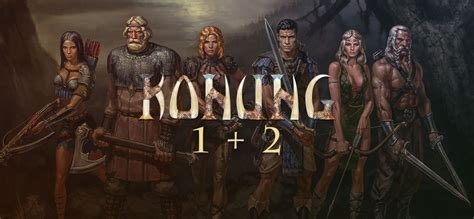
Konung 1 + 2 is a compilation of two classic strategy games set in a richly detailed medieval world. The first game, Legend of the North: Konung, immerses players in the political intrigue and military tactics of Viking-era Scandinavia. The sequel, Konung 2: Blood of Titans, expands on this with enhanced gameplay mechanics and a deeper narrative. This package includes both games, along with their manuals, soundtracks, concept art, and a wallpaper, offering a comprehensive experience for fans of historical strategy.
Gameplay Videos
Where to Buy Konung 1 + 2
PC
Konung 1 + 2 Mods
Konung 1 + 2 Cheats & Codes
PC
Edit the ‘KONUNG2.SA0’ file with a hex editor. Always back up the file before making changes.
| Code | Effect |
|---|---|
| 04b314-04b315-04b316-04b317 (Hex: DFFF or similar) | Grants a large amount of free experience points for the main character |
| 04b2f2-04b2f3-04b2f4-04b2f5 (Hex: DFFF or similar) | Increases the amount of money in the main character’s inventory |
Konung 1 + 2: Review
Introduction
In the sprawling tapestry of late-’90s and early-2000s RPGs, the Konung series stands as a defiantly regional gem—a Slavic-flavored saga of mythical kings, warring tribes, and ancient magic. The 2016 compilation Konung 1 + 2 bundles Legend of the North: Konung (1999) and Konung 2: Blood of Titans (2003), preserving two chapters of a franchise that carved its niche in Eastern European gaming culture. Though largely overlooked in the West, these games offer a raw, unfiltered dive into a mythology rarely explored in RPGs. This review argues that while Konung 1 + 2 is mechanically rough by modern standards, its cultural specificity and ambition cement its status as a fascinating artifact of gaming history.
Development History & Context
Studio and Vision
Developed by Russian studio 1C Company (later published by 1C Publishing EU), the Konung series emerged during a golden age of isometric RPGs. Unlike contemporaries like Baldur’s Gate or Planescape: Torment, Konung drew inspiration not from Tolkien-esque fantasy but from Slavic folklore and Early Medieval history. The creators sought to emulate the complexity of Western RPGs while grounding their world in regional legends—a bold move in an era dominated by anglophone narratives.
Technological Constraints
The original Konung (1999) debuted when 3D graphics were still nascent. Its isometric 2D sprites and hand-drawn environments were typical of the era, but budget limitations led to clunky animations and inconsistent visual polish. By Konung 2’s 2003 release, 3D acceleration had become mainstream, yet the sequel retained a hybrid 2D/3D approach, prioritizing atmospheric world-building over technical spectacle.
Gaming Landscape
The late ’90s RPG boom saw giants like Diablo and Fallout redefine the genre. Konung arrived as a regional underdog, offering a slower-paced, narrative-heavy experience that catered to players hungry for non-Western perspectives. Its compilation release in 2016 reflects a growing interest in preserving niche titles, with GOG.com making these cult classics accessible to new audiences.
Narrative & Thematic Deep Dive
Plot and Characters
Legend of the North: Konung casts players as a Scandinavian warrior stranded in a mythic Slavic realm, The Northern Land. The story unfolds as a power struggle between six tribes, each vying for control of ancient artifacts tied to the titular Konung (king). The sequel, Blood of Titans, expands the lore with a quest to awaken dormant titans, blending Slavic creation myths with a proto-Witcher tone of moral ambiguity.
Dialogue and Themes
Both games feature verbose, often melodramatic writing—a hallmark of Eastern European RPGs. Themes of tribal identity, ancestral duty, and the corrupting allure of power permeate the narrative. Dialogues are steeped in folklore, with characters referencing Leshy (forest spirits), Baba Yaga, and other mythological staples. While the English localization is notoriously uneven, it adds to the games’ rugged charm.
Gameplay Mechanics & Systems
Core Loop
Konung blends RPG staples—questing, inventory management, and faction diplomacy—with a semi-open world. Players recruit party members from rival tribes, balancing alliances and betrayals. The quest design is nonlinear but plagued by opaque objectives, demanding patience from players.
Combat and Progression
Combat is a mix of real-time and pause-and-play tactics, though lacking the precision of Baldur’s Gate. Melee clashes feel weightless, and spellcasting suffers from poor feedback. Character progression leans heavily on stat allocation, with skills tied to weapons and spells. The system is deep but poorly explained, creating a steep learning curve.
UI and Innovation
The UI is a relic of its time: cluttered menus, tiny text, and minimal tooltips. Yet Konung 2 introduces a dynamic weather system and season-based events—innovative touches that influence NPC behavior and quest availability, foreshadowing later immersive sims.
World-Building, Art & Sound
Atmosphere and Visuals
Konung’s world oozes atmosphere. Dense pine forests, crumbling Slavic fortresses, and mist-shrouded marshes evoke a primal, almost melancholic beauty. The art style mixes pixelated sprites with painterly backdrops, while Konung 2’s 3D models clash awkwardly with 2D environments—a testament to the era’s transitional tech.
Sound Design
The soundtrack, composed with traditional instruments like the gusli (a Slavic zither), is a highlight. Tracks alternate between haunting choral chants and frenetic battle themes, grounding the player in the setting. Voice acting, however, ranges from passable to laughably stiff.
Reception & Legacy
Initial Reception
Konung earned modest acclaim in Eastern Europe for its ambition, but Western critics dismissed it as a “Baldur’s Gate knockoff” with technical flaws. Konung 2 fared slightly better, praised for its narrative depth but criticized for its janky combat.
Long-Term Influence
Despite its obscurity, Konung’s DNA can be traced to later Slavic RPGs like The Witcher and Kingdom Come: Deliverance—games that similarly prioritize regional authenticity. The 2016 re-release introduced the series to retro RPG enthusiasts, sparking newfound appreciation for its niche appeal.
Conclusion
Konung 1 + 2 is a flawed but fascinating time capsule. Its clunky mechanics and uneven presentation make it a tough sell for modern players, yet its commitment to Slavic mythology and nonlinear storytelling remains uniquely compelling. For historians and genre devotees, this compilation is a vital artifact—a reminder that gaming’s evolution is shaped not just by blockbusters but by forgotten underdogs. 6/10 – A rough-hewn relic with a soul worth rediscovering.