
- Release Year: 2003
- Platforms: Windows
- Publisher: XDGames
- Developer: XDGames
- Genre: Puzzle
- Perspective: Top-down
- Game Mode: Single-player
- Gameplay: Point and select, Real-time, Track laying, Train driving
- Setting: Railroad, Train
- Average Score: 50/100
Description
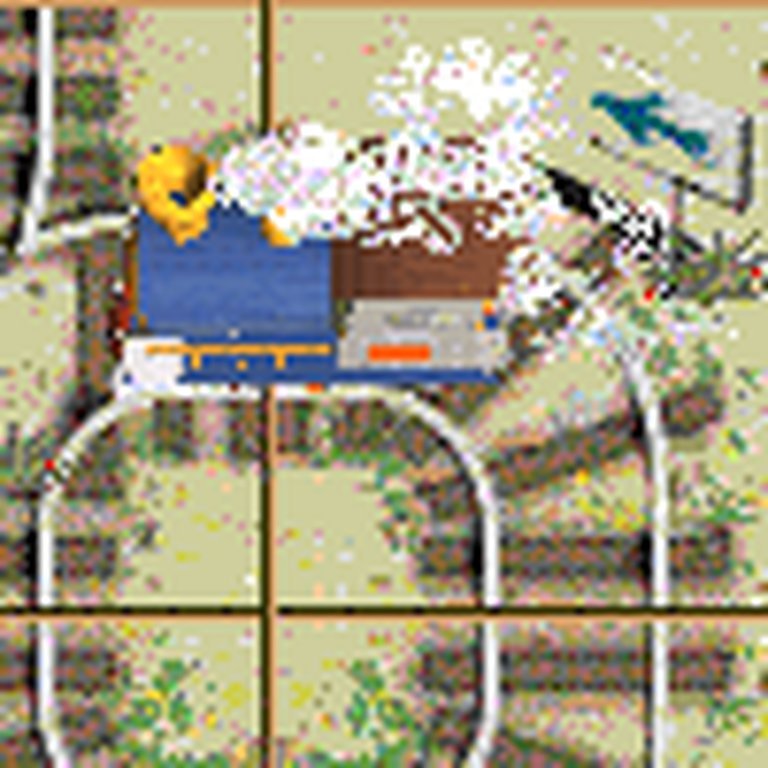
Puzzle RailRoad is a real-time puzzle game where players must strategically lay and rotate train tracks to guide a steam engine from a starting station to its destination. Set on a dynamic 5×10 grid, the challenge involves collecting all workers, managing coal supplies, and avoiding derailments while tracks are adjusted ‘on the fly’ as the train moves. With elements like signals, tunnels, and interchangeable track pieces, the game demands quick planning under pressure to ensure a safe and complete journey.
Puzzle RailRoad: Review
The Forgotten Curves of Early 2000s Shareware Puzzle Design
Introduction
In the annals of puzzle gaming history, few titles embody the scrappy ingenuity—and limitations—of early 2000s indie shareware quite like Puzzle RailRoad. Released in 2003 by the obscure developer XDGames, this real-time track-laying simulator dared to ask: What if building a railroad felt like defusing a bomb? Its blend of spatial reasoning and frantic urgency carved a niche in the puzzle genre, yet its lack of narrative depth and minimalist execution relegated it to obscurity. This review examines Puzzle RailRoad’s bold mechanical vision, its place in the puzzle genre’s evolution, and why its legacy remains a footnote rather than a landmark.
Development History & Context
A Studio in the Shadows
XDGames left almost no imprint on gaming history beyond Puzzle RailRoad. Operating during the wild west of early digital distribution, the studio leveraged the shareware model—a popular approach for indie developers in the early 2000s—where players could trial the game for 10 days before purchasing. This low-risk, DIY ethos mirrored the era’s technological constraints: With dial-up internet still prevalent, Puzzle RailRoad’s compact 1MB download size was a necessity, not a choice.
The Puzzle Boom of the Early 2000s
The game emerged alongside titans like Bejeweled (2001) and Luxor (2005), which popularized accessible, replayable puzzle loops. Yet Puzzle RailRoad diverged by prioritizing real-time pressure over turn-based calm—a gamble that mirrored the rising popularity of speed-based puzzles in Flash games but lacked their polish. Its railroad theme capitalized on a modest trend of train-centric games (Railroad Tycoon, Sid Meier’s Railroads!), though it stripped away their managerial depth for pure logistical chaos.
Technological Minimalism
Built for Windows PCs, Puzzle RailRoad’s interface relied on mouse-only controls, a design choice that emphasized accessibility but limited mechanical complexity. The game’s 5×10 grid and crude tile rendering suggest development constraints typical of small teams: functional but artistically austere.
Narrative & Thematic Deep Dive
Structure Over Story
Puzzle RailRoad eschews narrative entirely—no characters, no lore, not even a tutorial conductor. Its “story” is an abstract imperative: Transport a steam locomotive from the lower-left station to the upper-right one while collecting all stranded workers and avoiding derailment. The absence of context reduces the experience to pure mechanical tension, a stark contrast to narrative-driven contemporaries like The Room (2012) or even Portal (2007).
Thematic Resonance
The game’s aesthetic identity is rooted in industrial pragmatism. Workers represent progress; coal symbolizes survival; signals enforce order. Yet these elements feel utilitarian rather than evocative. Unlike Ticket to Ride’s romanticized railroads or Thomas the Tank Engine’s charm, Puzzle RailRoad’s world is a sterile grid where humanity exists only as collectible tokens. Thematically, it echoes the isolation of industrialization—a train moving relentlessly forward, indifferent to the hands guiding it.
Gameplay Mechanics & Systems
High-Pressure Puzzle Laying
At its core, Puzzle RailRoad is a real-time logistics simulator. Players rotate and reposition track tiles—straights, curves, crosses, tunnels—on a 5×10 grid while a train chugs forward inexorably. Key mechanics include:
– Resource Management: Coal must be collected to prevent stalling; workers serve as mandatory pickups.
– Routing Challenges: Derailment occurs if tracks don’t connect seamlessly or if the train hits a dead end.
– Time as an Enemy: The instant the level starts, the train departs, forcing split-second decisions.
Innovations and Flaws
The real-time element was novel for railroad puzzles, injecting a Lemmings-like desperation into genre conventions. However, the rigid 5×10 grid limited creative solutions, and levels often devolved into trial-and-error memorization. The lack of a pause or rewind feature amplified frustration, while the fixed starting/ending tracks stifled emergent play.
UI and Progression
The interface is Spartan: a grid, a train sprite, and rudimentary menus. There’s no level editor, no difficulty scaling, and no meta-progression system—features that could have salvaged replayability. Shareware limitations meant only a handful of levels were available in the trial, hampering long-term engagement.
World-Building, Art & Sound
Aesthetics of Functionality
Puzzle RailRoad’s top-down visuals prioritize clarity over artistry. Tracks are color-coded (grays for standard pieces, red for signals), and workers appear as static sprite tokens. The train itself is a pixelated antique, evoking a generic “steam engine” archetype. Screenshots suggest a palette dominated by earthy browns and industrial greens—a conscious choice to reinforce the game’s utilitarian tone.
Sound Design: The Rhythm of Rails
Audio cues are minimal but purposeful: the chug of the engine intensifies as coal depletes, while derailments trigger a crude crash sound. Signals halt the train with a metallic clank, offering seconds of respite. Though far from immersive, these elements succeed as gameplay feedback rather than atmospheric embellishment.
Reception & Legacy
Critical Silence and Player Ambivalence
Puzzle RailRoad garnered negligible attention upon release. MobyGames records just one user review—a 2.5/5 score—with no critic analyses. Players praised its tense premise but lamented shallow depth and repetitive design. The absence of a community or modding scene cemented its fate as a curiosity rather than a classic.
Influence and Genre Context
While not directly influential, Puzzle RailRoad foreshadowed trends in real-time puzzle hybrids. Games like Mini Metro (2015) and Railway Empire (2018) expanded on its spatial routing ideas with richer systems and presentation. Its shareware roots also presaged the indie puzzle boom of the 2010s, though titles like Baba Is You (2019) would elevate the genre with bolder innovation.
Conclusion
Puzzle RailRoad is a fascinating artifact of early 2000s indie experimentation—a game whose ambitions outstripped its execution. Its real-time track-laying mechanic remains a bold, if undercooked, idea, and its deterministic design offers a punishing challenge for puzzle purists. Yet the lack of narrative, progression hooks, or audiovisual polish renders it more historical curiosity than must-play classic. Today, it stands as a reminder that even flawed experiments pave track for future journeys. For historians and genre completists, it’s a worthy excavation. For casual players? A derailment best avoided.
Final Verdict: A mechanically intriguing but tragically austere relic—2.5/5, echoing its solitary user score. A footnote in puzzle history, but a footnote with steam.