
- Release Year: 2008
- Platforms: Windows
- Publisher: Atari Deutschland GmbH
- Developer: destraX Entertainment Software GbR
- Genre: Educational
- Perspective: 3rd-person (Other)
- Game Mode: Single-player
- Gameplay: Mini-games
- Setting: House, winter setting
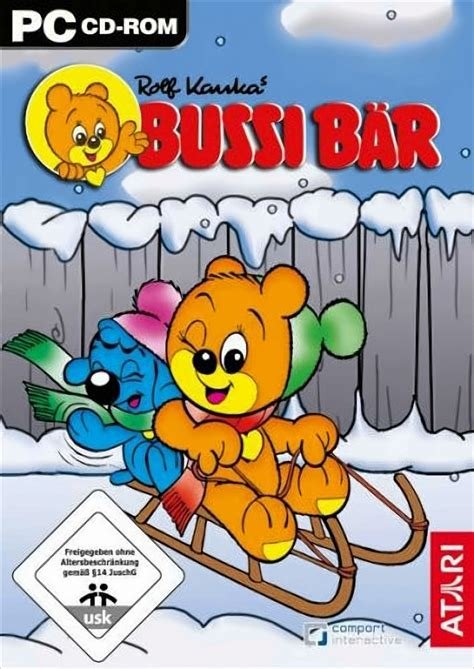
Description
Rolf Kaukas Bussi Bär is an educational game released in 2008 for Windows, featuring the beloved children’s magazine character Bussi Bär. Set in a winter wonderland around Bussi Bär’s house, the game offers a variety of mini-games designed to help young children develop basic cognitive and motor skills. Activities include addition games, concentration exercises, coloring pictures, sledding, building a snowman, and decorating a Christmas tree. The game also includes a printing function for coloring pictures and activities, and parents can set a timer to limit daily playtime.
Rolf Kaukas Bussi Bär: A Forgotten Gem of Children’s Edutainment
Introduction
In the late 2000s, as blockbuster franchises dominated gaming headlines, a humble educational title quietly carved out a niche for itself in German households: Rolf Kaukas Bussi Bär. Based on the eponymous children’s magazine character, this 2008 Windows game offered a cozy winter wonderland of mini-games designed to teach toddlers basic cognitive and motor skills. While overlooked by mainstream critics, Bussi Bär represents a fascinating case study in regionally targeted edutainment and the challenges of preserving low-budget children’s software. This review examines its legacy as both a pedagogical tool and a cultural artifact of 2000s German gaming.
Development History & Context
Studio Vision & Era Constraints
Developed by the small German studio destraX Entertainment (known for family-friendly titles like Fix & Foxi: Familienspiele) and published by *Atari Deutschland GmbH, Bussi Bär emerged during a transitional period for PC gaming. By 2008, high-definition 3D graphics were becoming standard, but destraX prioritized accessibility, crafting a game that could run on low-end hardware. The developers leaned into the point-and-click interface, avoiding complex controls to cater to preschoolers.
The Gaming Landscape
The late 2000s saw a surge in licensed children’s edutainment, with titles like V.Smile and LEGO Learning Series dominating the market. Bussi Bär differentiated itself by leveraging a pre-existing German IP—Rolf Kaukas’ beloved bear character—and focusing on seasonal winter activities. Its release coincided with the rise of digital storefronts, though physical copies remained prevalent in German retail, often bundled with parenting magazines.
Narrative & Thematic Deep Dive
Plot & Characters
The “narrative” is minimal but charming. Players join Bussi Bär, a cheerful anthropomorphic bear, in his snow-covered home and yard. There’s no traditional plot; instead, the game simulates a day of playful learning. Activities like decorating a Christmas tree or building a snowman are framed as cooperative tasks between Bussi and the player, fostering a sense of companionship.
Themes & Pedagogy
The game subtly reinforces themes of routine, creativity, and problem-solving:
– Mathematics: A simple addition game teaches counting.
– Motor Skills: Sledding requires timed clicks to navigate slopes.
– Artistic Expression: Coloring pages encourage creativity, with a printer function letting kids display their work offline.
– Concentration: Memory-matching games reward focus.
The inclusion of a parental timer underscores its commitment to balanced screen time—a forward-thinking feature for 2008.
Gameplay Mechanics & Systems
Core Loop & Mini-Games
The game structures learning through eight primary activities:
1. Snowman Construction: Drag-and-drop accessories onto a snowman.
2. Christmas Tree Decoration: Match ornaments by color and shape.
3. Sledding Reaction Test: Click to avoid obstacles while sledding downhill.
4. Math Puzzles: Solve addition problems with visual aids (e.g., apples).
5. Memory Cards: Flip cards to find pairs.
6. Coloring Book: Paint pre-drawn scenes.
7. Pattern Recognition: Complete sequences of winter-themed items.
8. Item Sorting: Organize tools by size and type.
Each mini-game rewards completion with playful animations but lacks difficulty scaling, which limits long-term engagement.
UI & Controls
The interface adopts a text-free design outside of menus, relying on icons and visual cues to accommodate non-readers. Navigation is intuitive, though some activities (e.g., sledding) suffer from imprecise hit detection.
World-Building, Art & Sound
Visual Design
The game’s art style mirrors the hand-drawn aesthetic of the Bussi Bär magazine, with soft watercolor textures and whimsical character designs. The winter setting is evoked through:
– Pastel Palette: Muted blues and whites dominate outdoor scenes, while indoor areas use warm yellows.
– Seasonal Details: Falling snowflakes, frosted windows, and crackling fireplaces enhance immersion.
Sound Design
A minimalist soundtrack mixes acoustic guitar melodies with ambient sounds like crunching snow and crackling fire. Bussi’s voice actor delivers encouraging feedback (“Gut gemacht!”) without overwhelming young players.
Reception & Legacy
Initial Reception
No formal critic reviews exist, but anecdotal evidence from German forums suggests it was well-received by its target demographic. Parents praised its focus on offline activities (e.g., printable coloring pages) and non-violent content.
Long-Term Impact
While Bussi Bär never achieved mainstream success, it spawned a 2009 sequel and remains a cult favorite among German retro gaming enthusiasts. Its abandonment of monetization tactics (e.g., microtransactions) contrasts sharply with modern children’s apps, making it a nostalgic curiosity.
Conclusion
Rolf Kaukas Bussi Bär is a time capsule of late-2000s German edutainment—a gentle, unambitious title that prioritized pedagogy over profit. Its simplistic design and lack of replayability prevent it from standing alongside classics like Reader Rabbit, but as a cultural artifact, it offers insight into a bygone era of regional, license-driven children’s software. For historians of gaming, Bussi Bär is a reminder that not all legacy titles need to be revolutionary; sometimes, they just need to make a child smile.
Final Verdict: A flawed but earnest educational tool, best preserved as a curiosity of its time.