
- Release Year: 1995
- Platforms: Windows
- Genre: Action
- Game Mode: Single-player
- Gameplay: Shooter
- Average Score: 83/100
Description
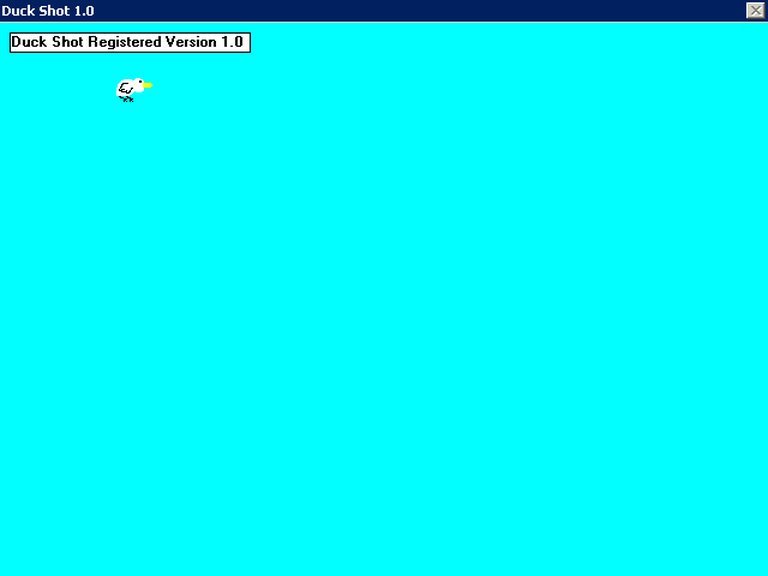
Duck Shot is a single-player arcade-style game inspired by Duck Hunt, where players shoot ducks that randomly appear on the screen in a ‘Whac-a-Mole’ fashion. With six ducks to target per round, the game offers no timer or scoring system but includes four adjustable difficulty settings to control the ducks’ speed, as well as a customizable option for varied gameplay. Upon shooting all ducks, players receive a congratulatory message and can replay indefinitely.
Duck Shot Reviews & Reception
mobygames.com (86/100): QuackShot Starring Donald Duck is a great Sega Genesis game, carrying on a tradition Sega started with Castle of Illusion, and it is also one of the best video games starring a Disney character.
reddit.com : On an artistic level this game is a marvel and it is satisfying to discover a game that visually is this beautiful and well detailed.
vgchartz.com : One of my top 10 favorite genesis games.. No, I’m not a disney fan, the game was just awesome..
imdb.com (80/100): Overall, Quackshot gets an 8 out of 10 from me.
Duck Shot Cheats & Codes
Sega Genesis (Game Genie)
Enter codes at the title screen. There are two versions of the game (A and B); try the other if one doesn’t work.
| Code | Effect |
|---|---|
| AJCA-AA2L / RECT-A6VE | Master code, must be entered |
| BBJA-AAD0 / BBJT-AAAA | Start with maximum power |
| AKJA-AAD0 / AKJT-AAAA | Start with less power |
| BBEA-AABW / BBEA-AAEG | Start with maximum power after you lose a Donald Duck |
| AKEA-AABW / AKEA-AAEG | Start with less power after you lose a Donald Duck |
| AKSA-AA24 / AKSA-AA9J | Almost infinite power (last boss’s sword can still hurt you) |
| AFJA-AABG / AFJA-AAFN | Start with 1 Donald Duck |
| AZJA-AABG / AZJA-AAFN | Start with 5 Donald Ducks |
| BBJA-AABG / BBJA-AAFN | Start with 8 Donald Ducks |
| BKJA-AABG / BKJA-AAFN | Start with 10 Donald Ducks |
| DFJA-AABG / DFJA-AAFN | Start with 25 Donald Ducks |
| GKJA-AABG / GKJA-AAFN | Start with 50 Donald Ducks |
| NPJA-AABG / NPJA-AAFN | Start with 99 Donald Ducks |
| AVEA-AA28 / AVEA-AA5W | Infinite Donald Ducks |
| AKJT-AA2J / AKJT-AA6W | Infinite popcorn on popcorn pick-up |
Sega Genesis (Action Replay)
Enter codes using an Action Replay device.
| Code | Effect |
|---|---|
| FF8F97:08 | Infinite Hits |
| FF8F99:09 | Infinite Lives |
| FF8F35:XX | Level Modifier (00 – Duckberg, 01 – Duckberg (Again), 02 – Mexico, 03 – Trans, 04 – Viking Ship, 05 – South Pole, 06 – Maharajah, 07 – Egypt, 08 – Hideout, 09 – The Island, 0A – Room 1, 0B – Room 2) |
| 005026:0007 | Start With Seven Lives |
| 005026:0009 | Start With Nine Lives |
| 00481E:6004 | Infinite Lives |
| 005E10:600C | Invulnerable To Enemy Attack |
| 005FDE:6002 | Donald Doesn’t Calm Down Until The End of A Level When He Loses His Temper |
| 007D0E:0001 | Donald Loses His Temper After Only One Chili Pepper |
| 00503C:31C2 | Begin The Game With About 15 Units of Popcorn |
| 005108:6002 | Once Your Grab Popcorn, It Never Decreases |
Sega Genesis (In-Game)
Perform the button sequence during gameplay after Donald eats a pepper and the game is paused.
| Code | Effect |
|---|---|
| Up, Up, Up, Up, Down | Temper Tantrum (Donald will lose his temper) |
QuackShot: Review
A Treasure Hunt Through Time – Revisiting Donald Duck’s Pinnacle 16-Bit Adventure
Introduction
In the pantheon of 16-bit Disney classics, QuackShot Starring Donald Duck stands not merely as a relic of nostalgia, but as a visionary hybrid of cinematic adventure and exploratory platforming. Released in 1991 for the Sega Genesis, this Sega-developed gem fused the anarchic charm of Disney’s most tempestuous icon with gameplay mechanics that quietly subverted linear conventions. Decades later, QuackShot remains a masterclass in world-building, marrying the globetrotting desperation of Indiana Jones with the kinetic absurdity of vintage Donald Duck cartoons. This review argues that QuackShot is not just a triumph of licensing but a foundational text in the evolution of the “Metroidvania” genre—a game whose legacy is etched in its painterly animation, inventive weaponry, and the sheer audacity of letting a plunger gun redefine platforming combat.
Development History & Context
QuackShot emerged during Sega’s fervent bid to rival Nintendo’s dominance in the console market. Developed by Sega’s internal AM7 team—led by director Emiko Yamamoto and artist Takashi Yuda—the game was part of a broader strategy to leverage Disney’s iconography following the success of Castle of Illusion Starring Mickey Mouse (1990). Yet QuackShot was no cynical cash-in. Drawing explicit inspiration from Spielberg’s Indiana Jones franchise (itself indebted to Carl Barks’ Uncle Scrooge comics), the team sought to craft an adventure that balanced Disney’s slapstick warmth with Sega’s penchant for technical ambition.
The Genesis’ hardware constraints—notably its limited color palette and sound capabilities—were turned into strengths. Artists employed meticulous sprite work to animate Donald’s signature tantrums and Pete’s hulking menace, while composer Shigenori Kamiya’s chiptune score evoked everything from Tex-Mex swagger (Mexico) to Transylvanian dread (Dracula’s Castle). Released in December 1991—mere months after the SNES’ debut—QuackShot was a statement piece: proof that Sega could deliver Disney magic without compromising its arcade-rooted identity.
Narrative & Thematic Deep Dive
At its core, QuackShot is a parable of greed redeemed by familial loyalty. The plot follows Donald after he discovers a partial treasure map in Scrooge McDuck’s library, hinting at the lost riches of King Garuzia. Ignoring girlfriend Daisy’s warnings, Donald enlists nephews Huey, Dewey, and Louie as pilots in a globe-spanning hunt—only to be stalked by rival Pete, whose design mirrors Raiders of the Lost Ark’s Belloq.
The narrative unfolds through environmental vignettes rather than cutscenes. In Mexico, a señorita cryptically demands a “hero key”; in Transylvania, a ghost reveals Dracula hoards the full map. Dialogue is sparse but potent, with Donald’s mute exasperation (a technical necessity, per IGN’s retrospective critique) lending pathos to his quest. Thematically, the game interrogates obsession: Donald’s initial avarice softens into determination as Pete kidnaps the nephews, forcing a climactic choice between treasure and family. The bittersweet finale—where the “treasure” is revealed as a mundane statue concealing a golden necklace—subverts expectations, rewarding humility over conquest. It’s a deft balance of Disney sentiment and adventure serial pragmatism.
Gameplay Mechanics & Systems
QuackShot’s genius lies in its plunger gun—a weapon that doubles as a traversal tool. Initially firing sticky plungers to stun enemies, it evolves via upgrades:
- Red Plunger: Creates temporary wall platforms for vertical scaling.
- Green “Viking” Plunger: Latches onto birds, enabling grapple-like swings across gaps.
Complemented by limited-use popcorn (spread shot) and bubblegum (wall-breaking explosives), the arsenal encourages experimentation. Yet progression hinges on nonlinear exploration, threading Metroid’s DNA into a family-friendly framework. Levels like Egypt or Duckburg’s rooftops feature multi-tiered paths, locked behind item-gated obstacles (e.g., the Scepter of Ra unlocks the South Pole’s ice-bound key).
The world map—a proto-fast travel system—lets players revisit prior zones via the nephews’ biplane, planting checkpoint flags to minimize backtracking. However, QuackShot isn’t flawless. Precision jumps occasionally suffer from “floaty” controls (IGN), while late-game zones (Pete’s Hideout, Treasure Island) spike in difficulty with insta-kill traps and finicky minecart sequences. The “Quack Attack” mechanic—where chili peppers trigger invincible rampages—adds whimsy but vanishes in later levels, undermining balance.
World-Building, Art & Sound
QuackShot’s globe-hopping locales remain visual marvels. Duckburg’s sun-drenched suburbs, rendered in lush greens and blues, contrast with India’s jewel-toned palace and the South Pole’s stark, penguin-dotted tundra. Each environment teems with kinetic detail: swaying cactus spines in Mexico, auroras shimmering over Viking ships, and Dracula’s castle dripping with candlelit gothic excess. Donald’s animation—stomping in impatience, waddling mid-jump—exudes personality, while bosses like Shere Khan (breathing pixelated fire) and a sword-wielding undead knight embody Disney-meets-Sega spectacle.
Kamiya’s soundtrack is equally evocative. The Duckburg theme’s jaunty saxophone channels Dixieland jazz, while Transylvania’s pipe-organ dirges and the Treasure Island’s percussive tension deepen immersion. Sound design punctuates action: the sproing of plunger shots, the crunch of Donald headbutting foes, and Pete’s guttural taunts form an auditory tapestry pivotal to the game’s charm.
Reception & Legacy
Upon release, QuackShot was a critical and commercial success. UK magazine Sega Pro (95/100) lauded its “breath-taking” pacing and “best graphics around,” though noted uneven difficulty. Computer and Video Games (89/100) praised its puzzles but cautioned its slower pace compared to pure action titles. It topped UK Genesis charts in late 1991, cementing Sega’s Disney partnership.
Retrospectively, opinions crystallize around its innovations. IGN’s 2008 review (7.3/10) highlighted the “excellent” art and music but lamented the lack of voice samples and “questionable controls.” Modern analysis (GamesRadar, VentureBeat) positions it as a proto-Metroidvania, influencing later exploratory platformers like Shantae. Its DNA surfaces in Disney’s Illusion Island (2023), while fan demand for remasters persists.
Notably, the unrelated 1995 freeware title Duck Shot—a barebones Whac-a-Mole clone—exists as a footnote, overshadowed entirely by QuackShot’s enduring cult status.
Conclusion
QuackShot Starring Donald Duck is more than a relic of the 16-bit wars. It is a masterful synthesis of Disney’s narrative warmth and Sega’s technical verve, a game that dared to equip a cartoon duck with a plunger gun and send him sprawling across a labyrinthine, interconnected world. While its control quirks and difficulty spikes frustrate, they pale against its triumphs: expressive animation, ingenious weapon-driven progression, and a soundtrack that conjures continents with a few chiptune notes. In video game history, QuackShot is a beacon—proof that licensed games could transcend cash-in mediocrity to become art. Donald Duck’s treasure hunt remains, unequivocally, a crown jewel of the Genesis era.