
- Release Year: 1999
- Platforms: Windows
- Publisher: Technical Group Laboratory, Inc.
- Developer: Technical Group Laboratory, Inc.
- Genre: Strategy, Tactics
- Perspective: Diagonal-down
- Game Mode: Single-player
- Gameplay: Point and select, Real-time, Unit management, Upgrades
- Setting: Fantasy
Description
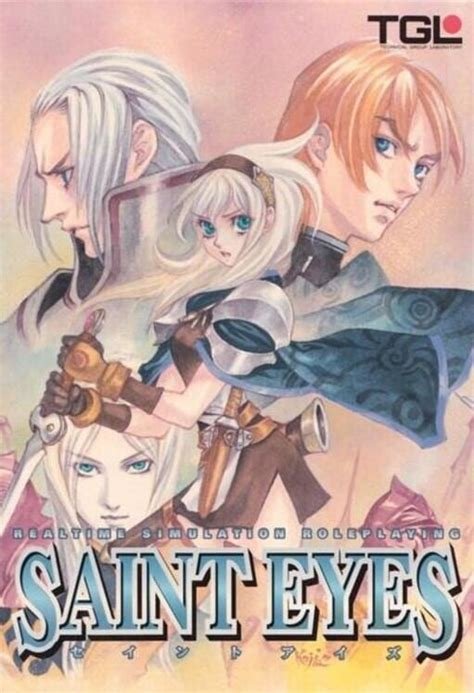
Saint Eyes is a real-time tactical strategy game set in a fantasy world where players command diverse armies, including male and female soldiers, archers, magicians, and more. The story follows Estelle, a priestess of a minority religion, who leads her allies against the invading Valde Empire to restore peace to the continent. Battles require tactical unit management, with survivors gaining upgrades for future encounters. The game features permadeath mechanics, no mid-battle saves, and intertwines political intrigue with strategic warfare across regions like Toro Village and the Carthian Kingdom.
Saint Eyes Free Download
PC
Saint Eyes Patches & Updates
Saint Eyes: Review
Introduction
In the twilight of the 20th century, amidst a sea of revolutionary 3D titles, Saint Eyes emerged as a defiantly 2D tactical gem. Released in 1999 by Japanese studio Technical Group Laboratory (TGL), this real-time strategy RPG carved a niche with its blend of anime storytelling, permadeath-driven progression, and unforgiving tactical combat. While overshadowed at launch by blockbusters like Starcraft and Final Fantasy VIII, Saint Eyes has since accrued a cult following—particularly in South Korea—thanks to its ambitious fusion of character-driven narrative and unit management. This review argues that Saint Eyes is an unheralded pioneer of persistence mechanics in strategy games, a flawed yet visionary experiment whose DNA echoes in modern titles like Fire Emblem and Valkyria Chronicles.
Development History & Context
The Studio and Its Vision
TGL (Technical Group Laboratory) was already a veteran of niche strategy RPGs by 1999, having honed its craft on the Farland Saga series. With Saint Eyes, the studio aimed to bridge the gap between Western real-time tactics (RTT) and Japanese narrative depth. As a latecomer to the Windows 95/98 era, it faced fierce competition from Blizzard’s Starcraft and Square’s Final Fantasy juggernauts. Yet TGL leaned into its strengths: hand-painted anime aesthetics, hybrid systems, and a refusal to abandon 2D spritework during the industry’s 3D craze.
Technological Constraints
Built for modest Pentium 100MHz systems with 32MB RAM, Saint Eyes prioritized fluid sprite animation over polygonal spectacle. Battles unfold via a diagonal-down perspective, evoking Ogre Battle’s theater of war, with units rendered as vibrant Kouji-designed sprites (the artist later known for Shakugan no Shana light novels). The lack of mid-battle saves—likely due to memory limitations—forced players into tense, unbroken campaigns, while CD-DA audio leveraged disc space for orchestral tracks rare in PC games of the era.
The 1999 Landscape
In Japan, Saint Eyes launched alongside Capcom’s Resident Evil 3 and Squaresoft’s Final Fantasy VIII—titans that drowned its marketing. In Korea, however, localized by Sego Entertainment, it tapped into a burgeoning PC bang culture and fantasy novel boom. Pirated copies flourished (due in part to its small 250MB footprint), embedding it in grassroots gaming circles despite minimal critical buzz.
Narrative & Thematic Deep Dive
A War of Gods and Generals
At its core, Saint Eyes is a medieval-political epic draped in theological conflict. Players follow Estelle, a blue-eyed priestess of the marginalized Gwangmo faith, who rallies Toro Village against the imperialist Valde Empire. The empire, manipulated by the corrupt Dirham Church, seeks to resurrect a dormant demonic force—a narrative scaffolding that recalls Final Fantasy Tactics’ church-state corruption.
Characters as Ideological Vessels
- Estelle: The titular “Saint Eyes” embodies hope and empathy, serving as both protagonist and phlebotomist of the game’s morale system. Her divine magic heals allies, but her death triggers instant failure—a mechanical reinforcement of her messianic role.
- Eugene: The fallen mediator and final boss mirrors Estelle’s powers but wields them for nihilistic ends. His tragedy—a priest corrupted by the Dirham Church’s dogma—echoes Berserk’s Griffith in miniature.
- Rosario: Valde’s pragmatic prince, whose coup against his brother (Hansel) frames war as cyclical rather than binary. His redemption arc—allying with Estelle against Eugene—interrogates “necessary evil” tropes.
Themes and Subtext
The Dirham-Gwangmo schism mirrors historical clashes between institutionalized religion (Dirham as medieval Catholicism) and grassroots spirituality (Gwangmo as animistic resistance). Ethan’s betrayal of Carthia’s prince Chris explores regent overreach, while mercenary Haran channels Legend of the Galactic Heroes’ archetypes, mentoring Estelle with world-weary pragmatism.
Gameplay Mechanics & Systems
The Bone-Grinding Core Loop
Battles unfold in real-time, with players directing 30 units across five squads (1-5 keys) against waves of AI-controlled foes. Each unit type—from shield-bearing Ironclads to artillery Gunners—demands distinct tactics:
– Archers auto-calculate ballistic trajectories (ahead-of-its-time feature), firing ahead of moving targets.
– Monks buff allies but crumple under direct assault.
– Mages unleash area spells at high MP cost, rewarding careful positioning.
Progression and Permadeath
Units earn XP to ascend five ranks, gaining stat boosts. If killed, they’re permanently lost—forcing players to recruit rookies mid-campaign. Estelle alone resurrects post-battle, cementing her as the strategic lynchpin. The system incentivizes veterancy but punishes recklessness, akin to XCOM’s Ironman mode.
Flaws and Innovations
- No Mid-Battle Saves: A contentious choice amplifying tension but also frustration during lengthy engagements.
- Rigid Formations: Pre-set formations (F1-F8 keys) limit tactical flexibility compared to free drag-select RTS contemporaries.
- AI Quirks: Enemy units “stagger” when struck, enabling stun-locking—abused by players to cheese bosses.
Interface and Difficulty
The mouse-driven UI feels archaic today, lacking unit hotkeys or attack-move commands. Difficulty spikes (e.g., Solar’s suicidal AI in “Anshan Plateau”) demand trial-and-error, while permadeath ensures losses cascade catastrophically. Still, mastery rewards players with crescendo moments—like gunner squads melting Eugene’s final form.
World-Building, Art & Sound
A Watercolor Apocalypse
Kouji’s art elevates Saint Eyes into a painterly vignette. Battlefields evoke medieval tapestries: marshes bloom with toxic greens; imperial forts loom in chiaroscuro grays. Character portraits fuse Record of Lodoss War-era aesthetics with ethereal glow effects—Estelle’s emerald eyes mirroring the game’s titular “Saint Eyes.”
Soundscapes of War
CD-DA tracks oscillate between haunting choral hymns (Gwangmo shrines) and percussive war drums (Valde sieges). Unit barks—though untranslated in pirated copies—sell desperation: archers shriek when flanked, while mages chant incantations. The lack of voice acting focuses attention on environmental storytelling, like villages crumbling post-siege.
Atmosphere as Antagonist
The world feels inhospitable, not heroic fantasy. Dirham zealots torch dissenters; Valde’s generals debate morality mid-carnage. Even Estelle’s powers can’t cleanse battlefields littered with corpses—a stark rebuttal to Fire Emblem’s sanitized warfare.
Reception & Legacy
Launch and Contemporary Reception
Japan’s Famitsu awarded 28/40 (7/7/7/7), praising its “compelling unit roster” but docking points for clunky controls. Korea’s PC Player celebrated its narrative depth, dubbing it “Game of Thrones meets Ogre Battle.” Commercially, it underperformed—TGL folded by 2005—but piracy seeded a grassroots following.
Posthumous Reappraisal
Abandonware communities resurrected Saint Eyes in the 2010s, modding widescreen support and fan translations. Critics now highlight its proto-Dark Souls persistence mechanics (unit veterancy) and moral ambiguity—Rosario’s arc foreshadows Trails of Cold Steel’s conflicted antagonists.
Influence on the Genre
While not a direct inspiration, Saint Eyes’ blend of RTT and RPG elements presaged Valkyria Chronicles’ hybrid combat. Its perma-death tension and unit bonding echoed in Into the Breach and XCOM 2. Yet its greatest legacy is cultural: a testament to how niche titles persevere through player passion.
Conclusion
Saint Eyes is a flawed masterpiece—a game whose technical limitations and brutal mechanics clash with its narrative ambition. It demands patience: to forgive its janky UI, to mourn lost units, to parse its dense lore. But for those who endure, it offers a richness absent in sanitized modern tactics games. Its tale of faith, betrayal, and redemption—woven through Kouji’s art and TGL’s systems—cements it as a vital artifact of JRPG-strategy fusion. Not merely a relic, but a beacon for what the genre could—and should—dare to be.
Final Verdict: A 7/10 game with a 10/10 soul. Essential for historians; rewarding for masochists.