
- Release Year: 2015
- Platforms: Macintosh, Windows
- Publisher: Solidplasma Studios LLC
- Genre: Action
- Perspective: Side view
- Game Mode: Single-player
- Gameplay: Direct control, Platformer, Puzzle
- Average Score: 76/100
Description
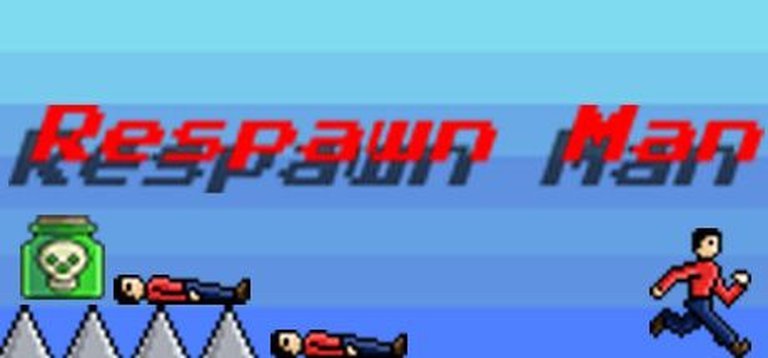
Respawn Man is a 2D side-scrolling platformer released in 2015 where players navigate challenging environments filled with obstacles and puzzle elements. With a focus on the titular character’s ability to respawn, the game leverages GameMaker-engine mechanics to blend fast-paced action with strategic problem-solving, set against a dynamic backdrop featuring the recurring character Death.
Gameplay Videos
Where to Buy Respawn Man
PC
Respawn Man Patches & Updates
Respawn Man Mods
Respawn Man Guides & Walkthroughs
Respawn Man Reviews & Reception
steambase.io (78/100): Respawn Man has achieved a Steambase Player Score of 78 / 100.
completionist.me (69/100): Game Rating 69.00
mobygames.com : Moby Score n/a
store.steampowered.com (81/100): 81% of the 27 user reviews for this game are positive.
Respawn Man: Review
Introduction
At first glance, Respawn Man (2015) appears to be another tongue-in-cheek indie platformer—until you realize its central mechanic transforms death from a punishment into a tool. Developed by Evan “Solidplasma” Peiperl under Solidplasma Studios LLC, this Windows/Mac title merges macabre humor, punishing precision, and systemic inventiveness into a puzzle-platformer that revels in its own absurdity. While not a commercial juggernaut, its legacy lies in its audacious reimagining of failure: here, dying is progress. This review dissects how Respawn Man leverages mortality as both a narrative punchline and a mechanical cornerstone, carving a niche in the crowded indie landscape of the mid-2010s.
Development History & Context
Respawn Man emerged during a pivotal era for indie developers. By 2015, platforms like Steam had democratized distribution, enabling solo creators like Peiperl to compete alongside AAA titans. Built using the accessible GameMaker engine, the game embraced the retro-minimalist aesthetic popularized by contemporaries like VVVVVV—no coincidence, given its soundtrack was composed by SoulEye (Magnus Pålsson), same as the latter.
The game’s release on December 21, 2015, positioned it as a holiday-season curiosity rather than a blockbuster contender. Yet its timing was strategic: the indie scene was booming with experimental titles (Super Meat Boy, Celeste) that celebrated difficulty. Peiperl’s twist? Weaponizing death itself. In an era where “permadeath” and “roguelike” were buzzwords, Respawn Man flipped the script, inviting players to embrace failure—literally building bridges from their corpses.
Narrative & Thematic Deep Dive
The “plot” is delightfully threadbare: a hapless, red-shirted protagonist navigates 30+ levels, dying repeatedly to spikes, poison, drowning, and gravity. Story beats are minimal, but the game’s subtext is a darkly comic meditation on persistence. Each death isn’t a setback but a resource—a corporeal stepping stone toward progress.
Thematically, Respawn Man channels absurdist philosophy. The protagonist’s Sisyphean struggle mirrors Camus’ “one must imagine Sisyphus happy,” reframing futility as empowerment. Death is trivialized, rendered slapstick: achievements reward dying 1,000 times (“You get used to it”) or expiring mid-fall into water while poisoned (“Overkill”). This nihilistic humor is amplified by the post-level title screen, where players gleefully fling accumulated corpses like ragdolls.
Characters are archetypes—Death appears as a glib observer—but the real narrative unfolds through gameplay. Each corpse tells a story of trial, error, and incremental mastery.
Gameplay Mechanics & Systems
At its core, Respawn Man is a precision platformer with a grim innovation: corpses persist. Dying leaves behind a physics-enabled body that can be used as a platform, counterweight, or shield. This mechanic births fiendish puzzles:
- Corpse Chaining: Die strategically to create staircases across spikes or gaps.
- Limited Lives: Finite “continues” per level pressure players to balance reckless experimentation with resource management.
- Dynamic Challenges: Achievements like “Stayin’ Alive” (complete a level death-free) and “Zombies are overdone” (defeat the boss with ≤6 active corpses) demand divergent playstyles.
The UI is sparse but functional, emphasizing clarity. A counter tracks deaths, while corpses fade to translucent silhouettes to avoid visual clutter. Controls are tight, though some players critiqued floaty jump physics—a minor gripe in an otherwise polished system.
Post-launch, Steam Workshop support extended longevity, enabling user-generated levels. Tools were rudimentary but functional, fostering a modest community of masochistic architects.
World-Building, Art & Sound
Respawn Man’s world is a garish, retro-styled purgatory. Levels are divided into themed segments—”Dawn,” “Day,” “Dusk”—each escalating in visual complexity: Dawn’s sparse spikes give way to Dusk’s labyrinthine machinery. The art’s simplicity serves gameplay: hazards are unmistakable, corpses visually distinct.
SoulEye’s chiptune soundtrack is a highlight. Tracks oscillate between adrenaline-pumping arpeggios (“Dawn”) and melancholic synths (“Dusk”), mirroring the protagonist’s futile journey. Sound design is minimalist but effective: squelchy death noises and the metallic clang of spikes undercut tension with dark comedy.
Atmosphere leans into the grotesque: the title screen’s corpse-flinging minigame and achievements like “The Organic Titanic” (dying in water within 10 seconds) cement the game’s tone as a celebration of failure.
Reception & Legacy
Upon release, Respawn Man garnered a “Mostly Positive” Steam rating (81% of 27 reviews). Critics applauded its creativity but noted janky physics and a steep learning curve. Player reviews praised its “devilishly clever” corpse mechanics and SoulEye’s soundtrack, while others bemoaned “repetitive” late-game puzzles.
Commercially, it was a sleeper hit—modest sales (1,092 owners, per completionist.me) but enduring cult appeal. Its legacy is twofold:
1. Mechanical Influence: Preceding games like Hades and Deathloop, it normalized respawning as a narrative device, not just a convenience.
2. Indie Design Philosophy: It exemplified the mid-2010s indie ethos—high concept, low budget, maximal creativity.
The game’s Workshop integration and achievement-driven replayability (average completion time: 3h 24m) sustained a niche audience. By 2025, its Discord community still shared custom levels, though activity had dwindled.
Conclusion
Respawn Man is a paradox: a game about dying that feels vibrantly alive. Its genius lies in transforming a genre staple (death) into a playful, systemic cornerstone. While not without flaws—floaty controls, occasional repetition—it remains a benchmark for indie innovation. In an industry obsessed with “winning,” Respawn Man dares players to find joy in losing, building victory from a pile of corpses. A decade later, its dark humor and mechanical audacity cement it as a cult classic—a testament to the power of small teams thinking big.
Final Verdict: A morbidly inventive gem. Not essential for casual players, but indispensable for puzzle-platformer devotees.