
- Release Year: 1999
- Platforms: Windows
- Publisher: ValuSoft, Inc.
- Developer: Lupine Games
- Genre: Strategy, Tactics
- Perspective: Diagonal-down
- Game Mode: Single-player
- Gameplay: Character-based, Level-based, Point and select, Real-time tactics
- Setting: Historical events, North America
- Average Score: 57/100
Description
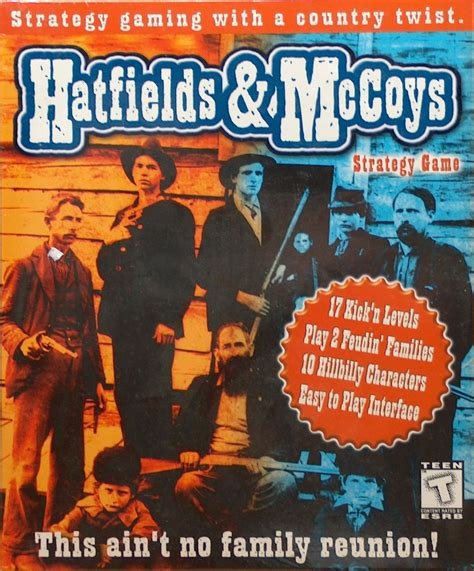
Hatfields & McCoys: Strategy Game is a real-time tactical strategy game set in late 1800s Kentucky, based on the infamous feud between the historical families. Players choose either the Hatfields or McCoys, leading hillbilly characters across 17 levels to outmaneuver and shoot rival family members in cartoony isometric environments. The game blends historical inspiration with arcade-style combat, featuring 10 unique characters and bright, exaggerated visuals reminiscent of animated series.
Hatfields & McCoys: Strategy Game Cracks & Fixes
Hatfields & McCoys: Strategy Game Patches & Updates
Hatfields & McCoys: Strategy Game Reviews & Reception
mobygames.com (55/100): An isometric strategy game set in late 1800s Kentucky, featuring the two families from the famous feud.
gamefaqs.gamespot.com (60/100): 1 users have rated this game (average: 3 / 5).
Hatfields & McCoys: Strategy Game: Review
An In-Depth Postmortem of Historical Discord Turned Digital Misfire
Introduction
The Hatfield-McCoy feud is etched into American folklore as a brutal, generation-spanning conflict—ripe material for a video game narrative exploring tribalism, vengeance, or moral decay. Hatfields & McCoys: Strategy Game (1999) attempts to weaponize this legacy but reduces it to a shallow real-time tactics simulator. Lupine Games’ reinterpretation of Appalachia’s most infamous blood feud fails as both historical commentary and engaging strategy, offering little beyond rudimentary combat and tonal whiplash. This review dissects its flawed execution, misguided vision, and paradoxical identity as a cartoonish romp through historical trauma.
Development History & Context
The Studio and Vision
Developed by Lupine Games and published by ValuSoft—a budget-label specialist known for low-cost titles like 3D Home Architect—the game emerged during the late ’90s RTS (real-time strategy) boom. While Command & Conquer and StarCraft defined the era with complex systems, ValuSoft targeted casual audiences with accessible, niche historical adaptations. Lupine’s ambition, per promotional material, was to deliver “17 levels of backwoods warfare” framed by isometric visuals.
Technological Constraints
Built for Windows 95/98 systems, the game leveraged pre-rendered sprites and fixed camera angles to minimize hardware strain. However, limitations manifested in static environments, rudimentary AI (enemies patrol rigidly until ambushed), and no multiplayer—a baffling omission for a feud-themed game. Designed to run on low-spec PCs, it prioritized accessibility over depth, aligning with ValuSoft’s budget-focused catalog.
Gaming Landscape
In 1999, the strategy genre bifurcated between AAA titans (Age of Empires II) and bargain-bin curiosities. Hatfields & McCoys landed in the latter category, competing with titles like Chicago 1930 but lacking their ambition. Its release coincided with a wave of “edutainment” titles romanticizing American history (Oregon Trail, Civil War Generals 2), yet it sidestepped educational substance in favor of trivialized conflict.
Narrative & Thematic Deep Dive
Plot and Characters
The game offers no cinematic intro, contextual dialogue, or historical synopsis. Players select either the Hatfields or McCoys across 17 missions, each framed as retaliatory skirmishes (“The neighbors are acting up again!”). Characters are reduced to “hillbilly” archetypes—10 units per faction, unnamed and mechanically identical except for weapon loadouts (rifles, pistols). Absent are famed figures like Devil Anse Hatfield or Randolph McCoy; instead, generic farmers embody the feud.
Dialogue and Themes
Units spout repetitive barks (“Got ’im!” or “Let’s move!”), devoid of personality or narrative weight. The feud’s origins—land disputes, wartime betrayal, and Romeo-and-Juliet romance—are ignored, reducing the conflict to perpetual shoot-first vendettas. Themes of cyclical violence are unintentionally mirrored in gameplay via respawning enemies, yet the game never critiques or contextualizes this brutality.
Tonal Dissonance
Despite its violent premise, Hatfields & McCoys sanitizes bloodshed with slapstick death animations (characters “jauknuti i odletjeti s ekrana” [yell and fly offscreen], per Hacker’s review) and colorful, cartoonish visuals. This clash—familial slaughter rendered as Looney Tunes escapism—raises ethical questions about trivializing real trauma, as the Croatian review bluntly asks: “Kakvu će pouku izvući djeca iz ove igre?” (“What lesson will children draw from this game?”).
Gameplay Mechanics & Systems
Core Loop
Missions task players with wiping out enemy units using real-time tactics. Key mechanics include:
– Ambush Tactics: Hide units behind foliage or structures, then flank enemies.
– Unit Management: Command 2–5 units with point-and-select movement, though pathfinding often falters.
– Resource-Free Combat: No bases, economies, or reinforcements—just attrition warfare until one side falls.
Combat and AI
Fights are simplistic: target an enemy, click to shoot, repeat. Units auto-return fire but lack self-preservation instincts, rushing into kill zones. Enemy AI alternates between passive patrolling and suicidal aggression, nullifying strategic depth.
Progression and UI
No RPG-like progression or unlockables exist. The UI is sparse, with minimal HUD elements (health bars, ammo counts) and a clunky radial menu for unit commands. Mission variety is illusory—objectives boil down to “kill all enemies” across nearly identical rural maps (forests, barns, creeks).
Innovations and Flaws
The game’s sole innovation—moral alignment via faction choice—proves hollow: both sides play identically. Flaws, however, abound:
– Repetitive Design: Missions blur together, lacking environmental storytelling.
– Technical Jank: Units clip through terrain; hit detection falters at medium range.
– No Difficulty Scaling: Enemy numbers increase, but tactics remain brainless.
World-Building, Art & Sound
Visual Design
The isometric perspective showcases pre-rendered 2D sprites against vibrant, oversized environments. Tree stumps resemble lollipops; barns tilt at Dr. Seussian angles. Character models, while detailed for a budget title, exude Saturday-morning-cartoon absurdity—an aesthetic clash with the grim source material.
Atmosphere
Kentucky’s Appalachian setting is evoked through syrupy greens and folksy structures, yet static backgrounds and absent weather effects sap immersion. Crates and haystacks serve as generic cover, devoid of interactive flourish.
Sound Design
A twangy banjo soundtrack nods to regional folk music but loops gratingly. Sound effects—gunshots, yelps, and ricochets—are serviceable but lack punch. Voice acting is limited to unit acknowledgments, recorded with low-fi grit.
Reception & Legacy
Critical Response
The game earned middling reviews upon release:
– Hacker (55/100): Criticized its childish tone and repetitive design, noting, “Najbolji dio igre su napravljene i šarene mape” (“The best part of the game is the colorful, cartoonish maps”).
– Player Reception: GameFAQs users rated it 3/5 (~20 hours playtime), citing “Just Right” difficulty but lamenting its wasted potential.
Commercial Performance
As a ValuSoft budget title, sales data is scarce, but its print run was likely limited. No sequels or remasters followed.
Legacy and Influence
Hatfields & McCoys faded into obscurity, eclipsed by deeper historical strategy games (Ultimate General: Gettysburg). Its sole legacy is as a curio—a misfire that trivializes tragedy while failing to innovate tactically.
Conclusion
Hatfields & McCoys: Strategy Game is a perplexing artifact. Lupine Games’ attempt to gamify America’s most infamous feud collapses under the weight of tonal dissonance, mechanical shallowness, and ethical myopia. While its cartoon aesthetic and accessible design might briefly entertain undemanding players, it squanders its rich source material, reducing a complex historical saga to click-to-kill drudgery. As both strategy and storytelling, it stands as a cautionary tale—proof that not all legends deserve the interactive treatment. For historians and gamers alike, this feud is best left in the archives.
Final Verdict: A forgettable skirmish in the annals of strategy gaming—2/5 stars.