
- Release Year: 2003
- Platforms: Macintosh, Windows
- Publisher: 1C Company, 2K Games, Inc., ak tronic Software & Services GmbH, Gathering of Developers, Inc., MacSoft, Mastertronic Games Ltd., Novitas Publishing GmbH, Take-Two Interactive Software, Inc., United Independent Entertainment GmbH
- Developer: PopTop Software Inc.
- Genre: Simulation, Strategy, Tactics
- Perspective: Diagonal-down
- Game Mode: LAN, Online PVP, Single-player
- Gameplay: Business simulation, Economic management, Industry Management, Managerial, Railroad Building, Stock Market
- Setting: Historical, Industrial
- Average Score: 84/100
Description
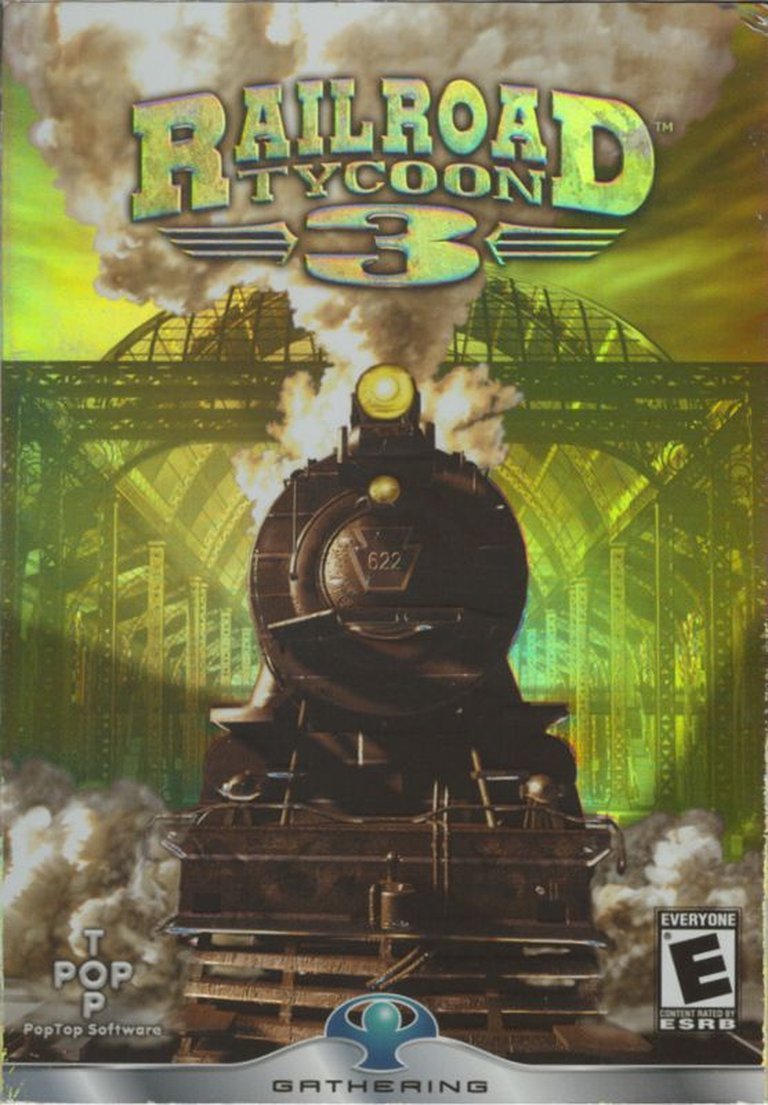
Railroad Tycoon 3 is a 3D business simulation game where players build and manage their own railroad empire. The game focuses on three key aspects: railroad building, where players plot routes and manage supply and demand; economy, where players can buy businesses, open restaurants, and hotels; and the stock market, where players can invest in other rail companies and manipulate the market to increase their wealth. Players can compete online to become the wealthiest tycoon.
Gameplay Videos
Where to Buy Railroad Tycoon 3
Railroad Tycoon 3 Free Download
Railroad Tycoon 3 Cracks & Fixes
Railroad Tycoon 3 Patches & Updates
Railroad Tycoon 3 Mods
Railroad Tycoon 3 Guides & Walkthroughs
Railroad Tycoon 3 Reviews & Reception
monstercritic.com (80/100): A fully realised 3D gaming world scaling from eye in the sky views of entire continents down to incredibly detailed close-ups of beautifully modelled locomotives, buildings and landscapes.
metacritic.com (95/100): A rich, immersive strategy title sure to please most dyed in the wool simulation and strategy fans. Highly Recommended to all, even those who may need more of a learning curve.
steambase.io (77/100): Railroad Tycoon 3 has earned a Player Score of 77 / 100. This score is calculated from 1,220 total reviews which give it a rating of Mostly Positive.
gamespot.com : Railroad Tycoon III is surprisingly easy to learn for a game of its scope, and it has something for anyone with a fondness for trains or making loads of money–which means just about everyone.
Railroad Tycoon 3 Cheats & Codes
PC
Press the period key (.) during gameplay to activate the cheat console, then enter one of the codes listed below.
| Code | Effect |
|---|---|
| we have a winner gold | Win the game (Gold Medal) |
| we have a winner silver | Win the game (Silver Medal) |
| we have a winner bronze | Win the game (Bronze Medal) |
| we have a winner | Win the game |
| all is lost | Lose the game |
| big dog | Give your player $10 million |
| fat cat | Give your player $1 million |
| bailout | Give your company $10 million |
| subsidy | Give your company $1 million |
| passport | Give your company access to all territories |
| go go go | All trains go double speed |
| oops | All trains crash |
| trains are in my blood | All locomotive types available for purchase |
| double shift | Buildings produce cargo at double normal rates |
| safety first | Trains never crash |
| upgrade | All trains upgraded to HST 125 (A nice diesel) |
| orca | Get the Orca engine |
Railroad Tycoon 3: Review
Introduction
In the pantheon of tycoon simulations, few franchises command the reverence of Railroad Tycoon. Released in 2003, Railroad Tycoon 3 marked a pivotal moment for the series, marrying the strategic depth of its predecessors with a bold leap into 3D graphics and dynamic economic systems. Developed by PopTop Software and published by Gathering of Developers, the game challenged players to build rail empires across historical and futuristic landscapes, balancing capitalism’s ruthlessness with the romanticism of steam-powered progress. This review argues that Railroad Tycoon 3 successfully modernized the franchise while retaining its soul, even if certain design choices sparked divisive reactions among longtime fans.
Development History & Context
PopTop Software, fresh off the success of Tropico (2001), sought to revitalize a series that had begun with Sid Meier’s 1990 classic. Led by Phil Steinmeyer, the team spent two-and-a-half years developing Railroad Tycoon 3, including 18 months dedicated solely to its proprietary 3D engine—a significant departure from the semi-3D systems of Railroad Tycoon II (1998). The early 2000s gaming landscape was shifting toward immersive simulations, with titles like RollerCoaster Tycoon dominating the genre. PopTop aimed to bridge accessibility and complexity, leveraging new hardware capabilities while ensuring the game could run on modest PCs (e.g., 400 MHz processors).
Technological constraints forced creative solutions: The team implemented six LOD (level-of-detail) variants for objects, reducing polygon counts from 931 to 55 based on camera distance. Despite Steinmeyer’s initial skepticism about 3D’s suitability for strategy games, the result was an engine that allowed full camera rotation and zooming—a first for the series.
Narrative & Thematic Deep Dive
While Railroad Tycoon 3 lacks a traditional narrative, its 16 scenarios function as vignettes of railroading history, framed as exhibits in a virtual museum narrated by an avuncular curator. From the 1840s “Go West!” mission—tasking players with linking Boston to Buffalo—to the futuristic “Dutchlantis” (2080), the game explores themes of industrialization, monopolistic ambition, and geopolitical influence.
The scenarios are steeped in historical authenticity: “Central Pacific” recreates the race to complete the Transcontinental Railroad, while “The Orient Express” challenges players to forge a luxury line across Europe. These missions underscore railroads as instruments of power, echoing real-world tycoons like Cornelius Vanderbilt. The absence of character-driven storytelling is compensated by systemic narratives—economic booms, rival buyouts, and city growth—that emerge organically from player decisions.
Gameplay Mechanics & Systems
At its core, Railroad Tycoon 3 revolves around three pillars: rail network construction, economic manipulation, and stock market dominance.
-
Track Building & Logistics
The game introduced free-angle track laying, tunnels, and switchbacks, allowing players to navigate mountains and rivers with unprecedented flexibility. Terrain gradients (color-coded from green/optimal to red/steep) impacted train efficiency, incentivizing thoughtful route planning. However, the interface sometimes struggled with automatic track alignment, leading to finicky adjustments. -
Dynamic Economy
Goods no longer magically appeared at stations; instead, raw materials like coal and lumber moved autonomously via rivers or roads, simulating pre-rail infrastructure. Factories processed these into higher-value goods (e.g., cotton to textiles), creating supply chains. Prices fluctuated based on regional demand, rewarding players who optimized routes. -
Stock Market & Automation
The stock market allowed hostile takeovers, short-selling, and bond issuance, reflecting real-world financiers’ cutthroat tactics. Controversially, PopTop automated micromanagement tasks: Trains auto-selected cargo based on profitability, and “folding” camera zoom replaced traditional controls—a flaw critics called “EXTREMELY annoying” (Cadorna, MobyGames). -
Multiplayer & Modding
LAN and internet multiplayer supported up to eight players, though connectivity issues plagued early sessions. The community thrived via modding tools, creating custom locomotives, maps, and scenarios like the “New American Millennium” mod.
World-Building, Art & Sound
Railroad Tycoon 3’s switch to 3D was transformative. Players could zoom from continent-wide views to intricate close-ups of Victorian-era locomotives, their pistons churning as they climbed gradients. Water effects and day-night cycles added immersion, though towns felt sparse, with limited architectural variety.
The art direction balanced realism with approachability: Trains were meticulously modeled, but landscapes lacked granular detail. Sound design excelled, blending bluegrass, blues, and Americana soundtracks with ambient noises—whistles, clattering tracks—to evoke the era. Critics praised the audio but noted repetition in the score.
Reception & Legacy
Upon release, Railroad Tycoon 3 earned an 83% average critic score (MobyGames) and accolades like GameSpy’s 2003 “PC Empire Builder of the Year.” Praise centered on its accessible depth and graphical leap, while criticism targeted the divisive camera system and simplified micromanagement.
The game’s legacy is multifaceted:
– Influence: It inspired later sims like Railway Empire (2018), particularly in dynamic economy design.
– Community: Modders kept the game alive for decades, crafting new scenarios and locomotives.
– Cultural Impact: Featured in 1001 Video Games You Must Play Before You Die, it remains a touchstone for transport sims.
Yet, some franchise veterans still consider Railroad Tycoon II the series’ peak, arguing that RT3’s concessions to accessibility diluted its strategic rigor.
Conclusion
Railroad Tycoon 3 is a watershed title that redefined the series for a new generation. Its 3D engine and economic innovations set benchmarks for the genre, even as its UI quirks and automation polarized purists. While not without flaws, the game’s blend of historical storytelling, strategic depth, and visual charm secures its place as a classic—one that reminds us why railroads remain enduring symbols of ambition and ingenuity. For newcomers, it’s a compelling entry point; for veterans, a flawed but fondly remembered sequel. All aboard.