
- Release Year: 2010
- Platforms: Windows
- Publisher: Akella
- Genre: Compilation
- Game Mode: Co-op, Online Co-op, Online PVP
- Average Score: 63/100
Description
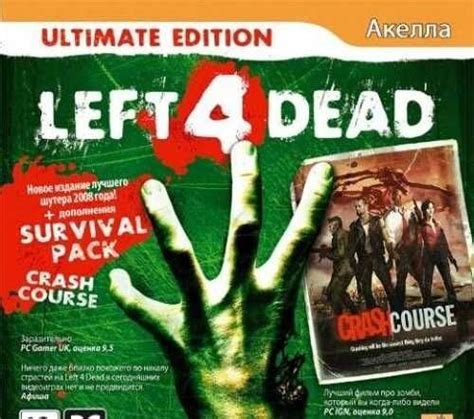
Left 4 Dead + Survival Pack + Crash Course is a cooperative first-person shooter set in a zombie apocalypse, where four survivors battle hordes of infected enemies while traversing perilous environments. This compilation includes the base game Left 4 Dead (2008) and two free DLCs: Crash Course, a short campaign bridging key story moments, and Survival Pack, which adds new challenge modes. Players work together to survive dynamic attacks from specialized infected, utilizing weapons and teamwork to reach evacuation points.
Gameplay Videos
Left 4 Dead + Survival Pack + Crash Course Cracks & Fixes
Left 4 Dead + Survival Pack + Crash Course Guides & Walkthroughs
Left 4 Dead + Survival Pack + Crash Course Reviews & Reception
metacritic.com (76/100): Crash Course doesn’t change the basic nature of Left 4 Dead, but like most good content packs delivers a jolt of energy into an existing gameplay formula. It’s something any fan of the original is sure to appreciate…
gamesradar.com : It’s L4D’s best siege by far – keeping two plates spinning while wave after wave of flesh-munching freaks pour in.
gamefaqs.gamespot.com (50/100): Crash Course is bad. That’s all there is to it.
consolemonster.com : Crash Course is a welcome addition to an already fantastic game.
Left 4 Dead + Survival Pack + Crash Course Cheats & Codes
PC
Enable the developer console in Options > Keyboard/Mouse, then press ~ during gameplay to open the console. Enter ‘sv_cheats 1’ to enable cheats.
| Code | Effect |
|---|---|
| sv_cheats 1 | Enables cheat mode |
| god | Grants invincibility |
| buddha 1 | God mode with damage |
| noclip | Toggles no-clip mode |
| sv_infinite_ammo 1 | Unlimited ammunition |
| give pistol | Gives pistol |
| give health | Grants full health |
| give ammo | Grants full ammunition |
| z_spawn weapon_SMG | Spawns SMG |
| z_spawn hunter | Spawns Hunter enemy |
| z_spawn boomer | Spawns Boomer enemy |
| z_spawn smoker | Spawns Smoker enemy |
| z_spawn witch | Spawns Witch enemy |
| z_spawn tank | Spawns Tank enemy |
| z_spawn mob | Spawns zombie horde |
| z_spawn zombie | Spawns single zombie |
| give hunting_rifle | Spawns hunting rifle |
| give autoshotgun | Spawns auto shotgun |
| give first_aid_kit | Spawns first aid kit |
| give pain_pills | Spawns pain pills |
| give pipe_bomb | Creates pipe bomb |
| give molotov | Creates molotov |
| give gascan | Spawns gas can |
| give oxygentank | Spawns oxygen tank |
| give propanetank | Spawns propane tank |
| director_stop | Disables all wanderers, mobs, specials, bosses |
| director_force_panic | Forces a panic event |
| director_panic_forever 1 | Toggles never-ending panics |
| z_common_limit | Set maximum number of regular zombies |
| z_speed | Changes zombie speed |
| z_health | Change zombie health |
| tongue_range | Set maximum range of Smoker’s tongue attack |
| thirdperson | Set camera to third-person mode |
| firstperson | Play in first-person mode |
| thirdpersonshoulder | Sets camera to over-the-shoulder third-person mode |
| ent_remove | Removes all bots |
| nb_blind 1 | Infected cannot see you |
| warp_all_survivors_here | Teleports all survivors to your position |
| warp_all_survivors_to_checkpoint | Teleports all survivors to the nearest checkpoint |
| warp_all_survivors_to_finale | Teleports all survivors to the finale |
| warp_to_start_area | Teleport yourself to the next chapter |
| changelevel | Quick change map |
| map | Start LAN server |
| sv_lan 0 | Enable Internet LAN |
| openserverbrowser | Display available servers |
| retry | Unlocks achievements while using cheats |
| ent_fire !self setteam 1 | Be spectator |
| ent_fire !self setteam 2 | Be survivor |
| ent_fire !self setteam 3 | Be infected |
| sb_friendlyfire | Sets whether bots can inflict friendly fire damage |
| z_witch_allow_change_victim | Allows the Witch to change targets |
| z_witch_burn_time | Sets time for a Witch to die from burning |
| z_witch_damage | Sets the Witch’s damage level |
| z_tank_health | Sets maximum Tank health |
| z_frustration_lifetime | Set seconds until player loses control of the Tank |
| director_no_mobs | Disables mob rushes |
| director_no_human_zombies | Toggles controllable boss Infected on any map |
| z_mega_mob_size | Set number of panic zombies |
| z_pounce_damage | Amount of damage you want to do to survivors |
| tongue_fly_speed | Set amount of speed for the Smoker’s tongue |
| z_pounce_door_damage | Set desired amount of damage to pounce through doors |
| sb_give | Give desired entity to your bot teammates |
| sb_openfire | Makes your bot teammates shoot nonstop |
| impulse 10 | All weapons and ammunition |
| impulse 101 | Gives ammo to your primary weapon |
| kill | Commit suicide |
| quit | Quit game |
Left 4 Dead + Survival Pack + Crash Course: A Comprehensive Retrospective on Valve’s Co-op Masterpiece
Introduction
In the pantheon of cooperative gaming, few titles loom as large as Left 4 Dead (2008). Bundled with its contentious yet integral DLC expansions—the free Survival Pack (2009) and the bridge-building Crash Course (2009)—this compilation represents Valve’s bold experiment in emergent, procedurally driven multiplayer horror. Set against a rabies-like apocalyptic outbreak, Left 4 Dead redefined teamwork under pressure, marrying the chaos of zombie films like 28 Days Later with systemic ingenuity. This review argues that while the bundle’s value is buoyed by relentless gameplay innovation, its legacy is tempered by missed narrative opportunities and the nascency of its DLC model.
Development History & Context
Studio Vision & Technological Constraints
Developed by Turtle Rock Studios (acquired by Valve in 2008), Left 4 Dead emerged from a Counter-Strike mod concept called “Terror Strike,” envisioned as a four-player defense against endless waves. Valve’s integration transformed it into a dynamic, replayable experience via the AI Director—a system that adjusted enemy spawns, item placement, and mood in real-time based on player performance. Built on the aging Source engine, the team prioritized atmospheric fidelity: multi-core CPU support enabled hundreds of on-screen infected, while physics-driven animation lent grotesque realism to zombie movements.
The Gaming Landscape of 2008–2010
Released amid a surge in cooperative titles (Gears of War 2, Resident Evil 5), Left 4 Dead stood out by rejecting scripted sequences in favor of procedural tension. The Survival Pack and Crash Course DLCs reflected Valve’s post-launch philosophy—quick, free updates (for PC) to sustain engagement. However, Microsoft’s paywall for Crash Course on Xbox 360 ($7.00) drew ire, exposing platform divides in content accessibility.
Narrative & Thematic Deep Dive
Minimalist Storytelling & Character Archetypes
Left 4 Dead’s plot is deliberately sparse: four immune survivors—gruff veteran Bill, college student Zoey, biker Francis, and office worker Louis—traverse plague-ridden Pennsylvania, seeking evacuation. The DLCs Crash Course and The Sacrifice (2010) expanded continuity, revealing the survivors’ carrier status and Bill’s canonical demise. Yet narrative remains secondary to environmental storytelling: graffiti scrawls (“Chicago Ted was here”) and idle chatter hint at societal collapse, while crescendo events (e.g., helicopter crashes) evoke Dawn of the Dead-style desperation.
Themes of Trust & Fragility
Survival hinges on cooperation—a design pillar manifest in dialogue. Zoey’s cynicism (“Trust me, they’re all dead!”) contrasts Louis’ optimism, reflecting human vulnerability. Crash Course intensifies this via its truck depot finale, where generator restarts demand sacrificial bravery. Notably, Bill’s lack of new voice lines (attributed to actor Jim French’s unavailability) underscores the DLC’s rushed production, weakening emotional stakes.
Gameplay Mechanics & Systems
Core Loop: Chaos as Curriculum
The bundle’s genius lies in its simplicity: four players battle hordes of “common infected” and five Special Infected (Boomer, Hunter, Smoker, Tank, Witch). Each SI demands unique counterplay: Boomer bile attracts swarms, while Tanks require coordinated focus fire. The AI Director ensures unpredictability—blocking paths, spawning witches in chokepoints, or throttling item drops to punish complacency.
DLC Innovations & Flaws
- Survival Pack: Introduced the eponymous Survival mode—a timed holdout against infinite waves across maps like The Lighthouse—and enabled Versus mode for Death Toll and Dead Air.
- Crash Course: A brief but intense two-chapter campaign linking No Mercy and Death Toll. Its versus-focused design condensed map scale for faster matches, yet drew criticism for brevity (30–45 minutes) and glitched achievements (Jumpin’ Jack Smash).
UI & Progression
The HUD’s minimalism—health bars, silhouette outlines for teammates—keeps focus on action. Character progression is nonexistent; survival rewards skill, not stats. Crash Course later added SI respawn timers for Versus, addressing balance complaints.
World-Building, Art & Sound
Atmospheric Decay
Left 4 Dead’s America is a ruin of visceral detail: overrun hospitals (No Mercy), claustrophobic sewers (Death Toll), and the rust-belt hellscape of Crash Course’s industrial yards. Lighting—flickering fluorescents, blood-hued sunsets—heightens dread, while dynamic weather in Dead Air obscures visibility, empowering the Director.
Sound as Weapon
Sound design is pivotal. Mike Patton’s (Faith No More) guttural vocals for infected sell their feral menace, while musical cues herald SI spawns (e.g., piano stings for Witches). Weapon sounds—shotgun blasts, Molotov shatters—are crunchy and weighty, though silenced SMGs in the German release (for censorship) neutered their impact.
Reception & Legacy
Critical & Commercial Triumph
Launch reception hailed Left 4 Dead as revolutionary (89/100 Metacritic). Critics praised its “procedural narrative” (Edge), though bemoaned repetitive campaigns. The bundle sold ~3 million copies by 2009, buoyed by Steam sales and The Orange Box’s halo effect.
Enduring Influence
The game birthed the “4vE” genre, inspiring Warhammer: Vermintide, Back 4 Blood (from Turtle Rock alums), and Deep Rock Galactic. Its AI Director became industry vernacular, echoed in Alien: Isolation’s Xenomorph. Yet later DLCs (Cold Stream for L4D2) felt iterative, exposing fatigue with Valve’s reliance on community maps.
Conclusion
Left 4 Dead + Survival Pack + Crash Course remains a milestone in cooperative design. Its AI Director and focus on emergent drama set standards still unmatched, while the bundled DLCs—flawed but ambitious—reflect Valve’s experimental ethos. Though narratively thin and constrained by 2000s tech, its core loop of frantic teamwork against insurmountable odds endures. For historians, this bundle captures a pivot in multiplayer gaming—from scripted campaigns to dynamic, player-driven stories. It is not merely a game but a blueprint for chaos.
Final Verdict: A seminal work whose innovations eclipse its shortcomings, cementing Left 4 Dead as a foundational text in co-op gaming.