
- Release Year: 1997
- Platforms: Windows
- Publisher: Sir-tech Software, Inc.
- Developer: Telstar Electronic Studios Ltd.
- Genre: Puzzle
- Perspective: Fixed / flip-screen
- Game Mode: Single-player
- Gameplay: Game show, quiz, trivia
- Setting: trivia
Description
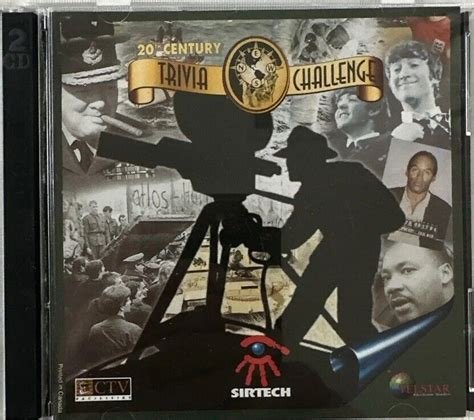
20th Century Trivia Challenge is a 1997 trivia game by Telstar Electronic Studios Ltd. and Sir-tech Software, Inc., featuring over 3,000 questions and 500 film clips spanning historical events, pop culture, and political milestones. Players can compete solo or form teams to test their knowledge of the 20th century in this Windows-based quiz experience with menu-driven gameplay and multimedia content.
20th Century Trivia Challenge Free Download
20th Century Trivia Challenge: A Time Capsule of Late-90s Edutainment Ambition
Introduction
In the golden age of CD-ROM multimedia, 20th Century Trivia Challenge (1997) arrived as a curious artifact—a trivia game marketed not just as a quiz, but as a cinematic journey through history. Developed by Telstar Electronic Studios and published by RPG stalwarts Sir-Tech Software, the game aimed to capitalize on the era’s fascination with interactivity and edutainment. This review argues that while 20th Century Trivia Challenge lacked innovation, its sheer breadth of content and accessible design positioned it as a nostalgic benchmark for trivia enthusiasts, albeit one lost in the shadow of its publisher’s more iconic titles.
Development History & Context
The Sir-Tech Paradox
Sir-Tech, revered for hardcore RPGs like Jagged Alliance and Wizardry, seemed an unlikely publisher for a trivia title. Yet in 1997, the studio diversified, banking on the CD-ROM boom’s promise of multimedia experiences. Telstar Electronic Studios, a lesser-known developer with a focus on accessible titles, handled production—a collaboration emblematic of the era’s experimental cross-pollination between genres.
Technological Ambitions
The game leveraged CD-ROM technology to deliver 500+ film clips alongside 3,000 questions, a feat impossible on cartridge-based systems. This design prioritized audiovisual spectacle over depth, aligning with mid-90s trends where FMV (Full Motion Video) and digitized audio were selling points. However, technological constraints persisted: clips were grainy, load times were inevitable, and installation required significant storage for the era.
The Trivia Boom
20th Century Trivia Challenge entered a crowded market. Competitors like Jeopardy! (1998) and You Don’t Know Jack (1995) dominated the space, raising expectations for humor and presentation. Telstar’s decision to emphasize breadth over personality—eschewing the latter’s sardonic wit—reflected a conservative approach, targeting families and educators rather than hardcore gamers.
Narrative & Thematic Deep Dive
A Century in Fragments
Though lacking a traditional narrative, the game’s thematic cohesion arose from its chronological scope. Questions spanned politics (e.g., “Who resigned after the Watergate scandal?”), pop culture (“Which actor played Indiana Jones?”), and technology (“When was the first computer mouse invented?”). Each served as a vignette, collectively constructing a fragmented yet comprehensive portrait of the 1900s.
The Host as Guide
An unnamed, “irreverent” host (per IGN’s description) introduced clips and questions, attempting to replicate the campy charm of TV game shows. While sources note “goofy interludes” between rounds, the host lacked the memorability of You Don’t Know Jack’s Cookie Masterson. His role was functional—a bridging device rather than a character—underscoring the game’s prioritization of content over personality.
Thematic Gaps
Notably absent was critical engagement with the century’s darker chapters (e.g., wars, colonialism). Questions sanitized history into digestible factoids, reflecting edutainment’s tendency toward nostalgia over analysis. This apolitical approach mirrored contemporary trends but limited the game’s depth as a historical tool.
Gameplay Mechanics & Systems
Core Loop: Simplicity as Virtue
Players selected question counts (10–50 per round) and topics (broad or era-specific). Correct answers awarded points; incorrect ones passed to opponents in multiplayer. The UI, described as “menu-driven” (MobyGames), was functional but utilitarian—a grid-based system favoring clarity over flair.
Multiplayer Dynamics
Hotseat multiplayer supported three teams, positioning the game as a party title. However, the lack of AI opponents in single-player limited replayability. Unlike Trivial Pursuit’s board-game progression, 20th Century offered no campaign or unlocks—just endless quizzing, reliant on the player’s intrinsic motivation to “battle through history” (Retrolorean).
Question Curation
With 3,000+ questions, variety was a strength, but inconsistency emerged. Some queries were surface-level (“What does ‘DVD’ stand for?”), while others demanded niche knowledge (“Which architect designed the Guggenheim Museum?”). Despite claims of covering “all periods of history” (MyAbandonware), Eurocentric bias was evident, with scant representation of Global South events.
World-Building, Art & Sound
Aesthetic: The CD-ROM Zeitgeist
The game embodied late-90s multimedia maximalism: vibrant, primary-colored menus (fixed/flip-screen, per MobyGames) and a “vibrant design with upbeat [soundtrack]” (Retrolorean). Film clips—ranging from newsreels to movie excerpts—served as both rewards and context, though their 240p resolution aged poorly.
Sound Design as Atmosphere
Stock music loops and canned applause reinforced the game-show illusion. The host’s voice acting was energetic but repetitive, lacking dynamic feedback for correct/incorrect answers—a missed opportunity for immersion.
Interface as Time Machine
The pre-Windows XP menu aesthetic—beveled buttons, pixelated fonts—now reads as retro-chic. For contemporaries, though, it signaled technological adequacy, not artistry. The game’s visual identity was defined by content, not style.
Reception & Legacy
Commercial Silence
No sales figures exist, but the game’s obscurity speaks volumes. Sir-Tech’s 1997 lineup—including cult hits like Jagged Alliance: Deadly Games—overshadowed it. Reviews were scarce; IGN’s brief summary (“hilarious trivia excitement”) and MobyGames’ absent critic scores suggest minimal press coverage.
Legacy: A Footnote in Trivia History
The game’s influence was indirect. It exemplified CD-ROM’s potential for data-rich trivia but lacked the innovation of peers. Its “film clip” approach presaged DVD-era titles like Scene It?, while its team-based multiplayer echoed in modern apps like QuizUp. Yet as abandonware, it lives on only among retro enthusiasts—a curiosity in Sir-Tech’s catalog.
Conclusion
20th Century Trivia Challenge is a paradoxical relic: ambitious in scope yet conservative in execution. Its 3,000 questions remain impressive, and its film clips capture a pre-YouTube era when multimedia felt revolutionary. However, its lack of personality, uneven curation, and absence of meta-progression prevent it from standing alongside classics of the genre. For historians, it exemplifies late-90s edutainment’s growing pains; for players, it’s a nostalgic time capsule—best remembered, not revisited. Final Verdict: A modestly engaging, technologically earnest product of its time, but no trivia king.