
- Release Year: 1999
- Platforms: Windows
- Publisher: Swing! Entertainment Software GmbH
- Genre: Compilation
- Average Score: 75/100
Description
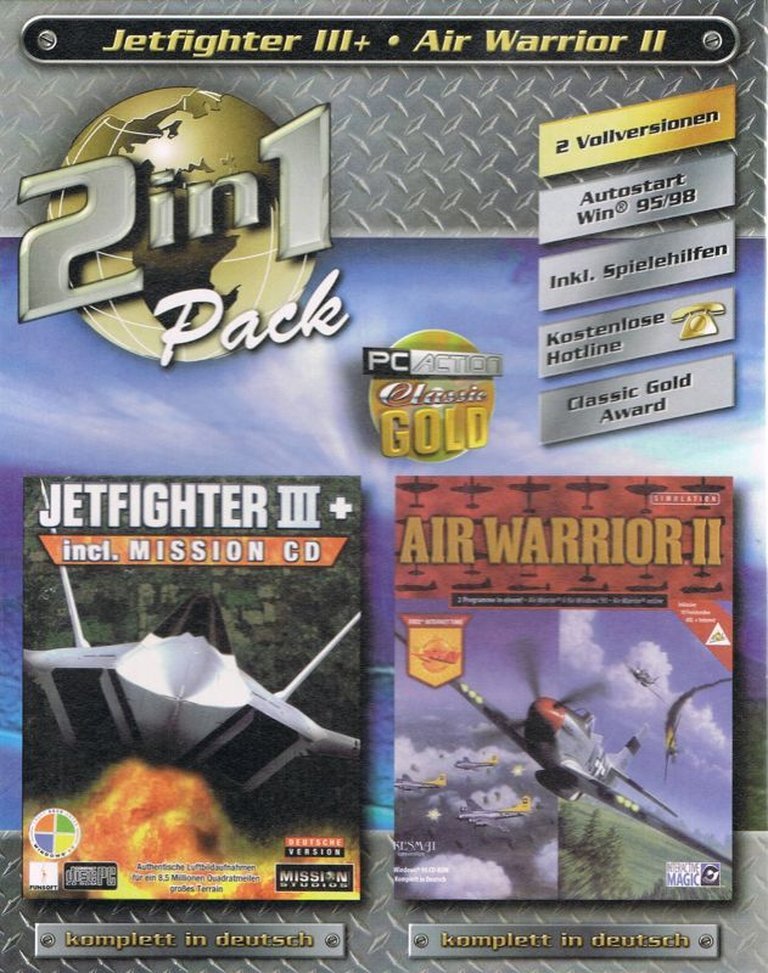
Jetfighter III+ / Air Warrior II is a 1999 compilation for Windows, featuring two distinct combat flight simulator experiences. Jetfighter III+ focuses on modern aerial combat with tactical missions, while Air Warrior II offers multiplayer-centric World War II dogfighting. The bundle combines fast-paced jet engagements with historical battles, delivering diverse gameplay for aviation enthusiasts.
Gameplay Videos
Jetfighter III+ / Air Warrior II Reviews & Reception
en.wikipedia.org (80/100): AWII is for WWII flight enthusiasts and an excellent choice for anyone looking for a great online multiplayer game.
gamespot.com (74/100): A worthwhile investment if you’re a fan of WWI or WWII flight and fight sims.
mobygames.com (73/100): Sequel to the first online multiplayer flight simulator, the legendary Air Warrior, the premise of this game is to offer an extensive collection of WW2 planes to go head to head in multiplayer dogfights with up to 100 pilots at the same time.
Jetfighter III+ / Air Warrior II Cheats & Codes
PC
Enter codes during gameplay.
| Code | Effect |
|---|---|
| Shift + F | Refill Fuel |
| Shift + M | Refill Ammo |
| Ctrl + X | Destroy Airborne Target |
| Ctrl + W | Destroy Airborne Target |
Jetfighter III+ / Air Warrior II: Review
Introduction
At the twilight of the 1990s, as flight simulators straddled the line between arcade spectacle and technical realism, Jetfighter III+ / Air Warrior II emerged as a curious artifact—a bundled chronicle of aerial warfare’s past and present. Released in 1999 by German publisher Swing! Entertainment, this compilation fused Jetfighter III+ (a modern jet combat experience) and Air Warrior II (a WWII-era multiplayer pioneer) into a single CD-ROM. While neither title redefined its genre, together they encapsulate a pivotal moment in flight simulation history, where the nascent internet era began reshaping how players engaged with virtual skies. This review argues that Jetfighter III+ / Air Warrior II serves as an essential, if flawed, time capsule—an unvarnished portal into an era when online dogfights were a revelation, and flight sims balanced ambition against technological constraints.
Development History & Context
The compilation’s two halves emerged from distinct creative lineages. Air Warrior II, developed by Kesmai Corporation and published by Interactive Magic in 1997, was the brainchild of industry veteran Bill Stealey, co-founder of MicroProse and a champion of military simulation authenticity. It arrived in an era when PC gaming was wrestling with the possibilities—and limitations—of online multiplayer. Kesmai leveraged its experience with the groundbreaking Air Warrior (1987), one of the first massively multiplayer online games, to craft a sequel aimed at refining WWII-era combat for dial-up warriors.
Meanwhile, Jetfighter III+ (titled Jetfighter Platinum in some regions) appeared in 1997 as an enhanced reissue of Mission Studios’ Jetfighter III, originally released earlier that year. Unlike Air Warrior II’s historical focus, Jetfighter III+ thrust players into near-future conflicts with fictional fighter jets, emphasizing single-player campaigns and mission variety. Both games bore the marks of late-’90s technological pragmatism: Air Warrior II’s need to accommodate hundreds of simultaneous players forced visual compromises, while Jetfighter III+’s hardware demands (like SVGA support) reflected growing consumer expectations for graphical fidelity.
Publishing these titles as a bundle in 1999 was a savvy, albeit unglamorous, business move. Swing! Entertainment targeted budget-conscious enthusiasts eager to sample divergent facets of flight simulation—a curation of aerial combat’s evolution. Yet this compilation also arrived at a precarious moment. By 1999, franchises like Jane’s Combat Simulations and Falcon 4.0 had raised the bar for realism, while broadband internet loomed, threatening to render Air Warrior II’s multiplayer infrastructure obsolete.
Narrative & Thematic Deep Dive
Air Warrior II wove its narrative through historical reenactment rather than traditional storytelling. The game offered six campaigns (three Axis, three Allied) spanning WWII’s European and Pacific theaters, with players reliving pivotal moments like Pearl Harbor, the Doolittle Raid, and the Battle of Britain. While lacking cinematic cutscenes, missions framed objectives through era-appropriate briefings, emphasizing battlefield roles—“defend the fleet” or “bomb the airfield”—over character drama. Historical authenticity bled into aircraft selection: the game included 45 planes, from the Spitfire to the A6M Zero, each modeled with period-accurate cockpits and handling quirks.
A thematic tension emerged between the game’s lofty aspirations and its execution. While the manual romanticized WWII pilots as “knights of the sky,” Air Warrior II’s online arenas often devolved into chaotic free-for-alls, distancing players from wartime gravitas. Single-player campaigns offered structured branching paths (360 missions total), yet repetitive mission design weakened narrative momentum. Brief forays into WWI and Korean War scenarios felt like afterthoughts—neat historical footnotes lacking depth.
Jetfighter III+ countered with speculative fiction. Its campaigns cast players as a modern fighter pilot thwarting global threats—rogue states, terrorist groups, and rogue generals—through 30 missions across Africa, Asia, and South America. While the writing leaned on boilerplate military thriller tropes, the focus was tactile immersion: Jetfighter III+ reveled in the minutiae of avionics, radar systems, and fictional (but plausible) aircraft like the F-88 Scorpion. The absence of moral ambiguity—clear-cut villains, unambiguous objectives—mirrored late-’90s action cinema but lacked the thematic nuance of contemporaries like EF2000.
Gameplay Mechanics & Systems
Air Warrior II’s legacy hinges on its multiplayer innovation. Supporting up to 100 players in dogfights via LAN, modem, or early internet, the game was a social experiment as much as a simulator. Four ground vehicles (tanks, AA guns) added tactical variety, allowing players to contest airfields or bombard enemies from below. Flight models prioritized approachability: stalls and spins were forgiving, while damage modeling—though featuring engine fires and hydraulic failures—never approached IL-2 Sturmovik’s brutality.
The GUI was cluttered yet functional, with radar, throttle, and weapons panels vying for screen space. Single-player missions leaned on “score attack” mechanics—destroy X bombers, survive Y minutes—but the AI proved erratic, oscillating between suicidal charges and passive circling. The mission editor empowered players to craft scenarios but lacked intuitive controls, reflecting Kesmai’s prioritization of multiplayer.
Jetfighter III+ contrasted sharply as a solo-focused experience. Its flight model emphasized speed and weapon management, with players juggling radar locks, missile trajectories, and countermeasures. Progression felt like a checklist: complete missions, earn promotions, unlock aircraft. The UI was cleaner than Air Warrior II’s, with HUD elements mirroring real fighter jets, but it suffered from sluggish menu navigation and overly sensitive input thresholds.
Both games struggled with inconsistency. Air Warrior II’s multiplayer—while revolutionary—was hobbled by lag and server instability, while Jetfighter III+’s stealth sequences (e.g., evading SAM sites) clashed awkwardly with its arcade-leaning combat. Neither title featured meaningful pilot customization, opting instead for pure vehicular mastery.
World-Building, Art & Sound
Technological constraints defined both games’ aesthetics. Air Warrior II employed flat-shaded polygons with resolution up to 1024×768, a leap beyond its predecessor but dated alongside contemporaries like Jane’s WW2 Fighters. Cockpits featured instrument clusters evocative of period aircraft, though textures were rudimentary. Landscapes blended repetitive terrain tiles with sparse landmarks (airfields, ships), creating functional but unmemorable battlefields. Sound design salvaged immersion: engines roared with palpable weight, while .50-caliber gunfire rattled with convincing menace. Daniel Bernstein’s score oscillated between tense percussion and orchestral swells, though it seldom rose above background ambiance.
Jetfighter III+ showcased Jetfighter III’s 1997-era 3D enhancements—higher-resolution textures, dynamic lighting—but still resembled a tech demo compared to F-22 Lightning II. Aircraft models prioritized geometric simplicity, with missile trails and explosions rendered as crude sprites. The soundscape fared better: afterburners hissed with authority, and radio chatter (while poorly voice-acted) added faux-military grit. Environments ranged from desert dunes to tropical islands, though pop-in and low-detail trees undermined grandeur.
Reception & Legacy
Upon release, Air Warrior II earned cautious praise. Next Generation awarded it 4/5 stars, applauding its multiplayer scope but critiquing unstable framerates. The Academy of Interactive Arts & Sciences nominated it for 1998’s “Online Game of the Year,” a testament to its ambition. Yet it struggled commercially, overshadowed by glossier peers. Jetfighter III+ fared worse critically, dismissed as an incremental upgrade over its predecessor.
As a 1999 compilation, Jetfighter III+ / Air Warrior II garnered negligible attention—neither MobyGames nor mainstream outlets reviewed the bundle. Its true legacy lies in preservation: Air Warrior II foreshadowed MMOs like WarBirds and Aces High, proving WWII sims could thrive online. Jetfighter III+, meanwhile, epitomized the late ’90s “hardware showcase” sim—a stepping stone between F-15 Strike Eagle II and Lock On: Modern Air Combat.
Conclusion
Jetfighter III+ / Air Warrior II is a digital museum piece—more valuable as historical testimony than as entertainment. Its components are uneven, technically creaky, and narratively thin, yet they capture flight simulation’s awkward adolescence in the internet age. For historians, this compilation illustrates how developers balanced realism against accessibility, and multiplayer dreams against dial-up realities. For modern players, it’s a curiosity best appreciated through retrospect. Ultimately, Swing! Entertainment’s bundle deserves recognition not for what it achieved, but for what it represented: a fleeting moment when the skies belonged to anyone bold enough to log on and climb.