
- Release Year: 2001
- Platforms: DOS, Windows
- Publisher: Hamster Republic Productions
- Developer: Hamster Republic Productions
- Genre: Action
- Perspective: Side view
- Game Mode: Single-player
- Gameplay: Arcade
- Average Score: 70/100
Description
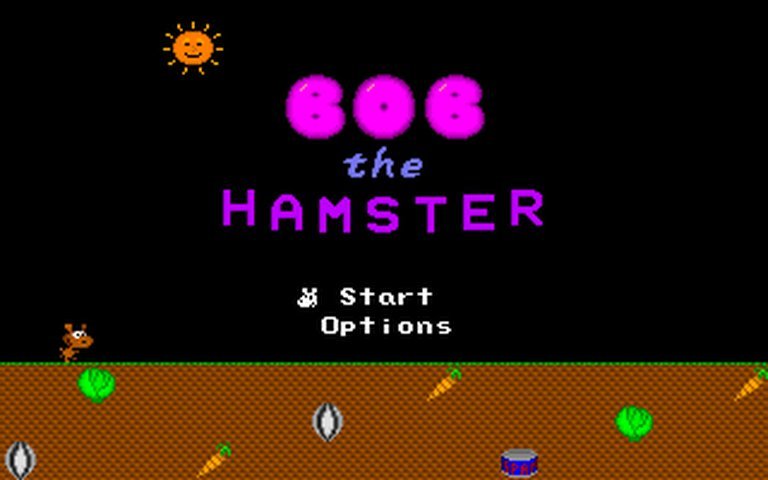
Bob the Hamster is an arcade-style game inspired by Mr. Do!, featuring single-screen levels where players control Bob, a hamster, to collect carrots while navigating dirt patches and pushable cabbages. Enemies with unique behaviors roam the levels, posing threats that players can defeat using cabbage traps or Bob’s upgradable spit attack. Bonus stages offer tougher challenges and temporary power-ups, while hidden extra lives add strategic depth. The game also includes an alternate character, Vlad, with reimagined levels and a dagger attack, maintaining core mechanics but refreshing the visual and enemy designs for varied gameplay.
Bob the Hamster Free Download
Bob the Hamster Reviews & Reception
metacritic.com (70/100): Hamster Bob is an interactive coloring storybook. There are different chapters correlating to respective categories, each introducing a small plot, sometimes with characters. Hamster Bob narrates the story, as you color the objects and optional characters.
Bob the Hamster Cheats & Codes
Super Nintendo
Enter codes at the specified screens.
| Code | Effect |
|---|---|
| Press B on controller 2 | Everything Maxed Out (at title screen) |
| A+B+C simultaneously on Controller 2 | Infinite Lives and Weapons (at ‘Foley High Tech Systems’ screen) |
| 672451 | Unlock Anciena – Area 1 |
| 272578 | Unlock Anciena – Area 2 |
| 652074 | Unlock Anciena – Area 3 |
| 265648 | Unlock Anciena – Area 4 |
| 462893 | Unlock Anciena – Area 5 |
| 583172 | Unlock Anciena – Area 6 |
| 426081 | Unlock Ending |
| 090000 | Goth – Area 1 with Full Weapons |
| Replace second letter in password with ‘9’ | Start on any stage with everything |
PlayStation 2 (SpongeBob Squarepants: The Flying Dutchman)
Pause the game and input the code.
| Code | Effect |
|---|---|
| Hold L1, R2, Square, O and press Select | Level Select |
PC
Enter passwords to unlock levels or effects.
| Code | Effect |
|---|---|
| START | Unlock level/power-up |
| TESSA | Unlock level/power-up |
| PILL | Unlock level/power-up |
| STONE | Unlock level/power-up |
| TRICK | Unlock level/power-up |
| ARROW | Unlock level/power-up |
| MANHOLE | Unlock level/power-up |
| NI | Unlock level/power-up |
| OHOH | Unlock level/power-up |
| BOOM | Unlock level/power-up |
| ELECTRIC | Unlock level/power-up |
| APPEAR | Unlock level/power-up |
| SKILL | Unlock level/power-up |
| HURRY | Unlock level/power-up |
| FIGURE | Unlock level/power-up |
| BZZZ | Unlock level/power-up |
| BOBO | Unlock level/power-up |
| KABOM | Unlock level/power-up |
| HAPPER | Unlock level/power-up |
| WATCH | Unlock level/power-up |
| BOBBY | Unlock level/power-up |
| PACMAN | Unlock level/power-up |
| RANDY | Unlock level/power-up |
| FLOP | Unlock level/power-up |
| KNOWP | Unlock level/power-up |
| LAB | Unlock level/power-up |
| TREE | Unlock level/power-up |
| TESST | Unlock level/power-up |
| GAMER | Unlock level/power-up |
| HISCORE | Unlock level/power-up |
| BOMM | Unlock level/power-up |
| SPACE | Unlock level/power-up |
| WARNING | Unlock level/power-up |
| PRESENT | Unlock level/power-up |
| WHOEI | Unlock level/power-up |
| SOS | Unlock level/power-up |
| BOOGY | Unlock level/power-up |
| FUN | Unlock level/power-up |
| ROCKER | Unlock level/power-up |
| LEVEL | Unlock level/power-up |
| LUCKY | Unlock level/power-up |
| FINAL | Unlock level/power-up |
GameCube (SpongeBob: The Battle for Bikini Bottom)
Hold L+R and input button sequences.
| Code | Effect |
|---|---|
| X, Y, Y, X, X, Y, Y, X | 10 Golden Spatulas |
| Y, Y, Y, Y, X, Y, X, Y, X, X, X, X | Giant Plankton |
| Y, X, Y, X, X, Y, X, X, X, Y, Y, Y, Y, X, X, Y | Shiny Objects Worth More |
| X, X, X, Y, Y, X, Y, X, X, X, Y | Always Shrapnel Death Animation |
Bob the Hamster: Review
Introduction
In the annals of indie gaming history, few titles embody the DIY ethos of early 2000s PC development quite like Bob the Hamster (2001). A love letter to arcade classics such as Mr. Do! and Dig Dug, this unassuming rodent-themed puzzler emerged from the passion of indie studio Hamster Republic Productions. While it never achieved mainstream recognition, Bob the Hamster became a cult artifact—a testament to the creativity flourishing in the margins of the gaming industry. This review argues that Bob the Hamster is a flawed yet fascinating time capsule, blending nostalgic arcade mechanics with inventive twists, while foreshadowing the indie revolution of the digital age.
Development History & Context
The Rise of Hamster Republic
Developed by James Paige under the banner of Hamster Republic Productions, Bob the Hamster was born from a fusion of technical experimentation and unabashed fandom. Paige, previously known for parody titles like Sidewalk Fighter 2 (1992) and RPG tools like the OHRRPGCE (Official Hamster Republic Role-Playing Game Construction Engine), sought to create a homage to the golden age of arcades. The studio’s ethos—reflected in its GPL-licensed releases and open-source advocacy—prioritized accessibility and community engagement.
Technological Constraints and Ambitions
Released initially for DOS in 2001 (and later ported to Windows in 2008), Bob the Hamster was constrained by early-2000s hardware. Designed for 320×200 resolution and direct keyboard controls, it embraced simplicity over graphical fidelity. Yet, this simplicity belied clever programming: the game’s physics-driven cabbage-pushing mechanics and enemy AI were surprisingly sophisticated for a freeware title. The DOS era’s decline loomed, but Paige leveraged its limitations, creating a game that ran smoothly on even the most modest systems.
The Gaming Landscape of 2001
At the turn of the millennium, gaming was dominated by console juggernauts like the PlayStation 2 and Grand Theft Auto III. PC gaming, meanwhile, leaned toward expansive RPGs (Baldur’s Gate II) and real-time strategy (Age of Empires II). Against this backdrop, Bob the Hamster was an outlier: a small-scale arcade revival targeting niche audiences who craved retro charm. Its release echoed the blossoming indie scene, where developers like Jeff Minter (Tempest 2000) and Derek Yu (Eternal Daughter) carved paths outside the mainstream.
Narrative & Thematic Deep Dive
A Minimalist Story with Maximalist Personality
Bob the Hamster eschews complex narrative in favor of whimsical character-driven charm. The titular Bob—visually ambiguously canine, but canonically a hamster—embarks on a quest to collect carrots while fending off surreal enemies. The game’s optional second protagonist, Vlad, reskins the experience with jewels and vampiric flair, though his gameplay mirrors Bob’s. This duality underscores the game’s lighthearted absurdity: a world where cabbages crumble like Boulder Dash boulders, and deadly foes include “pirate monks” and “doughnut mafia” (as hinted in Paige’s later DireSPAM project).
Themes of Persistence and Chaos
Beneath its cute exterior, Bob the Hamster grapples with themes of entropy and control. Each level—a grid of dirt, carrots, and obstructive cabbages—is a fragile ecosystem. Digging destabilizes the terrain, cabbages cascade unpredictably, and enemies respawn relentlessly. The player must balance aggression (using Bob’s spit attack) with strategic repositioning, echoing the tension of Lemmings or Spelunky. Even the bonus stages, which reward temporary power-ups, emphasize risk-reward dynamics. Thematically, it’s a game about imposing order on chaos—only to watch it unravel anew.
Gameplay Mechanics & Systems
Core Loop: Dig, Collect, Survive
At its heart, Bob the Hamster is a single-screen arcade puzzle game. Each level tasks players with collecting all carrots while avoiding enemies that patrol the maze-like dirt grids. Key mechanics include:
– Terrain Deformation: Walking over dirt removes it, creating paths or traps.
– Cabbage Physics: Cabbages act as pushable obstacles; when dropped, they tumble vertically, crushing enemies or clearing paths.
– Combat Options: Bob’s spit attack (or Vlad’s dagger) offers ranged offense, but requires reloading, while cabbage-crushing rewards tactical positioning.
Progression and Power-Ups
- Sunseed Upgrades: Collecting sunseeds grants three tiers of spit-attack enhancements (faster reload, increased range). A fourth “death-defying” upgrade is earned in bonus stages but expires upon death.
- Bonus Stages: These high-pressure challenges—more difficult than standard levels—test precision and timing.
- Hidden Lives: Each level conceals an extra life, rewarding thorough exploration.
Flaws and Innovations
While the gameplay is engaging, Bob the Hamster suffers from erratic enemy AI. Some foes actively chase Bob, while others wander aimlessly, undermining tension. The respawn system—wherein most enemies reappear quickly—can feel unfair. Yet, its dual-character mode (Bob/Vlad) and modular upgrades were novel for the era, offering replayability absent in contemporaries like Mr. Do!.
World-Building, Art & Sound
Visuals: Charming Retro Austerity
Adopting a fixed side-view perspective, Bob the Hamster’s visuals are rudimentary but endearing. Bob’s sprite—a pixelated orange blob with vague rodent features—exudes DIY charm, while Vlad’s palette-swapped design (red cape, jeweled carrots) adds playful variety. The dirt-and-vegetable aesthetic channels Dig Dug’s subterranean vibes, though the lack of visual diversity across levels grows repetitive.
Sound Design: Minimalism with Personality
Sound effects are sparse: dirt crumbles, cabbages thud, and Bob punctuates actions with squeaks or sarcastic quips (e.g., “Spiffy!”). The absence of a soundtrack amplifies the tension, immersing players in the creaks and crashes of each level. While not groundbreaking, the audio complements the game’s arcade roots, prioritizing functional feedback over orchestration.
Reception & Legacy
Initial Reception and Cult Following
Upon release, Bob the Hamster garnered modest attention. Critics praised its faithfulness to arcade traditions but critiqued its repetitive structure and simplistic presentation. DOSGames.com’s review (3/5 stars) noted, “[It] captures the fun of old arcade games… though enemy AI isn’t too impressive.” Commercial success was limited, but its 2008 re-release as freeware—and eventual open-sourcing via GPL—cemented its status as a cult curiosity.
Long-Term Influence
Bob the Hamster’s legacy lies in its role as a catalyst for indie experimentation. James Paige’s later projects, including the OHRRPGCE engine and Wandering Hamster RPG, expanded upon its foundational code. The game also inspired a microgenre of rodent-centric indies, from Flying Hamster (2010) to Hamster Playground (2022). More broadly, it exemplified early-2000s indie resilience, proving that small teams could create enduring experiences without AAA resources.
Conclusion
Bob the Hamster is neither a masterpiece nor a footnote. It is a heartfelt tribute to arcade gaming’s golden age, brimming with inventive mechanics and wistful charm. Its flaws—uneven difficulty, repetitive design—are outweighed by its ambition and accessibility. For historians, it represents a pivotal moment in indie gaming’s evolution; for players, it remains a quirky, engaging curiosity. In the pantheon of video game history, Bob the Hamster deserves remembrance not as a titan, but as a testament to the creativity thriving in the industry’s shadows. Final Verdict: A B-tier classic with A-tier heart.