
- Release Year: 2023
- Platforms: Linux, Macintosh, Nintendo Switch, Windows
- Publisher: GaGa Games Studio
- Developer: GaGa Games Studio
- Genre: Action, Platform, Puzzle
- Perspective: Side view
- Game Mode: Single-player
- Gameplay: Platform, Puzzle elements
- Setting: Fantasy
Description
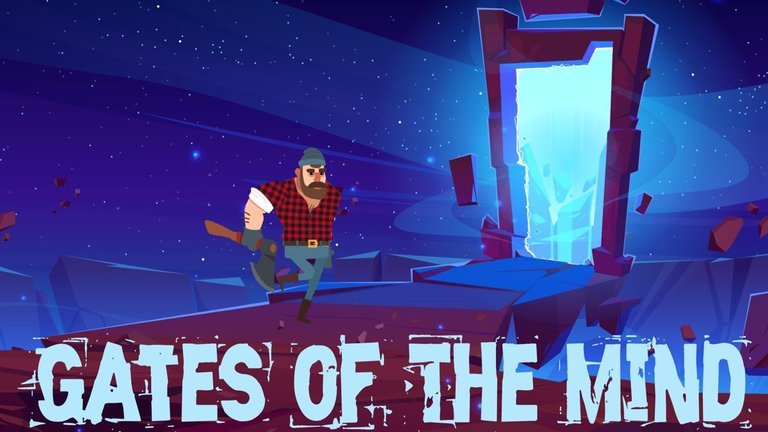
Gates of the Mind is a 2D hardcore platformer set in a fantastical realm within the protagonist’s mind. The game follows Miles, a Canadian logger who, after being attacked by a bear, finds himself trapped within his own consciousness. Players must navigate through challenging levels and boss fights, restoring Miles’ consciousness piece by piece. The game emphasizes quick reflexes and ingenuity, offering non-linear solutions to open the gates of the mind and ultimately wake Miles from his coma.
Gates of the Mind Guides & Walkthroughs
Gates of the Mind Reviews & Reception
steamcommunity.com : The game is recommended at a heavy discount because of generic gameplay and barely playable state.
Gates of the Mind: Review
Introduction
In an era where indie platformers often oscillate between nostalgic homage and punishing masochism, Gates of the Mind (2023) stands as a curious oddity—a game that dares to meld psychological introspection with hardcore platforming. Developed by the enigmatic GaGa Games Studio, this 2D side-scroller follows Miles, a Canadian logger trapped in his own subconscious after a bear attack, tasked with reassembling his fractured consciousness. While its premise brims with potential, Gates of the Mind is a study in contradictions: a game that tantalizes with metaphysical themes but stumbles in execution. This review argues that beneath its janky mechanics lies a flawed yet fascinating experiment in blending narrative abstraction with retro-inspired challenge.
Development History & Context
GaGa Games Studio, a relatively obscure developer, opted for Unity Engine to craft Gates of the Mind—a pragmatic choice given the engine’s accessibility for 2D projects. Released in December 2023 for Nintendo Switch, with subsequent ports to PC and macOS in 2024, the game emerged during a resurgence of “hardcore” indie platformers like Celeste and Hollow Knight. However, unlike its polished peers, Gates of the Mind lacks the precision and polish expected of the genre.
The studio’s vision, as stated in the Steam description, aimed to fuse “reaction and ingenuity” in boss fights with “non-linear solutions” for progression. Yet, the game’s development constraints are palpable: repetitive assets, minimal tutorialization, and unclear mechanics suggest a small team working under tight resources. This context is critical—it’s a game that wears its indie scrappiness on its sleeve, for better or worse.
Narrative & Thematic Deep Dive
At its core, Gates of the Mind is a surreal odyssey through Miles’ psyche. The bear attack serves as a metaphor for trauma, with each level representing a fragment of his consciousness. The woodland stage symbolizes primal fear, the claustrophobic tunnels evoke buried memories, and the ice stage reflects emotional numbness. The narrative’s vagueness is both a strength and weakness: while it invites interpretation, the lack of dialogue or textual exposition leaves players adrift.
Themes of self-recovery and mental fortitude are undercut by the game’s mechanical obtuseness. Collecting “souls” to restore consciousness feels arbitrary, as players are never told how many exist per stage or their significance. This disconnect between theme and gameplay diminishes the emotional resonance the story strives for.
Gameplay Mechanics & Systems
Core Platforming & Combat
The game’s controls are serviceable but unrefined. Movement is floaty, and the jump mechanic falters near edges—a cardinal sin in a precision platformer. Combat, involving axe swings, kicks, and punches, is poorly balanced. Most enemies can be ignored due to absent contact damage, and attacks lack impactful feedback, reducing encounters to tedious button-mashing.
Level Design & Boss Fights
Each of the four stages introduces unique gimmicks:
1. Woodland: A race against darkness, where safe zones are marked by vibrant colors.
2. Tunnels: A maze-like water labyrinth plagued by confusing dead ends.
3. Sky Temple: Straightforward platforming with light-chase segments.
4. Ice Realm: Tree-chopping and fire-lighting to stave off hypothermia.
Boss fights, however, verge on dysfunctional. Insta-kill attacks, unskippable death cutscenes, and cryptic weak points (e.g., the fourth boss’s unexplained mechanics) frustrate rather than challenge. The “non-linear solutions” touted in marketing material are scarcely evident, with most stages funneling players into linear pathways.
Progression & Replayability
Collecting souls unlocks achievements but offers no tangible rewards. With no post-game content and minimal incentive for replayability beyond completionism, Gates of the Mind feels insubstantial.
World-Building, Art & Sound
The 2D pixel art is competent but uninspired. Environments lack detail, relying on generic biomes (forest, caves, ice) that fail to evoke the psychological depth the narrative promises. Bright vs. dark contrasts in the woodland stage are visually effective, but repetitive textures dull the impact.
Sound design is conspicuously absent from available critiques, suggesting it plays little role in immersion. The silence amplifies the game’s mechanical flaws, leaving players with only the clunky sounds of combat and platforming.
Reception & Legacy
At launch, Gates of the Mind flew under the radar, with no major critic reviews on Metacritic, IGN, or Kotaku. Player feedback, exemplified by Steam user Sosich’s review, highlights its divisive nature: praised for its ambition but criticized for technical jank. The game’s commercial performance remains unclear, though its lack of visibility suggests modest sales.
While unlikely to join the pantheon of indie classics, Gates of the Mind could cultivate a niche following among masochists and genre completists. Its legacy may lie in serving as a cautionary tale—proof that thematic ambition must align with mechanical polish.
Conclusion
Gates of the Mind is a game of unrealized potential. Its premise—a journey through the subconscious—is rich with possibility, but clumsy execution undermines every strength. The combat is forgettable, the platforming uneven, and the narrative too opaque to resonate. Yet, for all its flaws, there’s a raw sincerity here: a developer reaching for something profound, even if they lack the tools to grasp it.
For hardcore platformer aficionados, it’s worth a curiosity play at a deep discount. For everyone else, Gates of the Mind remains a fascinating misfire—a game that dares to dream big but collapses under the weight of its own ambitions. Its place in history? A footnote, but one that hints at what could have been.