
- Release Year: 2021
- Platforms: Browser, Linux, Windows
- Publisher: NanningsGames
- Developer: NanningsGames
- Genre: Puzzle
- Perspective: Diagonal-down
- Game Mode: Single-player
- Gameplay: Board game, Point and select
- Average Score: 95/100
Description
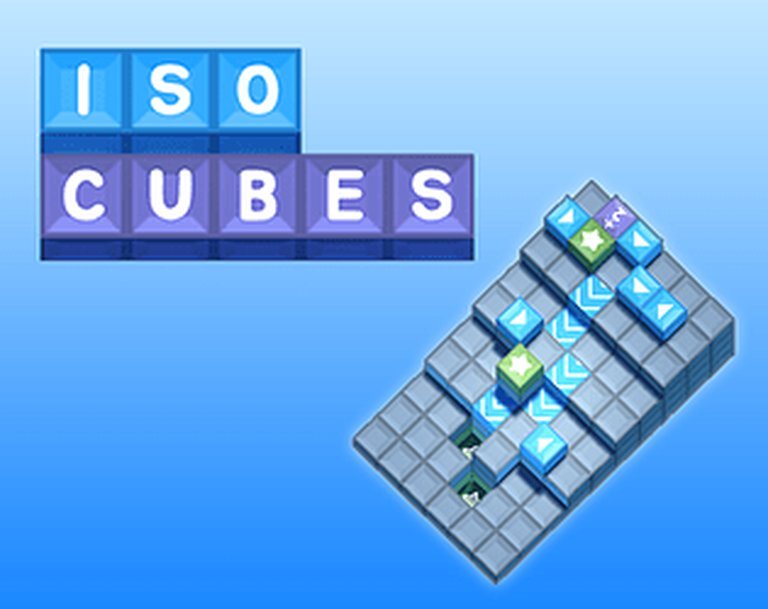
IsoCubes is an isometric puzzle game where players manipulate colored cubes to solve increasingly complex challenges. The goal is to push green starred cubes onto matching target blocks using blue directional cubes, while avoiding mistakes like dropping cubes or placing them incorrectly. With 46 progressively difficult levels, the game introduces new mechanics such as purple spawner cubes, neutral yellow blocks, conveyor belts, and multi-level elevations. Designed for single-player gameplay with controller support, it rewards players with achievements for each completed puzzle.
Where to Buy IsoCubes
PC
IsoCubes Patches & Updates
IsoCubes Guides & Walkthroughs
IsoCubes: Review
Introduction
In an era dominated by open-world epics and narrative-driven experiences, IsoCubes (2021) stands as a defiant love letter to the purity of abstract puzzle design. Developed by the solo studio NanningsGames, this deceptively simple isometric puzzler challenges players to unravel increasingly intricate spatial conundrums within a minimalist, geometric universe. Its legacy lies not in grand storytelling or technical spectacle, but in its surgical refinement of classic block-pushing mechanics—a testament to the enduring power of elegant systems-driven gameplay. This review argues that IsoCubes carves a distinct niche within the puzzle genre by transforming basic interactions into a cerebral odyssey worthy of analysis alongside foundational titles like Sokoban and Portal.
Development History & Context
The Solo Vision of NanningsGames
IsoCubes emerged from the creative isolation of Dutch developer NanningsGames, a one-person studio dedicated to iterative, mechanics-first puzzle design. With predecessors like Color Cube and Push The Box 3D in its portfolio, the studio prioritized accessibility and precision over narrative ambition. The game’s 2021 release coincided with a resurgence of interest in short-form, hyper-focused indie puzzle games—a counter-movement to AAA bloat.
Technological Constraints as a Creative Catalyst
Built for browser, Linux, and Windows platforms, IsoCubes embraced its technical limitations. The decision to use an isometric perspective was both aesthetic and practical: it allowed for multidimensional puzzles without demanding advanced 3D rendering. System requirements were intentionally lean (tested on a modest AMD Radeon HD 7500M GPU), ensuring accessibility across low-spec devices. This constraint informed the game’s visual minimalism, stripping away excess to spotlight mechanical clarity.
The 2021 Puzzle Landscape
Launched amid a sea of genre hybrids, IsoCubes stood out by refusing contemporary trends. While peers like Baba Is You deconstructed puzzle logic through meta-narrative, NanningsGames doubled down on orthodox purity. Its refusal to incorporate RPG elements, rogue-lite progression, or cinematic flair positioned it as a deliberate anachronism—and a bold statement on timeless design.
Narrative & Thematic Deep Dive
The Absence of Narrative as a Statement
Unlike genre contemporaries that weave environmental storytelling or textual lore, IsoCubes exists in a narrative vacuum. There are no characters, no dystopian backstories justifying its geometric labyrinths. This austerity isn’t an oversight but a philosophical stance: the game posits that intellectual engagement requires no emotional scaffolding. The “story” lies purely in the player’s escalating dialogue with the systems—a battle of wits against an indifferent, algorithmic universe.
Themes of Order and Entropy
Beneath its sterile facade, IsoCubes explores existential themes through abstraction. Each puzzle begins in pristine symmetry (green target blocks aligned like temple altars) only to descend into chaos through player intervention. The introduction of conveyor belts—mechanisms that forcibly redirect cubes—echoes themes of predestination vs. agency. Meanwhile, purple spawner blocks inject organic unpredictability, transforming static puzzles into dynamic ecosystems. The tension between control and collapse mirrors the player’s own cognitive struggle.
Gameplay Mechanics & Systems
Core Loop: Precision as High Stakes
The objective is ruthlessly simple: maneuver starred green cubes onto matching targets using blue “pusher” blocks. Success depends on parsing isometric depth perception—a deliberate cognitive hurdle—while anticipating chain reactions. Four critical failure states escalate tension:
1. A cube plunges off the platform’s edge
2. A non-target block occupies a goal
3. A misaligned push creates irrevocable gridlock
4. Purple spawners overwhelm the board
This economy of interaction creates a razor’s-edge balance between deliberate strategy and emergent chaos.
Mechanical Evolution
IsoCubes unveils its complexity gradually across 46 levels:
– Yellow Null Cubes (Levels 1-10): Passive obstacles demanding spatial forethought
– Purple Spawners (Levels 11-20): Introduces resource management as spawned cubes multiply variables
– Conveyor Belts (Levels 21-35): Temporal dimension where cubes auto-move, demanding real-time recalibration
– Elevation Shifts (Levels 36-46): Verticality transforms puzzles into 3D mazes, requiring multi-plane visualization
Each mechanic retroactively recontextualizes earlier puzzles, mirroring the “Eureka” structure of The Witness.
UI/UX: Minimalism with Hidden Depth
The interface reduces interaction to point-and-click (or controller inputs), eliminating menus and tutorials. Achievements—one per level—serve as subtle difficulty markers rather than extrinsic rewards. Notably, the game’s Steam Deck compatibility (though sparsely utilized) reflects a design ethos valuing frictionless engagement across hardware.
World-Building, Art & Sound
Isometric Geometry as a Character
The game’s sterile aesthetic—sharp-edged cubes floating against void-black backgrounds—initially reads as generic. Yet this minimalism proves subversive. By stripping away textures and scenery, IsoCubes forces players to anthropomorphize geometry itself: conveyor belts become “rivers,” purple spawners “life-givers,” and pit drops “abysses.” The isometric angle (diagonal-down perspective) introduces deliberate optical illusions, turning perception into a core puzzle element.
Synesthetic Sound Design
While no soundtrack exists, IsoCubes employs ASMR-like audio feedback:
– Metallic clinks accompany cube pushes
– Hollow thuds denote misaligned drops
– An ethereal chime marks goal completion
These minimalist cues create an auditory tapestry that mirrors the game’s mechanical precision—a sensory reinforcement of its mathematical soul.
Reception & Legacy
Critical and Commercial Impact
Despite zero Metacritic critic reviews, IsoCubes garnered a 95% “Very Positive” Steam rating (21/22 reviews) by December 2025. Players praised its “hypnotic simplicity” and “escalating brain-melting challenge.” Commercially, its inclusion in bundles (Puzzle Games Bundle, Isometric View Games) amplified reach while anchoring its identity within niche communities.
Influence on the Puzzle Canon
Though not a mainstream breakthrough, IsoCubes refined ideas latent in earlier titles:
– The binary success/failure states of Sokoban
– The conveyor systems of Infinifactory
– The achievement-as-progress model of Monument Valley
Its legacy manifests in subsequent indie puzzlers like A Monster’s Expedition, which adopted similar austere aesthetics married to systemic depth.
Conclusion
IsoCubes is a masterclass in subtractive design—a game that distills the puzzle genre to its crystalline essence. By rejecting narrative pretensions and leveraging its isometric perspective as both aesthetic framework and cognitive obstacle, it transforms basic block-pushing into a meditative exploration of spatial logic. While its minimalism may deter players seeking cinematic spectacle, its mechanical precision and escalating brilliance cement it as a quiet titan within the puzzle pantheon. In an industry chasing perpetual innovation, IsoCubes dares to assert that depth lies not in complexity, but in the elegant iteration of simple truths. Final verdict: A timeless, if niche, essential for puzzle purists.