
- Release Year: 2007
- Platforms: Windows
- Publisher: Shockwave
- Developer: Article 19 Group, Inc., The
- Genre: Action
- Perspective: Isometric
- Game Mode: Single-player
- Gameplay: Arcade, Time management
- Average Score: 90/100
Description
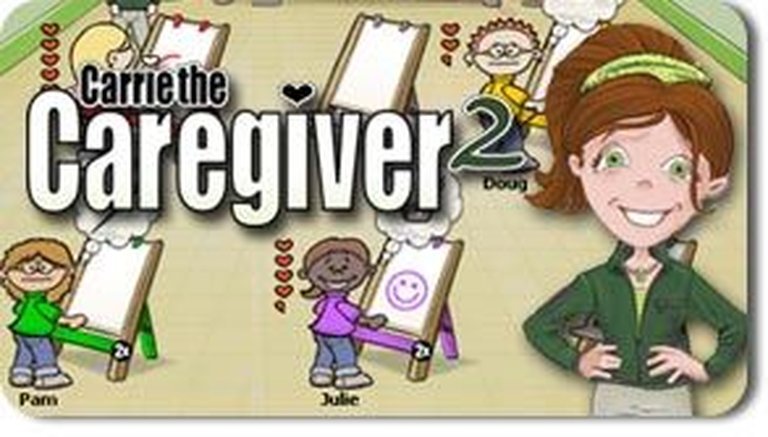
Carrie the Caregiver 2: Preschool is the sequel to the popular time management game, where players take on the role of Carrie, now a preschool teacher. The objective is to keep the children happy and engaged through various activities such as painting, shapes, lunch, writing names, and baking cookies. Players must manage Carrie’s energy levels while attending to the unique needs and personalities of each child, aiming to accumulate points by the end of the day.
Gameplay Videos
Carrie the Caregiver 2: Preschool Cracks & Fixes
Carrie the Caregiver 2: Preschool Guides & Walkthroughs
Carrie the Caregiver 2: Preschool Reviews & Reception
mobygames.com (90/100): Your goal is to reach a certain amount of points at the end of the day by taking care of toddlers.
Carrie the Caregiver 2: Preschool: Review
Introduction
In the mid-2000s, the casual gaming boom birthed countless time-management titles, but few characters resonated as enduringly as Carrie, the star of Carrie the Caregiver 2: Preschool. Released in 2007 as a sequel to Carrie the Caregiver, this title expanded its predecessor’s formula with a preschool setting, refining mechanics while retaining the charm that defined the series. This review argues that Carrie the Caregiver 2 exemplifies the golden age of Shockwave-era casual games—a flawed yet endearing title that balanced accessibility with strategic depth, even as technical limitations and repetitive design held it back from greatness.
Development History & Context
Developed by The Article 19 Group and published by Shockwave, Carrie the Caregiver 2 emerged during a pivotal era for downloadable casual games. The mid-2000s saw the rise of titles like Diner Dash and Cake Mania, which popularized the time-management genre. Shockwave, a hub for browser-based gaming, leveraged this trend, positioning Carrie the Caregiver 2 as a family-friendly alternative.
The game’s design was constrained by the technological limitations of its time. Built for Windows 2000/XP/Vista and requiring the Shockwave Player 10, it targeted low-spec systems with modest requirements: a 600 MHz CPU and 128 MB RAM. This accessibility came at a cost—the game’s visuals and mechanics were simplistic, relying on 2D isometric art and click-and-drag interactions. Yet, this simplicity ensured broad appeal, particularly among casual players and younger audiences.
Narrative & Thematic Deep Dive
Narratively, Carrie the Caregiver 2 is sparse but charming. Carrie transitions from a maternity ward nurse to a preschool teacher, tasked with managing toddlers through five activities: painting, shape-sorting, lunchtime, name-writing, and cookie-baking. While there’s no overarching story, the game subtly explores themes of patience, nurturing, and the chaos of early childhood education.
Each toddler boasts a rudimentary personality system. Redheaded children, for example, are coded as more impatient, requiring swift attention—a small but effective touch that adds strategic variety. The dialogue is minimal, with toddlers communicating via thought bubbles indicating needs (e.g., tissues for runny noses). This focus on nonverbal communication reinforces the game’s universal appeal, transcending language barriers.
Gameplay Mechanics & Systems
At its core, Carrie the Caregiver 2 is a time-management simulator with arcade elements. Players must juggle toddlers’ demands across stations, earning points for fulfilling requests and bonus points for seat-color matching or action chains. The energy bar mechanic—depleting as Carrie works and refilling when she rests or snacks—introduces a risk-reward dynamic: Do you prioritize efficiency or self-care?
The game excels in its progression system. With 75 levels, five mini-games, and ten room upgrades, it offers substantial content for a casual title. However, repetition sets in quickly. Activities like “painting” and “cookie baking” differ only cosmetically, relying on the same click-and-drag framework. Later levels ramp up difficulty through sheer toddler volume, leading to frustration rather than innovation.
Flaws are evident in the UI and controls. Dragging children to stations occasionally misfires, and the energy bar’s slow regeneration can halt momentum. Technical hiccups, including freezes and loading issues (as noted by player reviews), further mar the experience.
World-Building, Art & Sound
The game’s preschool setting is brought to life through bright, hand-drawn visuals and an isometric perspective. Stations like the paint easels or cookie oven are whimsically detailed, while toddlers’ exaggerated expressions (e.g., teary-eyed sniffles) heighten the charm. Yet, the art style is undeniably dated, with stiff animations and limited environmental variety.
Sound design is a highlight. A jaunty soundtrack offsets the chaos, while vocal cues (giggles, cries) and sound effects (brushes swishing, cookies clattering) immerse players in the classroom. The lack of voice acting for Carrie feels like a missed opportunity, but the minimalist approach ensures clarity.
Reception & Legacy
Critically, Carrie the Caregiver 2 was well-received. GameZebo awarded it 90%, praising its “growth and improvement” over the original. However, player reception was mixed. While some lauded its addictiveness (“Things change every day on the game, so it isn’t that repetitive” – kermit993), others criticized its pacing (“boring after a while” – princetonsboo91) and technical flaws (“it freezes up” – santos245).
The game’s legacy lies in its role within the broader Carrie the Caregiver series, which spawned three sequels and a dedicated fanbase. Though it never achieved the mainstream success of Diner Dash, it demonstrated the viability of childcare-themed simulators, influencing later titles like Nanny Mania. Its shareware model, offering a free trial with paid upgrades, also exemplified early 2000s monetization strategies.
Conclusion
Carrie the Caregiver 2: Preschool is a time capsule of mid-2000s casual gaming—a title that balanced charm and challenge but was hamstrung by repetitive design and technical limitations. While it lacks the polish of modern indie darlings, its earnest portrayal of caregiving and strategic depth earn it a place in gaming history. For nostalgic players or genre enthusiasts, it remains a worthwhile, if flawed, relic of the Shockwave era. In the pantheon of time-management games, Carrie may not be a queen, but she’s undoubtedly a caring, chaotic princess.