
- Release Year: 1999
- Platforms: Macintosh, Windows
- Publisher: Levande Böcker i Norden AB
- Developer: ELD Interaktiv Produktion AB
- Genre: Educational
- Perspective: First-person
- Game Mode: Single-player
- Gameplay: Educational activities, Mini-games, Spelling, Word Puzzles
- Setting: Fictional Town, Waterfront
- Average Score: 70/100
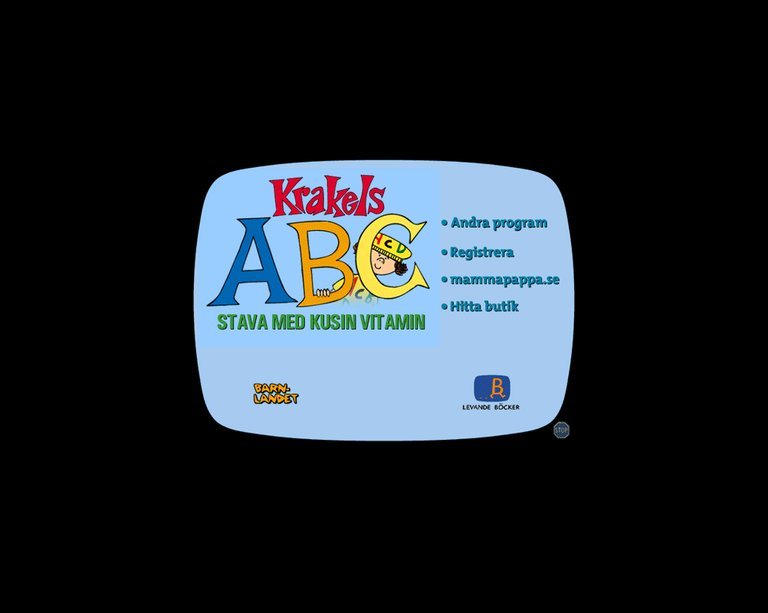
Description
Krakels ABC: Stava is an educational spelling game for Swedish children aged 6-8, set in the fictional town of Näppelunda. As the fourth installment in the Krakels ABC series – based on Lennart Hellsing and Poul Ströyer’s book characters – players help Kusin Vitamin through three waterfront-themed mini-games: reconstructing shipping container labels, unscrambling garbled submarine radio transmissions, and solving cell-block crossword puzzles with image clues. Progress unlocks creative tools including a sign-maker and story notebook.
Krakels ABC: Stava Cracks & Fixes
Krakels ABC: Stava Reviews & Reception
sockscap64.com (70/100): Educational game for kids to learn spelling.
Krakels ABC: Stava: Review
In the pantheon of educational video games, few titles have managed to blend learning and entertainment as seamlessly as Krakels ABC: Stava. Released in 1999, this Swedish educational game stands as a testament to the potential of interactive media in fostering literacy. Krakels ABC: Stava is not just a game; it is a cultural artifact that encapsulates the educational ethos of its time while offering a rich, immersive experience for young learners. This review will delve into the game’s development history, narrative depth, gameplay mechanics, world-building, and its enduring legacy.
Development History & Context
The Studio & Creative Vision
Krakels ABC: Stava was developed by ELD Interaktiv Produktion AB, a Swedish studio known for its educational titles. The game is part of a broader series inspired by the characters from the children’s books of Lennart Hellsing and Poul Ströyer. The series aimed to leverage the charm and familiarity of these literary figures to make learning more engaging for young children.
The development team consisted of 28 individuals, including programmers, graphic designers, sound engineers, and pedagogical consultants. This diverse group ensured that the game balanced entertainment with educational value. The executive producer, Lotta Nylander, and the producer, Linn Johansson, played pivotal roles in steering the project towards its vision of creating an interactive learning tool that was both fun and effective.
Technological Constraints & Gaming Landscape
Released in 1999, Krakels ABC: Stava was developed for Windows and Macintosh, reflecting the era’s transition to CD-ROM-based gaming. The game’s fixed/flip-screen visuals and point-and-click interface were standard for educational titles of the time. However, the fully voiced dialogue and animated cutscenes were notable for their polish, setting the game apart from many of its contemporaries.
The gaming landscape in 1999 was dominated by titles like Reader Rabbit and The ClueFinders, which also focused on educational content. Krakels ABC: Stava distinguished itself through its Swedish cultural context and the integration of local literary icons, making it uniquely accessible to its target audience.
Narrative & Thematic Deep Dive
Plot & Characters
The narrative of Krakels ABC: Stava revolves around the fictional town of Näppelunda, the home of the beloved characters from Lennart Hellsing’s books. Players are guided by Kusin Vitamin, a character from the series, through three spelling mini-games set in different locations around the waterfront. Each location presents a unique challenge that reinforces spelling skills through interactive puzzles.
The first mini-game takes place in a warehouse filled with shipping containers. The letters on the labels have fallen off, and players must recreate the correct words on the box labels, aided by drawings that show the box’s contents. Clicking on the box image speaks the word, and clicking on a single letter gives the sound of the letter, providing auditory reinforcement.
The second location is a radio station where a submarine captain is transmitting words that are textually garbled in reception. Players must sort the mixed letters into words, initially aided by image clues and spoken words from the captain. As the game progresses, the image clues are omitted, challenging players to guess the words without any visual aids.
The third mini-game is set in an old prison where prisoners have scribbled patterns similar to simple crosswords. Players receive a single starting word and image clues to the missing words. The image clues are also spoken when clicked on, providing additional support.
Educational Themes
Krakels ABC: Stava focuses on literacy, with mini-games designed to reinforce vocabulary and spelling. The game’s interactive approach to learning makes it an effective tool for young learners, as it engages them in a way that traditional textbooks cannot. The use of Swedish language and folklore makes the game uniquely accessible to native speakers, while the educational content is aligned with Swedish educational standards.
Gameplay Mechanics & Systems
Core Loop
The game’s core loop alternates between story-driven cutscenes and mini-games, each tied to a specific educational objective. The three difficulty levels ensure scalability for different skill levels, making the game accessible to a wide range of players.
Strengths & Flaws
One of the game’s strengths is its innovative blend of narrative and mini-games, which was ahead of its time for educational software. The point-and-click interface is intuitive for young players, and the fully voiced dialogue enhances immersion. However, the fixed-screen design feels dated by today’s standards, and the lack of modern replayability features, such as saving progress, is a notable drawback.
World-Building, Art & Sound
Visual Design
The art style of Krakels ABC: Stava is cartoonish and colorful, aligning with Lennart Hellsing’s illustrations. The backgrounds are static but detailed, with character animations adding life to the story. The visual design is consistent with the game’s educational focus, providing a visually engaging environment that supports learning.
Sound & Music
The fully voiced dialogue in Krakels ABC: Stava enhances immersion, with sound effects like magical spells reinforcing the fantasy setting. The soundtrack is cheerful and unobtrusive, typical of children’s educational games. The use of Swedish language in the dialogue and sound effects adds to the game’s cultural authenticity.
Reception & Legacy
Critical & Commercial Reception
Krakels ABC: Stava did not receive formal reviews at the time of its release, but its inclusion in the Krakels ABC series suggests commercial success. The game’s pedagogical approach aligns with Swedish educational standards, likely contributing to its adoption in schools.
Influence
While not as globally recognized as Reader Rabbit, Krakels ABC: Stava exemplifies how local literature can be adapted into effective educational tools. Its legacy lies in its cultural specificity and the series’ enduring popularity in Sweden. The game’s interactive learning approach has influenced subsequent educational titles, demonstrating the potential of video games as effective teaching tools.
Conclusion
Krakels ABC: Stava is a testament to the power of storytelling in education. Though technologically modest by today’s standards, its creative integration of narrative and learning remains admirable. For Swedish children of the late 1990s, it was a magical gateway to literacy—proving that educational games can be both fun and meaningful. Its place in video game history is secure, not just as an educational tool but as a cultural artifact that reflects the educational ethos of its time.