
- Release Year: 1989
- Platforms: Atari 2600, Windows, Xbox 360
- Publisher: Atari Corporation, Microsoft Corporation
- Developer: Atari Corporation
- Genre: Action
- Perspective: Side view
- Game Mode: Co-op, Single-player
- Gameplay: Arcade, Paddle, Pong
- Setting: Oriental
- Average Score: 62/100
Description
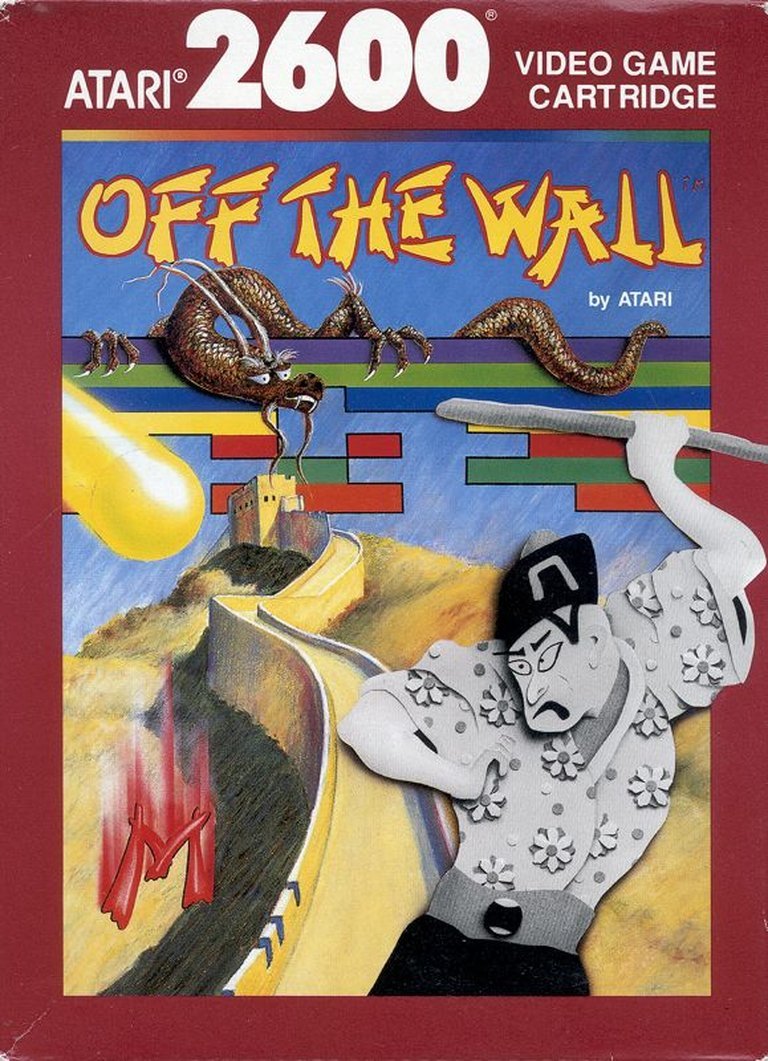
Off the Wall is an arcade action game with Breakout-style gameplay, where players control Kung Fu Lu, tasked with destroying a mysterious wall by reflecting a bouncing ball into its bricks. A mystical dragon guards the wall, while a disruptive blackbird complicates gameplay. Power-ups like magnetic balls, explosive strikes, and paddle upgrades aid progress, with players advancing ranks by clearing waves. Lives are lost if the ball falls, and the challenge intensifies across levels with faster speeds and obstacles.
Off the Wall Free Download
Atari 2600
Off the Wall Reviews & Reception
brettweisswords.com : There are certainly worse ways to kill half an hour than to play this game a few rounds.
mobygames.com (55/100): Overall, Off the Wall is a largely forgotten title for the Atari 2600.
digitpress.com (70/100): It is one of the better offerings in this genre.
Off the Wall: A Pivotal Brick in the Atari 2600’s Twilight Era
Introduction
In the winter of 1989, as the Nintendo Entertainment System dominated living rooms, Atari Corporation quietly launched Off the Wall—a swan song for the aging Atari 2600 that dared to reimagine Breakout through the lens of arcade ambition. Developed by Axlon, a studio helmed by Atari co-founder Nolan Bushnell, this late-era release fused martial arts mystique with frenetic brick-breaking action. But does it stand as a forgotten revolution or a relic of technological compromise? This review dissects Off the Wall as a pivotal artifact—a game caught between honoring the 2600’s legacy and straining against its limitations.
Development History & Context
The Bushnell Factor and Axlon’s Vision
Off the Wall emerged from Axlon, a short-lived studio founded by Nolan Bushnell after his departure from Atari. Tasked with revitalizing the 2600’s waning relevance, Bushnell’s team aimed to push the console’s 8-bit architecture to its limits. The game’s 16K ROM was a technical flex for the 2600, enabling detailed sprites and multi-layered gameplay—a stark contrast to earlier brick-breakers like Breakout (1976).
Era of Transition
By 1989, the 2600 was commercially obsolete, yet Atari leaned into nostalgia, repackaging the console as the Atari 2600 Jr. Axlon’s directive was clear: craft a game that felt modern while respecting the hardware’s constraints. Off the Wall’s development coincided with the rise of Nintendo’s Arkanoid (1986), a Breakout successor with power-ups and bosses—elements Axlon mirrored to compete.
Technological Trade-offs
The Atari 2600’s 6507 CPU (1.19 MHz) and 128 bytes of RAM forced ingenuity. Designer Steve Baker prioritized fluid ball physics and flicker-free sprites, but compromises abounded. Most notably, Off the Wall abandoned the 2600’s paddle controllers—optimal for Breakout-style precision—for digital joystick support, a decision critics lambasted as aligning with cost-cutting over gameplay.
Narrative & Thematic Deep Dive
The Mythos of Kung Fu Lu
Players embody Kung Fu Lu, a warrior tasked with dismantling an “evil wall” guarded by a dragon—a thin but evocative narrative scaffolding. Each level positions Lu as an underdog: a “Peasant” ascending ranks by clearing waves. The dragon, rendered as a serpentine sprite, embodies Eastern mysticism, while the Blackbird (a bat-like foe introduced post-Level 1) injects chaotic unpredictability.
Power-Ups as Narrative Devices
Magic tokens—Magnetic (M), Explosive (Bomb), Zigzag (Z), and Paddle Extend (Raindrop)—function as mystical artifacts. Their acquisition temporarily empowers Lu, framing progression through a warrior’s mastery of tools. The “?” token, a wildcard, furthers the game’s unpredictable tone—rewarding or sabotaging players with equal whimsy.
Thematic Undercurrents
Off the Wall subtly critiques futility: the wall regenerates endlessly, mirroring arcade gaming’s Sisyphean grind. Yet its rank system—from Peasant to Samurai—offers a hopeful undercurrent: skill can elevate status, a metaphor for player growth amid repetition.
Gameplay Mechanics & Systems
Core Loop and Innovation
The game’s framework is pure Breakout: deflect a ball upward to shatter bricks. Off the Wall innovates via dual objectives: clear all bricks OR strike the dragon six times. The latter introduces risk-reward dynamics—prioritize speed (dragon kills) or thoroughness (brick clearing). This duality, coupled with multi-ball chaos in 2P mode, elevates strategy.
Power-Up Economy
- Magnetic (M): Ball sticks to Lu’s staff, enabling precise aiming.
- Explosive (Bomb): Ball detonates brick clusters upon impact.
- Zigzag (Z): Erratic trajectory bypasses defenses.
- Paddle Extend: Widens Lu’s hitbox, easing rebound control.
Tokens spawn randomly, demanding reactive play. However, their fleeting duration (4–8 seconds) discourages over-reliance, preserving challenge.
Controls: A Fatal Compromise?
The joystick control—responsive yet imprecise—remains Off the Wall’s most divisive element. Lacking the paddle’s analog finesse, players contend with delayed lateral movement, turning high-speed ball returns into guesswork. The Blackbird’s deflections exacerbate this, creating moments of unfair frustration.
Progression and Penalties
Rank ascension (every four waves) accelerates ball speed and Blackbird aggression. With five lives and no continues, death is punitive—especially when the ball inexplicably accelerates post-rebound, a quirk attributed to programming oversights.
World-Building, Art & Sound
Visual Identity
Off the Wall’s vibrant, blocky sprites push the 2600’s 160×192 resolution to its limits:
– Dragon: An animated, coiled sprite with fiery eyes.
– Blackbird: A pitch-black, flitting silhouette.
– Bricks: Multi-colored grids evoking stained glass.
Backgrounds cycle through static oriental motifs (pagodas, torches), though sprite flicker mars cohesion during chaos.
Soundscape
Minimalism defines the audio:
– Ball impacts: Sharp, metallic clinks.
– Power-up jingles: Brief 8-bit fanfares.
– Dragon hit: A deep, gong-like tone.
While functional, the lack of a continuous soundtrack renders moments hollow—a missed opportunity for atmospheric depth.
Reception & Legacy
Launch Reception
Critics praised Off the Wall’s ambition but skewered its controls:
– Woodgrain Wonderland (75%): “The closest thing to Arkanoid on 2600—challenging and fun!”
– Digital Press (65%): “Fast-paced and cool, but paddles would’ve perfected it.”
– The Game Hoard (29%): “Frustration overshadows innovation.”
Commercial performance was tepid, buried under the 16-bit console boom.
Long-Term Influence
Off the Wall’s experimental DNA surfaced in later titles:
– Dual win conditions resurfaced in Wizorb (2011).
– Rank-based progression inspired indie roguelikes like Brick Breaker Quest.
Its inclusion in compilations (Atari Flashback Classics, Atari 50) cements its cult status.
Conclusion
Off the Wall is a paradox: a technically impressive finale for the Atari 2600, hamstrung by its refusal to embrace the console’s strengths. Its inventive power-ups, dual objectives, and Eastern aesthetic showcase Axlon’s creative spark, yet the joystick controls and erratic difficulty undermine its potential. For historians, it’s a vital relic—a bridge between Breakout’s purity and Arkanoid’s arcade excess. For players, it remains a compelling, if flawed, curiosity—proof that even in twilight, the 2600 could still spark flashes of brilliance.
Final Verdict: A 7/10—an essential artifact for retro enthusiasts, but a footnote in the broader canon.