
- Release Year: 1995
- Platforms: DOS, Macintosh, Windows 16-bit, Windows
- Publisher: Activision Value Publishing, Inc., Sierra On-Line, Inc.
- Developer: Sierra On-Line, Inc.
- Genre: Adventure
- Perspective: 3rd-person (Other)
- Game Mode: Single-player
- Gameplay: Point-and-click, Puzzle
- Setting: Church, City, Monastery, Munich
- Average Score: 87/100
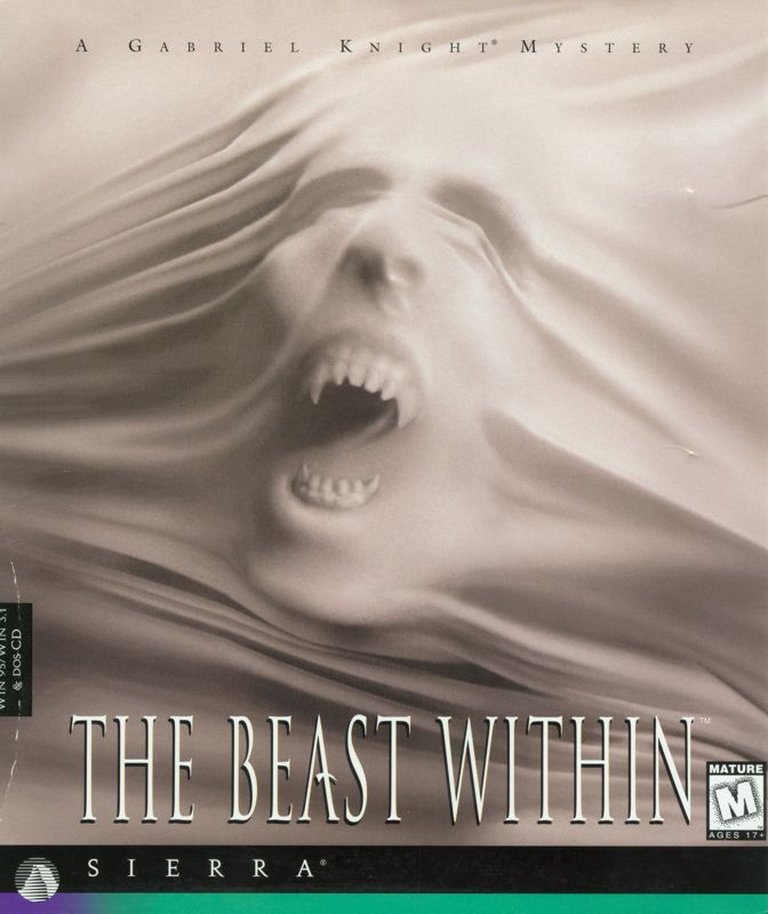
Description
In ‘The Beast Within: A Gabriel Knight Mystery,’ supernatural detective Gabriel Knight, the last of the Schattenjaegers (shadow hunters), relocates to his ancestral castle in Bavaria to investigate a brutal werewolf killing. Teaming with assistant Grace Nakimura, they delve into Bavaria’s dark history and the secretive Hunter Society, unraveling a conspiracy tied to lycanthropy. The game uses full-motion video with live actors against photorealistic Munich backdrops, preserving classic point-and-click adventure gameplay through puzzles, detective work, and dual protagonist chapters.
Gameplay Videos
Where to Buy The Beast Within: A Gabriel Knight Mystery
The Beast Within: A Gabriel Knight Mystery Free Download
The Beast Within: A Gabriel Knight Mystery Patches & Updates
The Beast Within: A Gabriel Knight Mystery Guides & Walkthroughs
The Beast Within: A Gabriel Knight Mystery Reviews & Reception
metacritic.com (82/100): This is easily one of the best Point & Click Graphic Adventures of all times.
imdb.com (90/100): Gabriel Knight: The Beast Within is not only the best computer game ever made, it’s also one of my favorite horror movies.
mobygames.com (89/100): The Beast Within is most certainly a worthy sequel.
The Beast Within: A Gabriel Knight Mystery Cheats & Codes
PC
Name a file ‘Fred’ (without the quotes) and place it inside the game’s folder on your hard drive. Start up the game to begin at any chapter.
| Code | Effect |
|---|---|
| Fred | Jump to any chapter |
Macintosh
Name a file ‘Fred’ (without the quotes) and place it inside the game’s folder on your hard drive. Start up the game to begin at any chapter.
| Code | Effect |
|---|---|
| Fred | Jump to any chapter |
The Beast Within: A Gabriel Knight Mystery
The Beast Within: A Gabriel Knight Mystery is a landmark in the annals of video game history, a title that seamlessly blends rich narrative, innovative gameplay, and groundbreaking technology. Developed by Sierra On-Line and released in 1995, this sequel to Gabriel Knight: Sins of the Fathers stands as a testament to the creative vision of designer Jane Jensen and her team. The game’s legacy is one of both critical acclaim and controversy, making it a fascinating subject for analysis.
Development History & Context
The development of The Beast Within was a monumental undertaking, marked by both ambition and constraint. Sierra On-Line, a pioneer in the adventure game genre, sought to push the boundaries of what was possible in interactive storytelling. Jane Jensen, the creative force behind the Gabriel Knight series, envisioned a game that would not only continue the narrative of Gabriel Knight but also revolutionize the way stories were told in video games.
The technological landscape of the mid-1990s was ripe for innovation. The advent of CD-ROM technology allowed for the inclusion of full-motion video (FMV), a feature that Sierra On-Line exploited to create a more immersive experience. The game was developed using Sierra’s Creative Interpreter (SCI) engine, which supported the integration of live-action video sequences. This decision was both a strength and a weakness, as it allowed for a more cinematic presentation but also introduced significant technical challenges.
The gaming landscape at the time was dominated by point-and-click adventures, with titles like Myst and The Secret of Monkey Island setting the standard for narrative-driven gameplay. Sierra On-Line, with its established reputation, aimed to elevate the genre by incorporating FMV, a technology that was both cutting-edge and fraught with risk. The studio assembled a talented team, including director Will Binder, producer Sabine Duvall, and a cast of actors who would bring the characters to life.
Narrative & Thematic Deep Dive
The narrative of The Beast Within is a complex tapestry of mystery, horror, and historical fiction. The story unfolds in Bavaria, Germany, where Gabriel Knight, the protagonist, has taken up residence in his ancestral castle, Schloss Ritter. The game’s plot revolves around a series of murders attributed to a werewolf, a creature that Gabriel must investigate and ultimately confront.
The game’s themes are rich and multilayered. At its core, The Beast Within explores the duality of human nature, the struggle between civilization and primal instincts, and the consequences of embracing one’s darker impulses. The narrative is deeply rooted in German folklore and history, drawing on the legends of werewolves and the real-life figures of King Ludwig II and Richard Wagner. This historical context adds depth to the story, making it both engaging and thought-provoking.
The characters in The Beast Within are meticulously crafted, each with their own motivations and arcs. Gabriel Knight, portrayed by Dean Erickson, is a complex figure, torn between his duties as a Schattenjäger (shadow hunter) and his personal desires. His assistant, Grace Nakimura, played by Joanne Takahashi, provides a counterpoint to Gabriel’s impulsive nature, offering a more rational and analytical approach to the mysteries they encounter.
The dialogue in the game is sharp and engaging, with each character’s voice reflecting their unique personality. The interactions between Gabriel and Grace are particularly noteworthy, as they often serve as a catalyst for the story’s development. The game’s pacing is deliberate, allowing the narrative to unfold at a measured pace, building tension and suspense as the story progresses.
Gameplay Mechanics & Systems
The gameplay mechanics of The Beast Within are a blend of traditional adventure game elements and innovative FMV sequences. The game is played from a third-person perspective, with the player controlling either Gabriel or Grace, depending on the chapter. The interface is simplified, featuring a single cursor that performs context-sensitive actions, a departure from the icon-based system used in the first game.
The core gameplay loop involves exploration, puzzle-solving, and conversation. The player must navigate various locations, gather clues, and interact with characters to unravel the mystery. The puzzles in the game are integrated into the narrative, requiring the player to use their wits and observation skills to progress. Some puzzles are straightforward, while others are more complex, requiring a deep understanding of the game’s lore and mechanics.
The FMV sequences are a double-edged sword. On one hand, they add a cinematic quality to the game, immersing the player in the story. On the other hand, they can be slow and repetitive, with the player often watching Gabriel or Grace perform mundane actions. This can lead to a sense of frustration, as the player is forced to wait through lengthy sequences to progress.
The game’s UI is functional but not particularly innovative. The inventory system is straightforward, allowing the player to examine and use items as needed. The conversation system is more limited, with topics disappearing once they have been explored. This can be frustrating, as it limits the player’s ability to revisit previous conversations and gather additional information.
World-Building, Art & Sound
The world-building in The Beast Within is exceptional. The game’s setting in Bavaria is brought to life through a combination of live-action video and computer-generated scenery. The locations are meticulously detailed, with each environment reflecting the game’s historical and cultural context. The use of real-life locations, such as Neuschwanstein Castle, adds a sense of authenticity to the game, making it feel more immersive.
The art direction is a blend of realism and stylization. The FMV sequences are shot in a cinematic style, with the actors performing against blue screens. The backgrounds are often photographs of real locations, enhanced with digital effects to create a seamless integration of live-action and digital elements. This approach allows for a high level of detail and immersion, but it also introduces technical challenges, such as the need for precise lip-syncing and motion capture.
The sound design is a crucial element of the game’s atmosphere. The soundtrack, composed by Robert Holmes, is a haunting and evocative blend of classical and operatic music. The use of leitmotifs, recurring musical themes associated with specific characters or ideas, adds depth to the narrative, tying together the various elements of the story. The sound effects are also well-integrated, with ambient sounds and voice acting contributing to the game’s immersive quality.
Reception & Legacy
The Beast Within received critical acclaim upon its release, with reviewers praising its storytelling, characterization, and presentation. The game was lauded for its ability to blend FMV with traditional adventure gameplay, creating a unique and engaging experience. However, the game was not without its critics, with some reviewers noting the slow pace and repetitive nature of the FMV sequences.
The game’s commercial performance was