
- Release Year: 1998
- Platforms: Macintosh, Windows
- Publisher: Jordan Freeman Group, LLC, Knowledge Adventure, Inc.
- Developer: Funnybone Interactive
- Genre: Adventure, Educational
- Perspective: Side view
- Game Mode: Single-player
- Gameplay: Spelling challenges
- Setting: Prehistoric
- Average Score: 89/100
Description
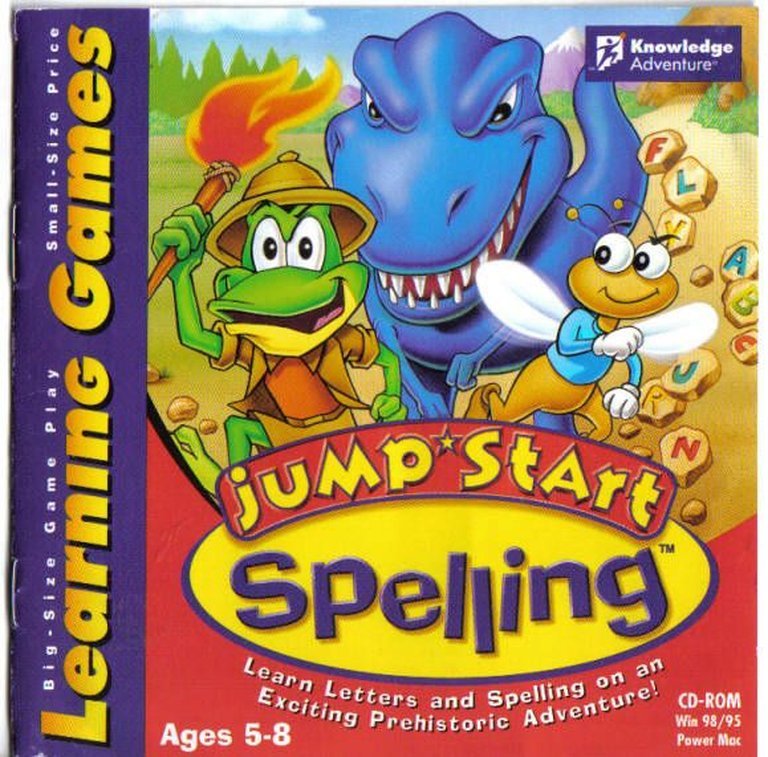
JumpStart Spelling is an educational adventure game for children ages 5-8 that follows CJ the frog and his glowing sidekick Edison in a prehistoric world. After a Tyrannosaurus Rex separates the duo, players help CJ navigate obstacle-filled environments by solving spelling challenges on rock tablets, assisted by Pteri the pterosaur. With grade-based difficulty levels (Kindergarten through 3rd grade), players progress through worlds by correctly spelling words and identifying proper spellings in dinosaur mini-games. The game adapts difficulty dynamically and tracks player progress through high scores.
Gameplay Videos
Where to Buy JumpStart Spelling
PC
JumpStart Spelling Free Download
JumpStart Spelling Guides & Walkthroughs
JumpStart Spelling Reviews & Reception
mobygames.com (78/100): Jump Start Spelling is an educational game that helps children ages 5-8 on spelling skills.
myabandonware.com (100/100): This game really only does one thing, and doesn’t pretend to do anything else. Run through a bunch of levels, pick up tablets and spell words.
JumpStart Spelling: Review
JumpStart Spelling, released in 1998, stands as a testament to the educational gaming era of the late 1990s. Developed by Funnybone Interactive and published by Knowledge Adventure, this title was part of the broader JumpStart Learning Games series, which aimed to blend entertainment with education for young audiences. This review will delve into the game’s development history, narrative, gameplay mechanics, world-building, reception, and its enduring legacy.
Development History & Context
Studio and Creators’ Vision
JumpStart Spelling was developed by Funnybone Interactive, a studio known for its educational software. The game was overseen by a team of experienced professionals, including Joel Fried as President, Susan Swanson-Decker as Vice President, and Kevin O’Neill as Executive Producer. The art direction was handled by Wesley Hodges, while Andrew Keplinger led the programming efforts. The design and concept were a collaborative effort involving Susan Swanson-Decker, Kevin O’Neill, Paul Joffe, Andrew Keplinger, and Ken Perkins. The writing team consisted of Susan Swanson-Decker, Kevin O’Neill, and Joel Gould, ensuring that the narrative was both engaging and educational.
Technological Constraints of the Era
Released in 1998, JumpStart Spelling was developed during a time when CD-ROM technology was at its peak. The game was designed to run on Windows and Macintosh platforms, utilizing the technological capabilities of the era to deliver an immersive educational experience. The use of 2D graphics and mouse-controlled gameplay was standard for the time, but the game managed to stand out with its engaging narrative and interactive elements.
Gaming Landscape
The late 1990s saw a surge in educational software, with titles like JumpStart Spelling competing in a market that valued both entertainment and learning. The JumpStart series, in particular, had already established a strong foothold with titles like JumpStart Kindergarten and JumpStart 1st Grade. JumpStart Spelling fit into this landscape by focusing on spelling skills, a crucial aspect of early education.
Narrative & Thematic Deep Dive
Plot
JumpStart Spelling follows the adventures of CJ the frog and his sidekick Edison, a firefly, as they explore a prehistoric world. The story begins with a Tyrannosaurus Rex separating the duo after a mighty roar, leading to Edison’s capture by a group of cavemen who mistake him for a source of light. The player’s goal is to help CJ reunite with Edison by navigating through various levels, solving spelling challenges, and overcoming obstacles.
Characters
The primary characters are CJ and Edison, who are accompanied by a friendly pterosaur named Perry. The cavemen, while not central to the narrative, play a crucial role in the plot by capturing Edison. The characters are designed to be relatable and engaging for young audiences, with CJ serving as the protagonist and Edison as the damsel in distress.
Dialogue and Themes
The dialogue in JumpStart Spelling is simple and straightforward, designed to be easily understood by children aged 5-8. The themes revolve around problem-solving, perseverance, and the importance of spelling skills. The game encourages players to think critically and apply their knowledge to progress through the levels.
Gameplay Mechanics & Systems
Core Gameplay Loops
JumpStart Spelling utilizes a platforming style of gameplay, where players control CJ’s movements by guiding Perry around the screen. The game features two main types of challenges:
-
Spelling Obstacles: Players move CJ to stone tablets, where they are asked to spell words. Letters fall from the top of the screen, and players must use Perry to catch them and place them in the correct spots on the tablet. Successfully spelling a word allows CJ to clear an obstacle and continue.
-
Timing Obstacles: These challenges test the player’s timing rather than spelling skills. Players must navigate CJ past physical obstacles such as geysers, requiring quick reflexes and precise timing.
Bonus Rounds
After completing a set of spelling and timing obstacles, players enter a bonus round where dinosaurs hold up signs with words. The player must select the correctly spelled word that matches the one CJ asks for. The more questions answered correctly, the higher the bonus points awarded.
Character Progression and UI
The game level is controlled based on the grade selected at sign-in, with Kindergarten being the easiest and 3rd Grade being the hardest. Players can also adjust the difficulty during the game through the options menu. The amount of words spelled correctly contributes to a high score at the end of the game. The user interface is intuitive, with clear instructions and visual cues to guide players through the challenges.
World-Building, Art & Sound
Setting and Atmosphere
JumpStart Spelling is set in the “Land of the Lost Words,” a prehistoric world filled with dinosaurs and cavemen. The setting is designed to be both engaging and educational, with each level featuring unique environments such as jungle jungles, prehistoric ponds, and magma caves. The atmosphere is vibrant and colorful, appealing to young audiences.
Visual Direction
The game’s visuals are characterized by 2D pixel art, which was standard for the time. The character designs are cute and cartoony, with CJ and Edison being particularly endearing. The environments are detailed and immersive, with each level offering a distinct visual style.
Sound Design
The sound design in JumpStart Spelling is simple but effective. The background music is upbeat and engaging, while the sound effects are clear and relevant to the actions on screen. The voice acting is minimal but well-executed, with the characters’ voices being clear and easy to understand.
Reception & Legacy
Critical and Commercial Reception
JumpStart Spelling received mixed reviews upon its release. Critics praised the game’s educational value and engaging gameplay, but noted that it lacked the depth and variety of its predecessors in the JumpStart series. The game was commended for its ability to teach spelling skills in a fun and interactive way, but critics also pointed out that the gameplay could become repetitive.
Influence on Subsequent Games and the Industry
Despite its mixed reception, JumpStart Spelling contributed to the broader educational gaming landscape. The game’s focus on spelling skills and its use of interactive challenges set a precedent for future educational titles. The JumpStart series as a whole has had a lasting impact on the industry, with its innovative approach to blending education and entertainment.
Conclusion
JumpStart Spelling is a product of its time, reflecting the educational gaming trends of the late 1990s. While it may not have achieved the same level of acclaim as some of its predecessors in the JumpStart series, it remains a notable title in the genre. The game’s engaging narrative, intuitive gameplay mechanics, and immersive world-building make it a valuable addition to the educational gaming canon. Its legacy endures as a testament to the potential of educational software to entertain and educate young audiences.