
- Release Year: 2005
- Platforms: Browser, Windows
- Developer: James Harvey
- Genre: Puzzle
- Perspective: Point and select
- Game Mode: Single-player
- Gameplay: Bridge Building, Grid-based, Logic puzzle
Description
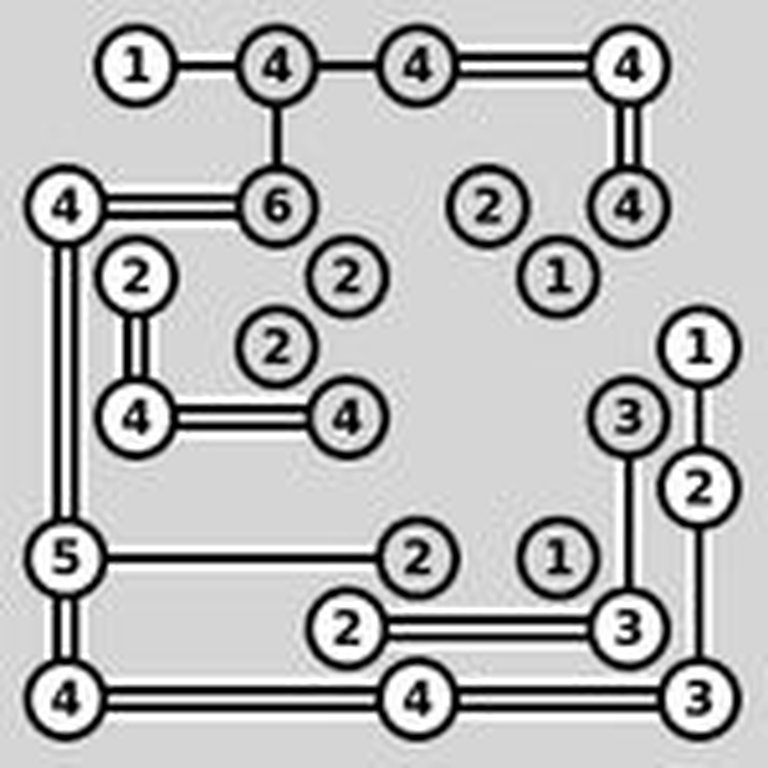
Bridges is a puzzle game where players must connect all islands with a network of straight vertical and horizontal bridges. Each island has a number indicating how many bridges are connected to it, and bridges cannot cross each other. The goal is to solve the puzzle by strategically placing the bridges according to the given numbers.
Where to Buy Bridges
PC
Bridges: Review
Introduction
In the sprawling landscape of video games, where narratives dazzle and graphics push technical boundaries, Bridges (2005) stands as a quiet outlier—a game that strips away excess to focus on pure, cerebral challenge. Developed as part of Simon Tatham’s Portable Puzzle Collection, this freeware title distills the essence of logic puzzles into a minimalist package. Though overshadowed by blockbuster releases of its era, Bridges carves out a niche as a refined adaptation of Nikoli’s Hashiwokakero puzzles. This review argues that Bridges exemplifies the timeless appeal of elegant puzzle design, even if its lack of frills and modest scope limit its broader recognition.
Development History & Context
Bridges emerged from Simon Tatham’s Portable Puzzle Collection, a suite of open-source logic games designed for cross-platform accessibility. Tatham, a British programmer, aimed to create “portable” puzzles that could run on any system, adhering to principles of simplicity and replayability. Released in 2005 for Windows (and later browsers in 2008), Bridges arrived during a transitional period for puzzle games. While franchises like Tetris and Bejeweled dominated the casual market, Japanese publisher Nikoli’s pen-and-paper puzzles—including Sudoku—were gaining global traction.
The game’s mechanics are directly inspired by Nikoli’s Hashiwokakero (“bridge building”) puzzles, which debuted in the 1990s. Tatham’s adaptation embraced the constraints of early 2000s technology: no elaborate visuals, no soundtrack, and no narrative. Yet this simplicity became its strength, allowing the game to function smoothly on low-end hardware and prioritize gameplay clarity. As a freeware title, Bridges avoided commercial pressures, instead catering to a dedicated audience of puzzle enthusiasts.
Narrative & Thematic Deep Dive
Bridges dispenses with narrative entirely—no characters, no plot, and no setting. Its premise is abstract: players must connect numbered “islands” with bridges, adhering to strict logical rules. While this lack of storytelling might alienate some, it reinforces the game’s focus on problem-solving as its own reward.
Thematically, Bridges embodies the existential satisfaction of creating order from chaos. Each puzzle presents a scattered archipelago of numbers, and the player’s role is to weave coherence into the disorder. The game’s silence—no dialogue, no text beyond instructions—amplifies this meditative quality, inviting players to lose themselves in the rhythm of connecting nodes. In an era of bombastic AAA titles, Bridges is a reminder that games can thrive on quiet introspection.
Gameplay Mechanics & Systems
At its core, Bridges is a game of constraints:
– Rules: Each island displays a number indicating how many bridges must connect to it.
– Construction: Bridges can be horizontal or vertical, never diagonal, and cannot cross.
– Limits: Islands can be linked by one or two bridges (depending on the mode), but no more.
The gameplay loop is deceptively simple:
1. Analyze the grid to deduce mandatory connections.
2. Avoid over- or under-connecting islands.
3. Use process of elimination to solve increasingly complex layouts.
The UI is Spartan but functional, with left-click to place bridges and right-click to mark invalid moves. While the lack of tutorials might daunt newcomers, the learning curve is fair, relying on intuitive trial-and-error. Difficulty escalates through grid size and island density, with later puzzles demanding foresight akin to chess strategy.
One flaw is the absence of innovation beyond Nikoli’s original rules. Unlike contemporaries like Minesweeper or Picross, Bridges offers little variation in modes or objectives. Yet its purity of purpose ensures that every puzzle feels like a calibrated test of logic.
World-Building, Art & Sound
Bridges forgoes traditional world-building, presenting players with a blank grid and monochromatic islands. Visuals are utilitarian: islands are white circles against a gray backdrop, and bridges are straight black lines. This austerity aligns with the game’s no-nonsense ethos but may feel sterile to players accustomed to vibrant aesthetics.
Sound design is equally minimalist. Clicks and error chimes provide basic feedback, but there’s no music or ambient noise. While this avoids distraction, it also robs the game of atmospheric texture. For a 2005 release, even modest audio flourishes—akin to Tetris’s iconic tunes—could have enhanced engagement.
Reception & Legacy
Critically, Bridges flew under the radar. With no professional reviews at launch, its reputation rests on player feedback. The game holds a 3.3/5 average on MobyGames (based on two user ratings), praised for its authenticity to Nikoli’s puzzles but criticized for its bare-bones presentation.
Its legacy lies in its preservation of Hashiwokakero as a digital format. While not a trailblazer, Bridges inspired later iterations like Flow Free: Bridges (2012) and Hashi Puzzles: Bridges and Islands (2012), which expanded the concept with color and thematic skins. Within Tatham’s Portable Puzzle Collection, it remains a staple, beloved by purists for its unadulterated challenge.
Conclusion
Bridges is a paradox: a game that is both forgettable and unforgettable. Its lack of narrative, visuals, and innovation limits its appeal, yet its razor-sharp puzzle design exemplifies the timeless joy of logical deduction. For players seeking a meditative challenge—or a portal to Nikoli’s world of pen-and-paper puzzles—Bridges delivers. It may not be a landmark title, but as a freeware artifact of early 200s puzzle gaming, it deserves recognition for doing one thing exceptionally well: making you think.
Final Verdict: A niche gem for puzzle enthusiasts, Bridges is worth discovering for its elegance and rigor—but its minimalism ensures it will never be a mainstream darling.