
- Release Year: 2010
- Platforms: Windows
- Genre: Adventure
- Perspective: 3rd-person (Other)
- Game Mode: Single-player
- Gameplay: Graphic adventure, Puzzle elements
- Setting: Contemporary
Description
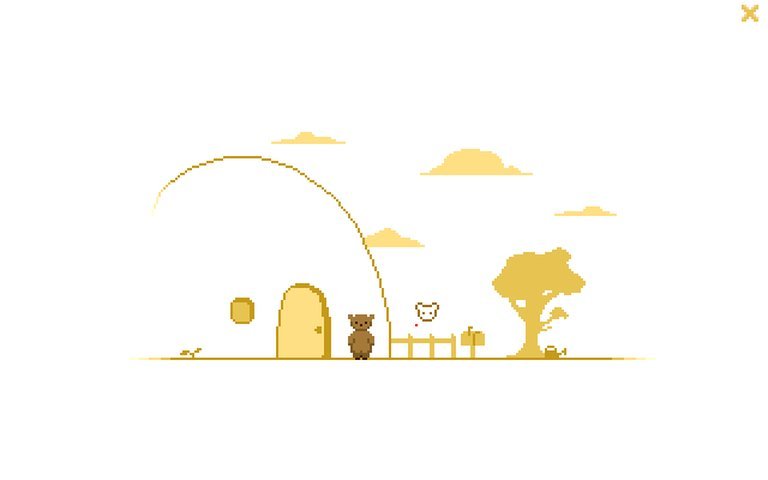
Kuma Story is a free 2D point-and-click adventure game where players control Kuma Bear on a quest to find an anniversary gift for his girlfriend, Cinnamon Bear. Set in a charming contemporary world with minimal text and image-based interactions, the game combines light puzzle-solving with a romantic narrative. Designed as a personal anniversary gift by Japanese creator SpacePirateCaine, this short experience can be completed in roughly 10 minutes using simple mouse controls.
Kuma Story Free Download
Kuma Story: Review
In the vast landscape of indie gaming, few titles have managed to capture the essence of simplicity and charm as effectively as “Kuma Story.” Released in 2010, this 2D click-and-point adventure game stands as a testament to the power of minimalism and heartfelt storytelling. Created by SpacePirateCaine as an anniversary gift for his girlfriend, “Kuma Story” transcends its humble origins to become a beloved gem in the annals of video game history. This review will delve into the various aspects of “Kuma Story,” exploring its development history, narrative depth, gameplay mechanics, world-building, and lasting legacy.
Development History & Context
“Kuma Story” was developed using the Adventure Game Studio (AGS), a popular tool for creating 2D adventure games. The game’s creator, Luke “SpacePirateCaine” Rideout, is a Japanese developer known for his unique storytelling and artistic style. The technological constraints of the era limited the game’s visual and auditory capabilities, but Rideout managed to leverage these limitations to create a game that is both visually and aurally pleasing.
The gaming landscape in 2010 was dominated by high-budget AAA titles, but there was a growing interest in indie games that offered unique experiences. “Kuma Story” fit perfectly into this niche, offering a fresh and innovative take on the adventure genre. The game’s development was driven by a personal motivation—to celebrate an anniversary—but it quickly gained traction in the indie community for its charm and creativity.
Narrative & Thematic Deep Dive
At its core, “Kuma Story” is a tale of love and surprise. The player controls Kuma Bear, who is on a mission to find the perfect anniversary gift for his girlfriend, Cinnamon Bear. The narrative is simple yet effective, focusing on the small moments that make relationships special. The game’s strength lies in its ability to evoke emotions through minimalistic storytelling.
The dialogue in “Kuma Story” is sparse, with most interactions taking place through images rather than text. This textless approach allows the game to be accessible to a global audience, regardless of language barriers. The themes of love, surprise, and the importance of small gestures are universal, making the game relatable to players from all walks of life.
Gameplay Mechanics & Systems
“Kuma Story” is a click-and-point adventure game, a genre that was popular in the 1990s but saw a resurgence in the 2000s thanks to indie developers. The gameplay is straightforward: players navigate through various environments, interacting with objects and characters to progress the story. The game’s interface is intuitive, with a point-and-select system that is easy to learn.
The core gameplay loop involves exploring different locations, solving simple puzzles, and collecting items. The puzzles are not challenging, but they serve as a means to engage the player and break the monotony of exploration. The game’s short length—about 10 minutes—ensures that players remain engaged throughout.
The user interface (UI) is clean and unobtrusive, allowing players to focus on the game’s narrative and visuals. The game’s controls are limited to the mouse, which is a testament to its simplicity. Despite its minimalistic approach, “Kuma Story” manages to create a engaging and immersive experience.
World-Building, Art & Sound
“Kuma Story” is set in a contemporary world, but its visual style is timeless. The game’s art direction is characterized by its 2D, fixed/flip-screen graphics, which give it a retro feel. The character designs are adorable, with Kuma Bear and Cinnamon Bear being particularly endearing. The game’s color palette is soft and pastel, adding to its charm.
The sound design in “Kuma Story” is minimalistic but effective. The game features a soothing soundtrack that complements the visuals and enhances the overall atmosphere. The sound effects are subtle, adding depth to the gameplay without being intrusive.
The game’s setting is not expansive, but it is well-crafted. Each location is unique and serves a purpose in the narrative. The world-building in “Kuma Story” is a testament to the power of simplicity, proving that a game does not need a vast open world to be engaging.
Reception & Legacy
Upon its release, “Kuma Story” received critical acclaim for its charm and creativity. The game was nominated for the Best Short Game at the AGS Awards 2011, a testament to its impact on the indie gaming community. Players praised the game for its heartfelt storytelling and adorable visuals.
The game’s legacy lies in its ability to evoke emotions through minimalistic storytelling. “Kuma Story” has inspired a generation of indie developers to create games that focus on narrative and emotion rather than graphics and gameplay. The game’s influence can be seen in subsequent titles that prioritize storytelling and simplicity.
Conclusion
“Kuma Story” is a masterclass in minimalistic storytelling. Its heartfelt narrative, adorable visuals, and engaging gameplay make it a standout title in the indie gaming landscape. The game’s legacy is a testament to the power of simplicity and emotion in video games. Despite its short length, “Kuma Story” manages to leave a lasting impression on players. It is a game that should be experienced by anyone who appreciates heartfelt storytelling and adorable visuals. In the annals of video game history, “Kuma Story” will always be remembered as a game that proved that less can be more.