
- Release Year: 2002
- Platforms: Windows
- Publisher: ak tronic Software & Services GmbH, Game Factory Interactive Ltd., Russobit-M, S.A.D. Software Vertriebs- und Produktions GmbH, Ubi Soft Entertainment Software
- Developer: Ubi Soft Entertainment Software
- Genre: Compilation
- Perspective: First-person
- Game Mode: Online PVP, Single-player
- Gameplay: Military Simulation, Tactical shooter
- Setting: Modern military
- Average Score: 81/100
Description
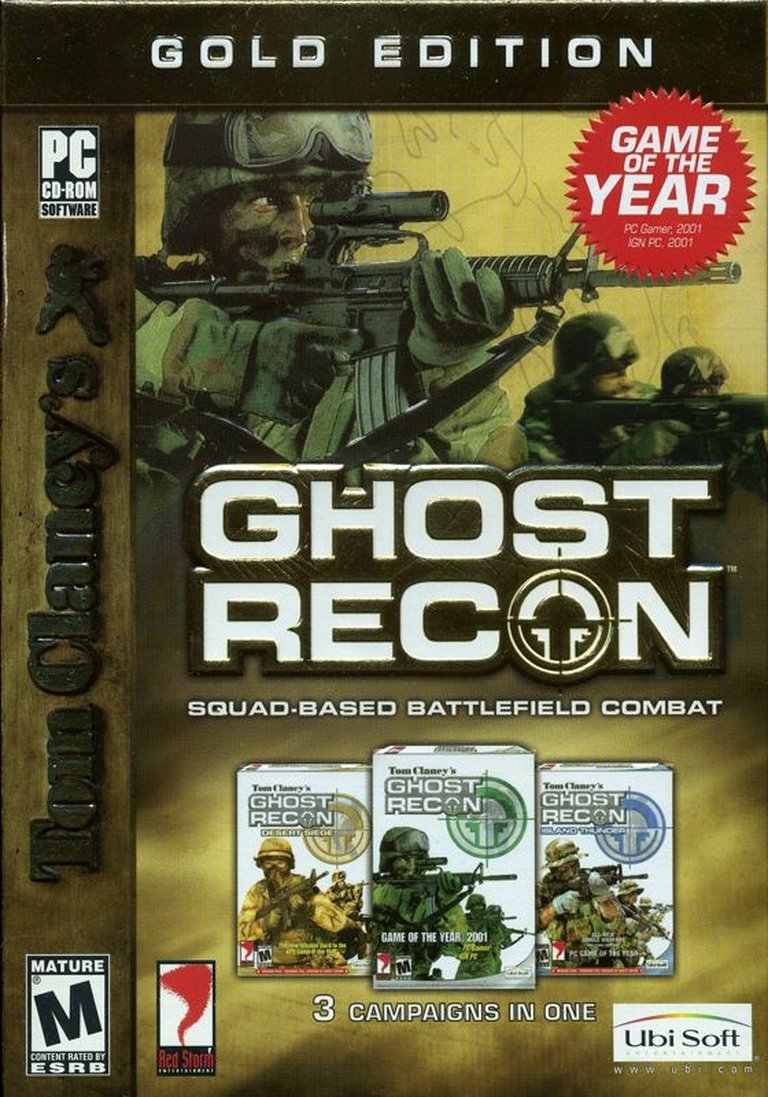
Tom Clancy’s Ghost Recon: Gold Edition is a tactical shooter compilation set in a near-future geopolitical conflict. The game follows the Ghosts, an elite team of U.S. soldiers deployed in 2008 to counter a Russian ultranationalist regime threatening global stability. This edition includes the base game and its two expansions, Desert Siege and Island Thunder, offering missions across diverse environments like African deserts and Caribbean jungles. Players engage in strategic combat, commanding squads in covert operations to prevent all-out war.
Gameplay Videos
Tom Clancy’s Ghost Recon: Gold Edition Cracks & Fixes
Tom Clancy’s Ghost Recon: Gold Edition Patches & Updates
Tom Clancy’s Ghost Recon: Gold Edition Mods
Tom Clancy’s Ghost Recon: Gold Edition Reviews & Reception
metacritic.com (84/100): Its slow pace, one-hit kills, and ugly graphics may turn off some gamers, but those willing to put some time and effort into the game will find a rewarding first-person shooter.
mobygames.com (78/100): It’s two great tastes that taste great together. Such is not the case here.
Tom Clancy’s Ghost Recon: Gold Edition Cheats & Codes
PC
Press the ENTER key on the numeric keypad to open the console window. Enter the code and press ENTER to activate.
| Code | Effect |
|---|---|
| ammo | Infinite ammo |
| autowin | Automatically complete mission |
| autolose | Fail current mission |
| boom | Shake the screen |
| chickenrun | Grenades become chickens |
| cisco | Achieve objectives one at a time |
| cover | Exit to Windows |
| eviltwin | Show enemy/team range in meters or change faces |
| extremepaintball | Enable paintball mode |
| ghost | Enemies become invisible |
| god | Commit suicide |
| gogetem | Hunt down enemies |
| hidecorpse | Hide corpse names |
| journalplaystart | Play current recording |
| kit |
Change your kit to the specified file |
| loc | Report current location |
| mark | Mark location for teleport |
| mark2 | Mark location for teleport |
| names | Display object names |
| perf | View debug counters |
| quit | Exit Ghost Recon |
| range | Show range between actors |
| refill | Refill entire inventory |
| rock | Capture enemy base |
| rumbleoff | Disable shaky screen |
| rumbleon | Enable shaky screen |
| run | Increase movement speed |
| setgama <0.0-1.0> | Adjust gamma (default 0.5) |
| shadow | Individual invisibility |
| showtextureprops | Show texture properties |
| spawn | Teleport to preset locations |
| superman | Individual god mode |
| squirrelkite | Grenades become squirrels |
| teamshadow | Team invisibility |
| teamsuperman | Team god mode |
| teleport | Teleport to marked location |
| testpath | Play dog growl sound |
| toggleai | Toggle AI |
| togglemovetrees | Toggle freezing trees |
| toggleshowactorstats | Toggle actor stats |
| toggleshoweffectsstats | Toggle effect stats |
| toggleshowframerate | Toggle frame rate display |
| toggleshowinterfacestats | Toggle interface stats |
| toggleshowlevelstats | Toggle level stats |
| toggleshowperfcounters | Toggle performance counters |
| toggleshowsystemmemorystats | Toggle system memory stats |
| toggleshowtexturememorystats | Toggle texture memory stats |
| toggleshowtotalstats | Toggle total stats |
| toggleui | Toggle user interface |
| tracers | Toggle tracer display |
| unlockheros | Unlock all hero characters |
Tom Clancy’s Ghost Recon: Gold Edition: Review
Introduction
In the pantheon of tactical shooters, few titles have carved as enduring a legacy as Tom Clancy’s Ghost Recon: Gold Edition. Released in 2002, this definitive compilation of the original 2001 game and its expansions, Desert Siege and Island Thunder, distilled the essence of cerebral, squad-based combat into a package that redefined military realism in gaming. Set against the backdrop of a near-future geopolitical powder keg, the game’s thesis is clear: warfare is a chess match played with live ammunition. Over two decades later, it remains a masterclass in tactical immersion—a testament to Red Storm Entertainment’s uncompromising vision.
Development History & Context
Studio & Vision:
Developed by Red Storm Entertainment—a Ubisoft subsidiary co-founded by Tom Clancy himself—the game emerged during a formative era for military simulations. Fresh off the success of Rainbow Six (1998), Red Storm sought to shift focus from counter-terrorism to large-scale military engagements. The studio’s goal was not merely to create a shooter but to simulate the weight of command, requiring players to balance stealth, positioning, and resource management in morally ambiguous conflicts.
Technological Constraints & Innovations:
The early 2000s presented significant limitations:
– Hardware: Built for PCs and later ported to consoles, the game leveraged DirectX 8.0-era technology, with 16MB VRAM GPUs struggling to render its vast, open-ended maps. Character models were rudimentary, and textures lacked detail by modern standards.
– AI: Enemy behavior relied on scripted routines, leading to occasional pathfinding glitches (criticized in reviews), though allies’ context-sensitive reactions (e.g., taking cover) felt revolutionary.
– Networking: Multiplayer support for 100+ players via LAN or internet was groundbreaking, albeit hampered by dial-up era latency.
Gaming Landscape:
Launching alongside titles like Operation Flashpoint: Cold War Crisis (2001), Ghost Recon stood out by prioritizing tactical depth over spectacle. It arrived in a post-9/11 climate where geopolitical anxieties fueled demand for “authentic” military narratives, setting a template for franchises like ARMA and Ghost Recon’s own successors.
Narrative & Thematic Deep Dive
Plot & Structure:
The campaign spans three distinct acts:
1. Georgia (2008): Ultranationalists backed by Russia destabilize the Caucasus, forcing the Ghosts to conduct sabotage and rescue ops. Missions like Gold Mountain—defending Tbilisi’s U.S. Embassy—evoke the desperation of a losing battle.
2. Baltic States: A preemptive Russian invasion of Lithuania and Latvia escalates into NATO intervention.
3. Russia: The Ghosts spearhead a counter-coup in Moscow, culminating in a Red Square showdown that topples the ultranationalist regime.
The expansions expand the scope:
– Desert Siege (2009): Halts an Ethiopian invasion of Eritrea.
– Island Thunder (2010): Thwarts a Cuban election hijacked by a Colombian cartel.
Characters & Dialogue:
Characterization is minimal—soldiers are largely nameless avatars—but deliberately so. The focus is on their roles: the Sniper’s patience, the Demolition expert’s calculated risks. Briefings and radio chatter sell the illusion of a high-stakes operation, though dialogue leans into utilitarian military jargon (“Bravo, move to waypoint Delta”).
Themes:
The game interrogates modern warfare’s moral ambiguity. Mission failure often results from collateral damage or poor planning, not just firefights. The Ghosts are instruments of policy, not heroes—a reflection of post-Cold War realpolitik.
Gameplay Mechanics & Systems
Core Loop:
Each mission begins with squad selection (6 soldiers max) and loadout customization. Classes define roles:
– Rifleman: Balanced, with grenade launcher options.
– Support: M249 SAW for suppressive fire.
– Demolition: Anti-tank weaponry and breaching tools.
– Sniper: Long-range elimination with trade-offs in mobility.
Combat & Tactics:
– Realism: A single bullet can down a soldier. Health doesn’t regenerate, and permadeath raises stakes.
– Command Interface: The map screen allows waypoint plotting and fireteam orders (e.g., “Hold Position,” “Open Fire”). Suboptimal commands could strand allies in kill zones.
– Progression: Surviving soldiers earn Combat Points to boost four stats:
1. Weapon (accuracy).
2. Stealth (sound suppression).
3. Endurance (health recovery).
4. Leadership (team-wide stat bonuses).
Flaws & Innovations:
– AI Quirks: Allies occasionally ignored orders or blocked paths (noted in PC Action’s critique).
– Multiplayer: Innovative for its time, with co-op and adversarial modes like “Domination” (Desert Siege) and “Cat and Mouse” (Island Thunder).
– Pacing: Missions like Blue Storm (swamp ambush) demand meticulous planning, rewarding patience but alienating run-and-gun players.
World-Building, Art & Sound
Setting & Atmosphere:
The game’s environments—dense Georgian forests, sun-baked Eritrean deserts, claustrophobic Cuban jungles—sell its authenticity. While textures are dated by today’s standards, the art direction emphasizes functional realism: dilapidated Soviet-era buildings, fog-drenched Baltic marshes, and dynamic weather that impacts visibility.
Sound Design:
Bill Brown’s score merges ominous synths with martial drums, underscoring tension without melodrama. Sound effects are minimalist yet effective:
– The crack of distant sniper fire.
– The metallic clink of a grenade bouncing near allies.
– Radio static interrupting mission briefings.
These elements create a haunting, immersive soundscape where auditory cues are as vital as visuals.
Reception & Legacy
Initial Reception:
– Critics: Averaged 78% (German outlets praised its tactical depth but noted aging tech). PC Games (83%) lauded its “complete package,” while GameStar (72%) called it a “labberiges Brötchen” (“soggy roll”) visually but redeemed by complexity.
– Players: Community reviews (4.7/5) highlighted its replayability and mod support.
Commercial Impact:
The series surpassed 5 million sales by 2004 and 40 million by 2025. Gold Edition’s bundled value (base game + expansions) made it a gateway for newcomers.
Industry Influence:
– Paved the way for Ghost Recon: Advanced Warfighter’s cross-com tech and Wildlands’ open-world pivot.
– Modding community innovations (e.g., realism mods) foreshadowed ARMA’s player-driven content.
– Cemented Ubisoft’s dominance in military sims, bridging Rainbow Six and The Division.
Conclusion
Tom Clancy’s Ghost Recon: Gold Edition is a cornerstone of tactical gaming—a title that sacrificed graphical flair for strategic depth and emotional weight. Its vision of warfare as a high-stakes puzzle remains timeless, even as later entries embraced spectacle. While its AI flaws and dated visuals betray its era, the core experience endures: a gripping, cerebral challenge that rewards patience and punishes impulsivity. For historians, it’s a snapshot of post-9/11 gaming; for players, it remains a benchmark for what tactical shooters can achieve. In the canon of Clancy’s interactive legacy, it is not just a game—it is a doctrine.
Final Verdict: A masterwork of tactical design whose influence resonates across decades. Essential for genre purists; daunting but rewarding for newcomers.