
- Release Year: 1997
- Platforms: Windows
- Publisher: Accolade, Inc.
- Developer: Saffire, Inc
- Genre: Football (American), Licensed, Sports
- Game Mode: Single-player
- Average Score: 47/100
Description
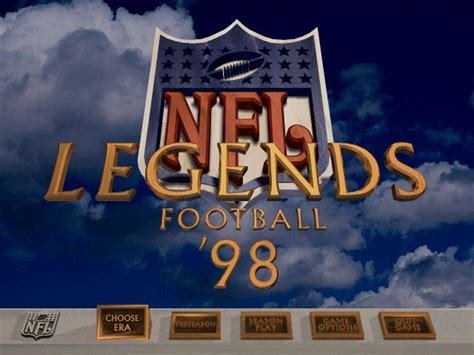
NFL Legends Football ’98 is a 1997 American football simulation game for Windows, developed by Saffire, Inc. and published by Accolade under the official NFL license. The game features standard football gameplay with support for gamepad, keyboard, and mouse controls, but was critically panned upon release for its poor execution. Reviews highlighted ambitious design concepts that failed to coalesce into a polished experience, citing clunky mechanics, graphical issues, and overall lack of playability despite its licensed branding.
NFL Legends Football ’98 Free Download
NFL Legends Football ’98 Patches & Updates
NFL Legends Football ’98 Guides & Walkthroughs
NFL Legends Football ’98 Reviews & Reception
gamespot.com : The game is still not ready.
archive.kontek.net (70/100): A nostalgic trip that’s only kinda hip.
mobygames.com (25/100): the freshest premise of any football game in years…impressive strategic richness…beautiful graphics and solid gameplay
NFL Legends Football ’98: Review
In the pantheon of sports video games, few titles have sparked as much controversy and debate as NFL Legends Football ’98. Released in 1997 by Accolade, Inc. and developed by Saffire, Inc., this game promised an innovative twist on the traditional football simulation genre. By allowing players to mix and match teams from four different eras of football history, NFL Legends Football ’98 aimed to create a unique and engaging experience. However, the game’s execution fell far short of its ambitious vision, resulting in a title that is often remembered more for its flaws than its innovations. This review will delve into the development history, narrative themes, gameplay mechanics, world-building, and the enduring legacy of NFL Legends Football ’98.
Development History & Context
The Studio and Creators’ Vision
Saffire, Inc., the development studio behind NFL Legends Football ’98, had a history of creating sports games, but this title was intended to be their magnum opus. The creators envisioned a game that would not only capture the excitement of modern football but also allow players to relive and reimagine historic matchups. The idea was to combine the strategic depth of traditional football simulations with the fantasy elements of time-traveling team compositions.
Technological Constraints of the Era
The late 1990s were a transitional period for PC gaming. The industry was moving from 2D graphics to 3D, and games were beginning to take advantage of more powerful hardware. However, NFL Legends Football ’98 was released at a time when many players still relied on older systems, which limited the game’s graphical capabilities and performance. This technological constraint likely contributed to the game’s subpar visuals and occasional performance issues.
The Gaming Landscape
In 1997, the sports gaming landscape was dominated by titles like Madden NFL 98 and NFL GameDay 98. These games set the standard for realism and depth in football simulations. NFL Legends Football ’98 attempted to differentiate itself by offering a unique historical twist, but it struggled to compete with the established franchises in terms of polish and execution.
Narrative & Thematic Deep Dive
Plot and Characters
NFL Legends Football ’98 does not have a traditional narrative or plot. Instead, it focuses on creating a rich and immersive football experience through its historical team compositions and era-specific rules. The game features over 80 teams and players from four legendary eras of football: 1932, 1950, 1968, and 1997. This allows players to create fantasy matchups that span decades, adding a layer of historical intrigue to the gameplay.
Dialogue and Themes
The dialogue in NFL Legends Football ’98 is minimal and primarily consists of play-by-play commentary. The game’s themes revolve around nostalgia, strategy, and the evolution of football. By allowing players to mix and match teams from different eras, the game explores how the sport has changed over time and encourages players to think strategically about team composition and play selection.
Gameplay Mechanics & Systems
Core Gameplay Loops
The core gameplay loop of NFL Legends Football ’98 revolves around creating and managing teams, selecting plays, and executing those plays on the field. The game features a wide range of playbooks and team management tools, allowing players to customize their experience to a high degree. However, the execution of these mechanics is often clumsy and unintuitive, detracting from the overall enjoyment.
Combat and Character Progression
Combat in NFL Legends Football ’98 is handled through a series of button presses and joystick movements, which control player actions on the field. The game features a variety of moves, including spins, hurdles, and dives, but the controls are often unresponsive and difficult to master. Character progression is handled through a series of stat tracking and management tools, but these are often buried in confusing menus and difficult to navigate.
UI and Innovative or Flawed Systems
The user interface of NFL Legends Football ’98 is one of its most significant flaws. The game lacks mouse support, forcing players to navigate menus using a gamepad, joystick, or keyboard. This makes even simple tasks, like selecting plays or managing teams, unnecessarily cumbersome. Additionally, the game’s stat tracking and management tools are often confusing and difficult to use, detracting from the overall experience.
World-Building, Art & Sound
Setting and Atmosphere
NFL Legends Football ’98 features a variety of settings, from modern stadiums to historic fields. The game’s atmosphere is largely determined by the era-specific rules and team compositions, which add a layer of historical authenticity to the experience. However, the game’s visuals are often blocky and outdated, detracting from the overall immersion.
Visual Direction
The visual direction of NFL Legends Football ’98 is one of its most significant shortcomings. The game’s graphics are often described as “chunky and blocky,” with little distinction between players. The uniforms are often indistinguishable, and the animations are stiff and unnatural. This makes it difficult to follow the action on the field and detracts from the overall enjoyment of the game.
Sound Design
The sound design of NFL Legends Football ’98 is similarly lacking. The play-by-play commentary is often repetitive and uninformative, and the ambient sounds are minimal and uninspired. This makes the game feel dull and lifeless, further detracting from the overall experience.
Reception & Legacy
Critical and Commercial Reception
NFL Legends Football ’98 received largely negative reviews upon its release. Critics praised the game’s unique concept but criticized its execution, citing issues with graphics, controls, and overall polish. The game’s average critic score was 25%, indicating a largely negative reception. Commercially, the game struggled to compete with established franchises like Madden NFL, and it quickly faded into obscurity.
Influence on Subsequent Games and the Industry
Despite its flaws, NFL Legends Football ’98 had a lasting influence on the sports gaming industry. The game’s unique concept of mixing and matching teams from different eras inspired future titles, such as NFL Blitz and NFL Street, which also focused on creating fantasy matchups and unconventional gameplay experiences. Additionally, the game’s emphasis on historical authenticity and era-specific rules paved the way for future sports simulations that sought to capture the unique characteristics of different eras.
Conclusion
NFL Legends Football ’98 is a game that is often remembered more for its flaws than its innovations. Despite its ambitious vision and unique concept, the game’s execution fell far short of expectations, resulting in a title that is often criticized for its poor graphics, unresponsive controls, and confusing menus. However, the game’s legacy endures, and its influence can still be seen in modern sports simulations. In the end, NFL Legends Football ’98 serves as a cautionary tale about the dangers of overambition and the importance of polish in game development. It is a game that, despite its flaws, deserves to be remembered for its bold attempt to reimagine the football simulation genre.