
- Release Year: 1997
- Platforms: Macintosh, Windows 16-bit, Windows
- Publisher: Palladium Interactive, Inc.
- Developer: Parroty Interactive
- Genre: Action
- Perspective: Top-down
- Game Mode: Single-player
- Gameplay: Investigation, Maze, Mini-games, quiz
- Setting: Comedy, Detective, Mystery
- Average Score: 47/100
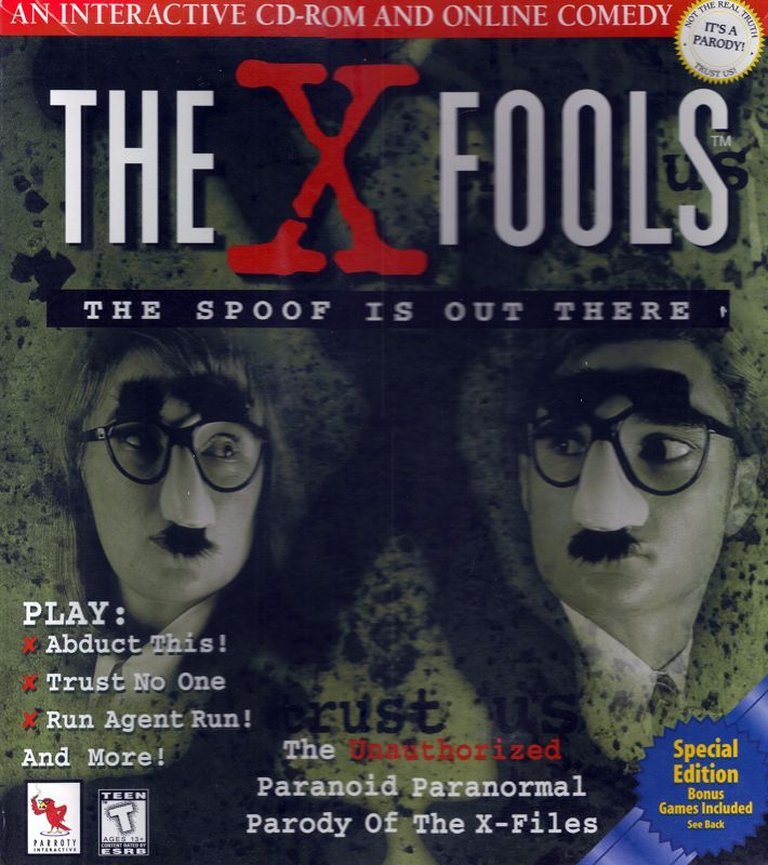
Description
The X-Fools: The Spoof is out There is a humorous parody of the popular 1990s TV series ‘The X-Files’. The game features a collection of mini-games and interactive elements, including a UFO abduction game, a trivia challenge, and a Pac-Man clone with villains and aliens from the show. Players can also explore historical photos, an evidence locker with items from the TV series, and spoofed documents, all designed to entertain fans of the original series with a comedic twist.
Gameplay Videos
The X-Fools: The Spoof is out There Free Download
The X-Fools: The Spoof is out There Reviews & Reception
mobygames.com (50/100): The X-Fools: The Spoof is out There is a parody on the popular 1990s TV series ‘The X-Files’.
imdb.com (44/100): Interactive tour and X-Files spoof. Join agents Mully and Scudder, on whom the show is actually based, in their secret trailer to view their tapes and files that prove that the aliens are here.
The X-Fools: The Spoof is Out There – Review
A Parody Lost in the Shadows of Its Inspiration
Introduction
In the late 1990s, as The X-Files dominated pop culture with its blend of paranormal mystery and government conspiracy, Parroty Interactive sought to capitalize on the frenzy with The X-Fools: The Spoof is Out There (1997). A satirical CD-ROM adventure targeting fans of Fox Mulder and Dana Scully, the game promised a comedic deconstruction of the series’ tropes through mini-games and interactive absurdity. But was it a clever homage or a textbook example of parody gone awry? This review examines The X-Fools as a relic of its time—a commercially opportunistic, creatively uneven experiment that reflects both the possibilities and pitfalls of 1990s multimedia gaming.
Development History & Context
The Parroty Interactive Formula
Developed by Parroty Interactive (Pyst, Star Warped) and published by Palladium Interactive, The X-Fools was the studio’s third parody title, arriving at the height of The X-Files’ cultural dominance. Vice President Steven Horowitz and producer Stacey Rubin led a team of writers and voice actors, including future comedy luminaries like Brian Posehn and Patton Oswalt, to lampoon FBI agents Mulder and Scully as the bumbling “Mully” and “Scudder.”
Technological Ambitions
Built using Macromedia Shockwave, the game leveraged the CD-ROM boom’s multimedia potential, cramming in digitized video, voice acting, and interactive mini-games. However, technical constraints of the era—limited storage, clunky UI design—hampered its execution. Released alongside The X-Files: The Game (a serious FMV adventure), The X-Fools aimed to contrast its competitor’s tone but struggled to justify its $30 price tag as a mere novelty.
Cultural Timing
The game’s October 1997 launch coincided with the 50th anniversary of the Roswell incident and Season 5 of The X-Files, a savvy marketing move. Yet Parroty’s reliance on dated pop-culture references and repetitive gameplay left it feeling more like a cash-in than a cohesive parody.
Narrative & Thematic Deep Dive
Plot: Mully and Scudder’s Misadventures
The game frames itself as a “deprogramming regimen” for new FBI recruits, guided by the washed-up duo Mully and Scudder. Through a series of mini-games and pseudo-documentary clips, players uncover “evidence” of alien conspiracies, such as UFO abductions and CIA cover-ups. The narrative is threadbare, serving only to string together comedic vignettes that parody iconic X-Files moments, like Mulder’s obsession with UFOs or Scully’s scientific skepticism.
Hits and Misses
While some gags land—e.g., a trivia game titled “Trust No One” mocking the series’ paranoid ethos—most jokes feel toothless. Parroty’s writers lacked the sharpness of MAD Magazine or The Simpsons’ brand of satire, opting for low-hanging fruit like rebranding the Cigarette Smoking Man as the “Cigar-Chomping Man.” The voice acting, though featuring talents like Cam Clarke and Mary Kay Bergman, is undermined by cheesy punchlines and uneven delivery.
Thematic Parody
The X-Fools attempts to critique The X-Files’ self-seriousness but fails to transcend surface-level spoofing. Its themes of government secrecy and alien paranoia are played for laughs but lack the nuance of later meta-commentary like The Lone Gunmen spin-off.
Gameplay Mechanics & Systems
Mini-Game Menagerie
The core experience revolves around disjointed mini-games:
– “Abduct This!”: A Dig Dug-inspired UFO game where players beam up cows and avoid military jets. Repetitive, but mechanically sound.
– “Run Agent Run!”: A Pac-Man clone substituting ghosts with X-Files villains. Power pellets become bullets, a clever twist.
– “Trust No One”: A trivia mode testing knowledge of X-Files lore, with questions ranging from obscure to nonsensical.
Lack of Cohesion
Beyond these, players can explore an “evidence locker” filled with static images and mock-dossiers, but interactivity is minimal. The game lacks progression—unlocking content requires grinding mini-games or inputting passwords from Parroty’s website (a proto-DLC tactic).
UI and Controls
The point-and-click interface is serviceable but marred by sluggish load times and unintuitive menus. Keyboard controls for action games feel imprecise, a relic of pre-standardized PC gaming conventions.
World-Building, Art & Sound
Visual Parody
The X-Fools adopts a cartoonish aesthetic, exaggerating The X-Files’ noirish visuals with bold colors and caricatured character designs. Tom Richmond’s illustrations (later known for MAD Magazine) inject vitality, but low-resolution sprites and pixelated FMV clips undercut the humor.
Sound Design
The soundtrack, composed by Chronic Music, mimics Mark Snow’s iconic X-Files theme with theremin-heavy parodies. Voice acting is a highlight—Jennifer Hale (Mass Effect) and Quinton Flynn (Metal Gear Solid) elevate mundane scripts with commitment—but the overuse of canned laughter and sound effects grows grating.
Atmosphere
While the game nails the X-Files’ “cheap motel” vibe in its grungy UI, its tone wavers between affectionate homage and lazy mockery. The lack of a consistent vision leaves the world feeling hollow compared to the show’s rich mythos.
Reception & Legacy
Critical Divide
The X-Fools earned a lukewarm 50% average from critics. macHOME praised its “unique diversion for fans,” while The MacGamer’s Ledge lambasted its “lukewarm” humor. User reviews averaged 1.7/5, with players criticizing its repetitive design. Notably, The Sydney Morning Herald later ranked it among the “100 worst games ever,” calling it “unfunny.”
Commercial Performance
The game sold modestly, buoyed by X-Files fandom, but failed to match the success of Parroty’s earlier Pyst. Palladium Interactive’s bankruptcy in 1998 buried any sequel potential.
Industry Impact
While The X-Fools didn’t revolutionize gaming, it exemplified the CD-ROM era’s experimental spirit—a cautionary tale about licensing-driven shovelware. Its DNA can be seen in later comedic titles like Portal 2’s pseudo-science humor, but as a standalone product, it remains a footnote.
Conclusion
The X-Fools: The Spoof is Out There is a fascinating artifact of 1990s multimedia excess—a game that understood its source material’s appeal but lacked the wit or technical polish to do it justice. For X-Files completists, it offers fleeting amusement through nostalgia-tinted mini-games and voice cameos. For historians, it serves as a case study in the risks of parody without purpose. Ultimately, The X-Fools is less a bold comedic statement than a reflection of an era when “interactive CD-ROM!” was a selling point unto itself. Its truth may be out there, but it’s hardly worth seeking.
Final Verdict: A 5/10 novelty—amusing in bursts, but more “forgotten FBI file” than “hidden gem.”